Secondary School Teachers, Except Special and Career/Technical Education: Career Overview
Teach one or more subjects to students at the secondary school level.
Featured schools near , edit
The Daily Work of Secondary School Teachers, Except Special and Career/Technical Education Perform?
The day-to-day responsibilities of secondary school teachers, except special and career/technical education span:
- Prepare students for later grades by encouraging them to explore learning opportunities and to persevere with challenging tasks.
- Instruct through lectures, discussions, and demonstrations in one or more subjects, such as English, mathematics, or social studies.
- Establish and enforce rules for behavior and procedures for maintaining order among students.
- Prepare materials and classrooms for class activities.
- Adapt teaching methods and instructional materials to meet students' varying needs and interests.
- Prepare, administer, and grade tests and assignments to evaluate students' progress.
- Establish clear objectives for all lessons, units, and projects, and communicate those objectives to students.
- Observe and evaluate students' performance, behavior, social development, and physical health.
Key Skills and Knowledge
Successful secondary school teachers, except special and career/technical education rely on a mix of skills and domain knowledge.
Most Important Skills
These are the skills most central to this role, rated on an importance scale of 0 to 5:
Knowledge Areas
Types of Secondary School Teachers, Except Special and Career/Technical Education Jobs
People in this occupation may also be known by titles such as:
- Accounting Teacher
- After School Teacher
- Algebra Teacher
- Art Educator
- Art Instructor
- Art Teacher
- Arts and Crafts Teacher
- Athletic Instructor
How Many Secondary School Teachers, Except Special and Career/Technical Education Are There?
There are about 561,804 secondary school teachers, except special and career/technical education working in the United States today. Employment is projected to grow by +1.8% over the projection horizon.

How Much Do Secondary School Teachers, Except Special and Career/Technical Education Make?
| Statistic | Value |
|---|---|
| Annual median | $77,927 |
| Hourly median | $37.47 |
| 10th percentile | $54,684 |
| 25th percentile | $66,306 |
| 75th percentile | $89,549 |
| 90th percentile | $101,171 |
Compensation varies based on experience, location, and industry.

How Much Do Secondary School Teachers, Except Special and Career/Technical Education Make in Different U.S. States?
| State | Annual median salary |
|---|---|
| Washington | $99,640 |
| California | $98,710 |
| New York | $98,370 |
| Rhode Island | $89,040 |
| Massachusetts | $88,990 |
| New Jersey | $80,440 |
| Oregon | $79,600 |
| District of Columbia | $78,770 |
| Pennsylvania | $77,990 |
| Alaska | $77,730 |
| Connecticut | $77,270 |
| Maryland | $77,030 |
| Illinois | $77,020 |
| Ohio | $76,740 |
| Delaware | $75,420 |
| Utah | $74,280 |
| Georgia | $73,340 |
| New Hampshire | $69,340 |
| New Mexico | $66,960 |
| Michigan | $64,000 |
| Minnesota | $63,950 |
| Virginia | $63,760 |
| Vermont | $63,740 |
| Colorado | $63,660 |
| Wyoming | $63,390 |
| Nevada | $62,870 |
| Maine | $62,230 |
| Texas | $61,980 |
| Nebraska | $61,900 |
| Hawaii | $61,830 |
| Wisconsin | $61,620 |
| South Carolina | $61,300 |
| Idaho | $60,960 |
| Alabama | $60,530 |
| Indiana | $60,430 |
| Kentucky | $60,420 |
| Tennessee | $60,330 |
| Arizona | $59,900 |
| Florida | $59,400 |
| North Dakota | $59,380 |
| Louisiana | $59,340 |
| Iowa | $58,910 |
| Kansas | $58,770 |
| Montana | $58,730 |
| Arkansas | $56,890 |
| West Virginia | $56,480 |
| North Carolina | $54,890 |
| Missouri | $50,780 |
| Virgin Islands | $50,730 |
| Puerto Rico | $49,920 |
| South Dakota | $49,530 |
| Mississippi | $49,340 |
| Oklahoma | $49,170 |
| Guam | $36,830 |
Where Secondary School Teachers, Except Special and Career/Technical Education Earn the Most
Pay for secondary school teachers, except special and career/technical education vary by region. The following regions pay the most:
| Region | Median annual wage | Share of U.S. jobs | Location quotient |
|---|---|---|---|
| Far Western US | $92,877 | 13.0% | 0.80 |
| Middle Atlantic | $86,494 | 17.6% | 1.17 |
| New England | $81,043 | 5.9% | 1.23 |
| Great Lakes | $71,096 | 15.1% | 1.10 |
| Rocky Mountains | $65,740 | 3.8% | 0.95 |
| Southwest | $60,614 | 14.7% | 1.17 |
| Southeast | $60,348 | 22.2% | 0.95 |
| Plains States | $57,720 | 7.0% | 1.02 |
Where the Jobs Cluster
| Metro area | State | Median annual wage | Employment |
|---|---|---|---|
| Olympia-Lacey-Tumwater, WA | WA | $106,970 | 510 |
| Kennewick-Richland, WA | WA | $105,630 | 720 |
| Mount Vernon-Anacortes, WA | WA | $105,400 | 280 |
| Kingston, NY | NY | $104,720 | 600 |
| Sacramento-Roseville-Folsom, CA | CA | $103,640 | 6,180 |
| San Jose-Sunnyvale-Santa Clara, CA | CA | $103,640 | 4,470 |
| Bellingham, WA | WA | $102,810 | 420 |
| Napa, CA | CA | $100,720 | 240 |
Which Industries Hire Secondary School Teachers, Except Special and Career/Technical Education
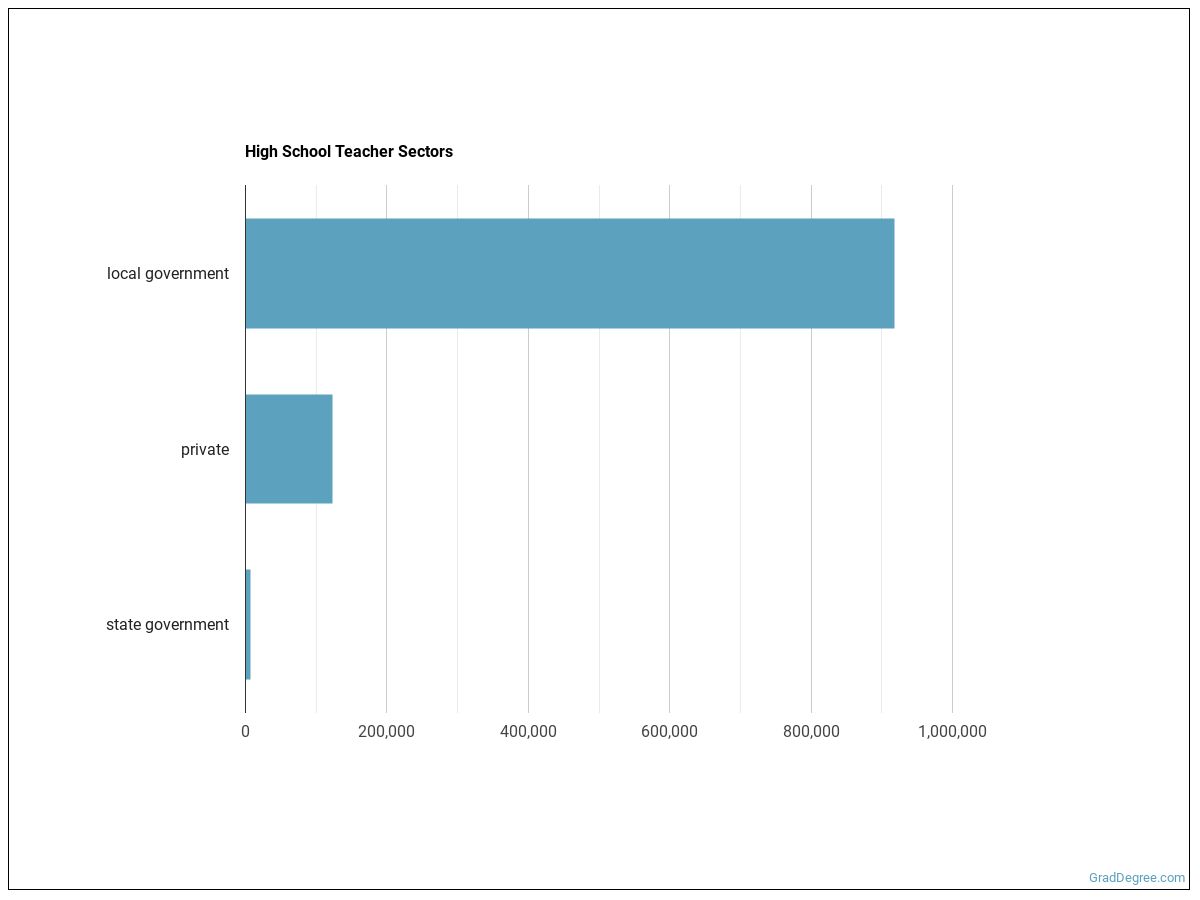
The bulk of secondary school teachers, except special and career/technical education are concentrated in the following sectors:
| Industry | Employment | Median annual wage |
|---|---|---|
| Educational Services | 1,067,580 | n/a |
| Other Services (except Public Administration) | 1,180 | n/a |
| Health Care and Social Assistance | 1,120 | n/a |
| Administrative and Support and Waste Management and Remediation Services | 520 | n/a |
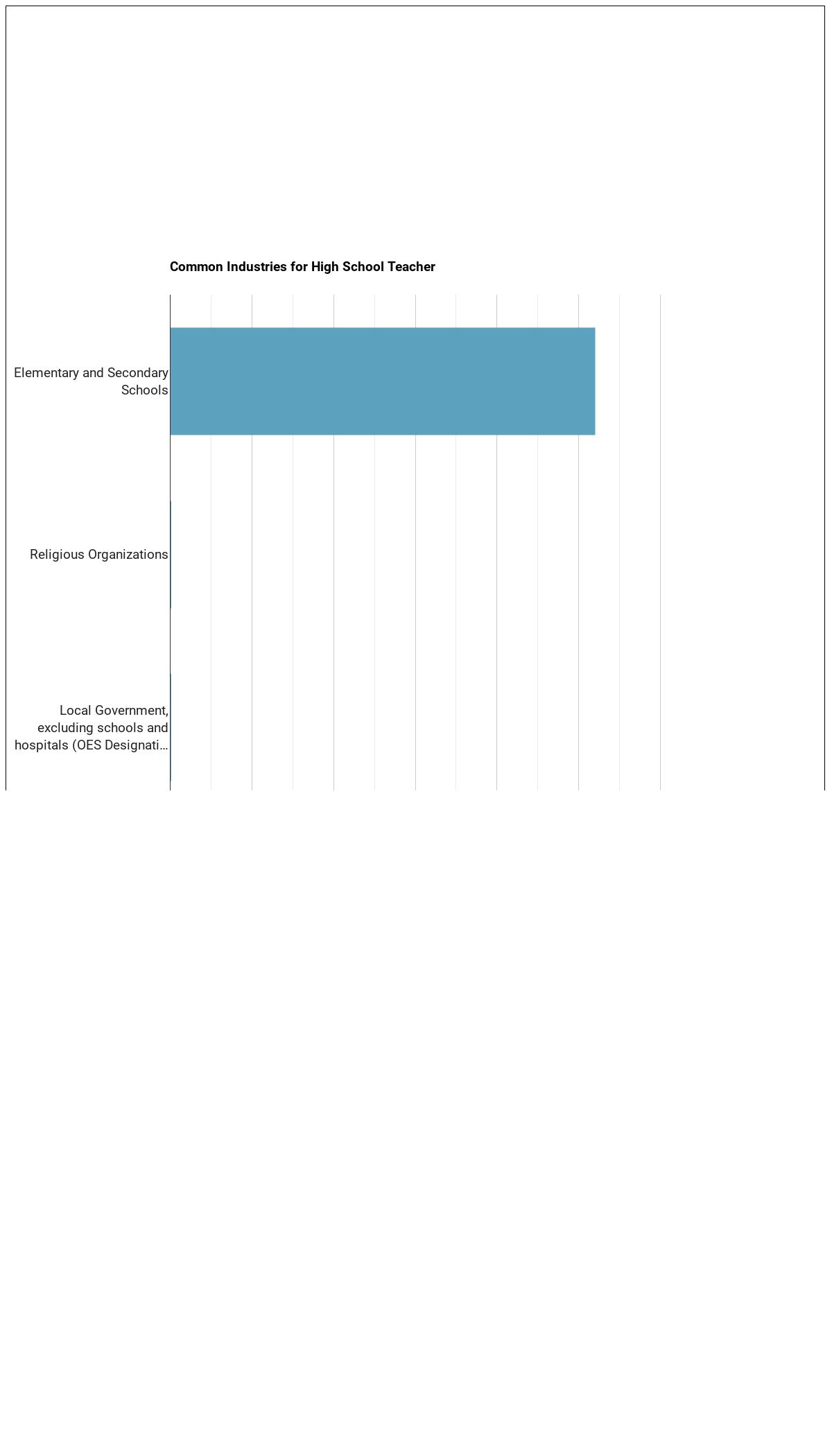
Secondary School Teachers, Except Special and Career/Technical Education work in the following industries:
Tools and Technology
- Spreadsheet software: Microsoft Excel (hot technology)
- Office suite software: Microsoft Office software (hot technology)
- Presentation software: Microsoft PowerPoint (hot technology)
- Document management software: Microsoft SharePoint (hot technology)
- Word processing software: Microsoft Word (hot technology)
What the Workplace Is Like
The work environment for secondary school teachers, except special and career/technical education reflects the following characteristics:
- Contact With Others
- Face-to-Face Discussions with Individuals and Within Teams
- Indoors, Environmentally Controlled
- Public Speaking
Education and Training
Most secondary school teachers, except special and career/technical education positions require a bachelor’s degree as the typical entry-level education. This occupation sits in Considerable Preparation Needed (Job Zone 4), indicating the level of preparation typically expected.
Other Careers to Consider
Similar Occupations
- Education Teachers, Postsecondary (Supplemental)
- Art, Drama, and Music Teachers, Postsecondary (Supplemental)
- English Language and Literature Teachers, Postsecondary (Supplemental)
- Kindergarten Teachers, Except Special Education (Supplemental)
- Elementary School Teachers, Except Special Education (Primary-Short)
- Middle School Teachers, Except Special and Career/Technical Education (Primary-Short)
- Career/Technical Education Teachers, Middle School (Primary-Long)
- Career/Technical Education Teachers, Secondary School (Primary-Long)
Where to Study
Students preparing for secondary school teachers, except special and career/technical education commonly pursue programs in:
Education
42 programs across 4 majors
- Teacher Education Subject Specific
- Teacher Education Grade Specific
- Teaching English or French
- Multilingual Education
Foreign Languages, Literatures, and Linguistics
27 programs across 11 majors
- Romance Languages
- Linguistics & Literature
- East Asian Languages
- Classical Languages & Literature
- American Sign Language
- Germanic Languages
- Other Foreign Language & Literature
- Middle Eastern Semitic Languages
- Slavic, Baltic & Albanian Languages
- Native American Languages
- Southeast Asian & Pacific Languages
Social Sciences
7 programs across 3 majors
Multi/Interdisciplinary Studies
5 programs across 5 majors
- Biological & Physical Science
- History and Language/Literature
- Environmental Geosciences
- Earth Systems Science
- Cultural Studies and Comparative Literature
Physical Sciences
3 programs across 3 majors
Visual and Performing Arts
2 programs across 2 majors
References
This profile draws on the following authoritative sources:
- U.S. Bureau of Labor Statistics — Occupational Employment and Wage Statistics (OEWS) for employment and wage data by state and industry.
- BLS Employment Projections for total employment and growth forecasts.
- O*NET (Occupational Information Network) for skills, knowledge, tasks, work activities, work context, technology, and education-zone data.
SOC code: 25-2031.00 (Secondary School Teachers, Except Special and Career/Technical Education).

GradDegree.com provides higher-education, college and university, degree, program, career, salary, and other helpful information to students, faculty, institutions, and other internet audiences. Presented information and data are subject to change. Inclusion on this website does not imply or represent a direct relationship with the company, school, or brand. Information, though believed correct at time of publication, may not be correct, and no warranty is provided. Contact the schools to verify any information before relying on it. Financial aid may be available for those who qualify. The displayed options may include sponsored or recommended results, not necessarily based on your preferences.
© GradDegree.com – All Rights Reserved.