Music Directors and Composers in Massachusetts
Want to work as a Music Directors and Composers in Massachusetts? Below are the key facts. Conduct, direct, plan, and lead instrumental or vocal performances by musical artists or groups, such as orchestras, bands, choirs, and glee clubs; or create original works of music.
What do Music Directors and Composers Make in Massachusetts?
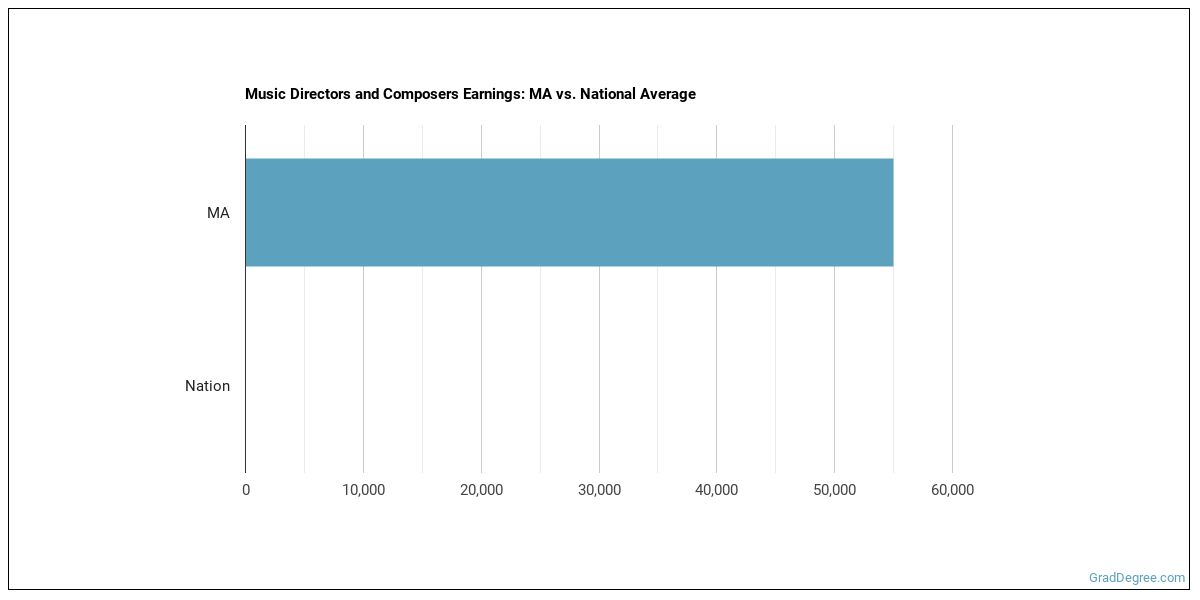
For a music directors and composers working in Massachusetts, wages run about $72,760 per year (or about $34.98/hour).Earnings range from $53,860 at the 10th percentile to $159,480 at the 90th percentile.
| Wage Statistic | Annual | Hourly |
|---|---|---|
| 10th percentile | $53,860 | $25.89 |
| 25th percentile | $58,930 | $28.33 |
| Median (50th) | $72,760 | $34.98 |
| 75th percentile | $78,050 | $37.52 |
| 90th percentile | $159,480 | $76.67 |

The job concentration index in Massachusetts relative to the national average — is 0.89, meaning fewer music directors and composers per worker than the national average.
National Wage Comparison
Nationally, music directors and composers earn a median of $66,915 per year ($32.17/hour), higher than the Massachusetts median.
Employment Outlook
Nationally, total employment in this occupation is 170,107 music directors and composers across the United States. In Massachusetts alone, around 260 people work in this role. That’s higher than the typical state, which employs around 150 music directors and composers.


Top Massachusetts Metros for Music Directors and Composers
The largest metro-area employers of music directors and composers in Massachusetts.
| Metro Area | Number Employed | Annual Median Salary |
|---|---|---|
| Boston-Cambridge-Newton, MA-NH | 200 | $74,910 |
Top States for Music Directors and Composers Employment
These states have the highest employment of music directors and composers work.
| State | Number Employed |
|---|---|
| California | 2,410 |
| New York | 1,610 |
| Florida | 670 |
| Texas | 650 |
| Tennessee | 640 |
| Illinois | 540 |
| Oregon | 470 |
| Pennsylvania | 450 |
| Washington | 390 |
| Ohio | 380 |
| New Jersey | 380 |
| Virginia | 340 |
| Michigan | 260 |
| Massachusetts | 260 |
| Indiana | 250 |
| North Carolina | 200 |
| Iowa | 170 |
| Rhode Island | 160 |
| Wisconsin | 150 |
| Connecticut | 150 |
Highest-Paying States for Music Directors and Composers
Where music directors and composers earn the most: music directors and composers.
| State | Annual Median Salary |
|---|---|
| Connecticut | $91,810 |
| New York | $80,230 |
| Utah | $78,010 |
| Washington | $77,840 |
| Hawaii | $77,440 |
| California | $74,760 |
| Wisconsin | $73,580 |
| Massachusetts | $72,760 |
| Indiana | $71,640 |
| Colorado | $69,160 |
Skills
Top music directors and composers skills, rated on an importance scale of 0 to 5:
Knowledge Areas
Important knowledge areas for this occupation, rated on an importance scale of 0 to 5:
Abilities
Top abilities for music directors and composers, rated on an importance scale of 0 to 5:
Daily Tasks
Common tasks include:
- Use gestures to shape the music being played, communicating desired tempo, phrasing, tone, color, pitch, volume, and other performance aspects.
- Direct groups at rehearsals and live or recorded performances to achieve desired effects such as tonal and harmonic balance dynamics, rhythm, and tempo.
- Study scores to learn the music in detail, and to develop interpretations.
- Apply elements of music theory to create musical and tonal structures, including harmonies and melodies.
- Consider such factors as ensemble size and abilities, availability of scores, and the need for musical variety, to select music to be performed.
- Determine voices, instruments, harmonic structures, rhythms, tempos, and tone balances required to achieve the effects desired in a musical composition.
- Experiment with different sounds, and types and pieces of music, using synthesizers and computers as necessary to test and evaluate ideas.
- Transcribe ideas for musical compositions into musical notation, using instruments, pen and paper, or computers.
- Audition and select performers for musical presentations.
- Plan and schedule rehearsals and performances, and arrange details such as locations, accompanists, and instrumentalists.
- Write musical scores for orchestras, bands, choral groups, or individual instrumentalists or vocalists, using knowledge of music theory and of instrumental and vocal capabilities.
- Position members within groups to obtain balance among instrumental or vocal sections.
Work Activities
- Thinking Creatively
- Establishing and Maintaining Interpersonal Relationships
- Getting Information
- Communicating with Supervisors, Peers, or Subordinates
- Scheduling Work and Activities
- Organizing, Planning, and Prioritizing Work
- Performing for or Working Directly with the Public
- Coordinating the Work and Activities of Others
- Communicating with People Outside the Organization
- Working with Computers
- Judging the Qualities of Objects, Services, or People
- Making Decisions and Solving Problems
Tools & Technology
Common tools and software used in this occupation include: Hot technologies: Microsoft Excel
What Major Will Prepare You For This Career?
Related college programs include:
- Music
- Arts & Media Management
- Drama & Theater Arts
- Sacred Music
Featured schools near , edit
Related Careers
Other careers like music directors and composers include:
- Agents and Business Managers of Artists, Performers, and Athletes
- Directors, Religious Activities and Education
- Art, Drama, and Music Teachers, Postsecondary
- Art Directors
- Fine Artists, Including Painters, Sculptors, and Illustrators
- Actors
Also Known As
Arranger, Artistic Director, Band Director, Band Leader, Band Master, Children's Choir Director, Choir Director, Choir Leader, Choirmaster, Choral Activities Director, Choral Director, Chorus Master, Composer, Conceptor, Conductor.
References
- U.S. Bureau of Labor Statistics, Occupational Employment and Wage Statistics — https://www.bls.gov/oes/
- O*NET Online — https://www.onetonline.org/
- BLS Employment Projections — https://www.bls.gov/emp/
- O*NET-SOC code: 27-2041.00

GradDegree.com provides higher-education, college and university, degree, program, career, salary, and other helpful information to students, faculty, institutions, and other internet audiences. Presented information and data are subject to change. Inclusion on this website does not imply or represent a direct relationship with the company, school, or brand. Information, though believed correct at time of publication, may not be correct, and no warranty is provided. Contact the schools to verify any information before relying on it. Financial aid may be available for those who qualify. The displayed options may include sponsored or recommended results, not necessarily based on your preferences.
© GradDegree.com – All Rights Reserved.