Surveying Engineering
Instructional content is defined in code 14.3801.
Types of Degrees Surveying Engineering Majors Are Earning
People majoring in Surveying Engineering have the option of earning degrees at several award levels.
| Award Level | Graduates |
|---|---|
| Bachelor’s Degree | 58 |
| Master’s Degree | 41 |
What Surveying Engineering Majors Need to Know
Programs in Surveying Engineering develop a specific mix of knowledge, skills, and abilities — derived from O*NET surveys of workers in occupations that Surveying Engineering graduates commonly enter.
Knowledge Areas
This major prepares you for careers needing Surveying Engineering emphasizes the following knowledge areas:

- Engineering and Technology — Importance 4.6 / 5; level 5.8 / 7.
- Mathematics — Importance 4.2 / 5; level 5.4 / 7.
- Design — Importance 4.0 / 5; level 4.9 / 7.
- Computers and Electronics — Importance 4.0 / 5; level 5.1 / 7.
- English Language — Importance 3.9 / 5; level 4.5 / 7.
Importance is rated 1–5; level is 1–7. Source: ONET Online — weighted across related occupations.*
Skills
Skills emphasized by a Surveying Engineering program reflects the day-to-day work of related occupations:
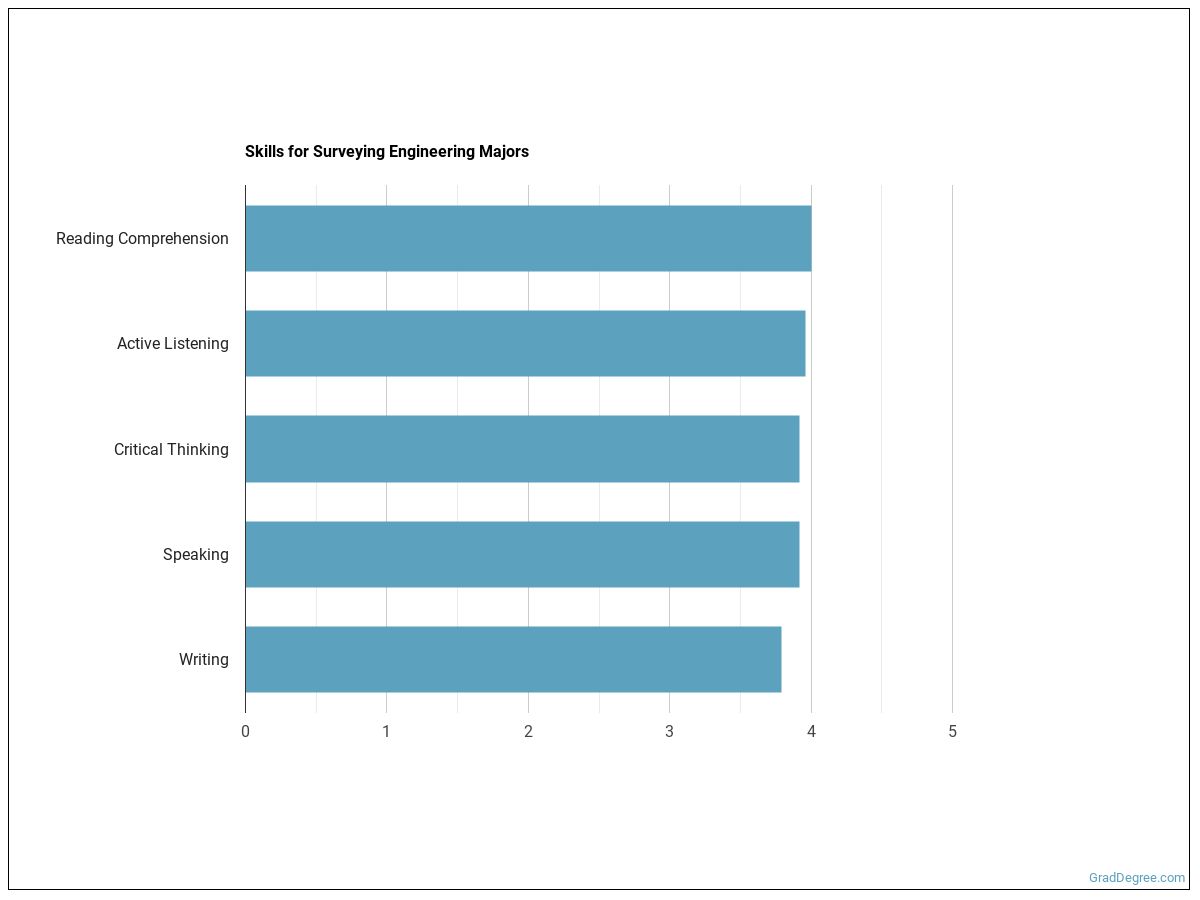
- Reading Comprehension — Importance 3.9 / 5; level 4.6 / 7.
- Critical Thinking — Importance 3.9 / 5; level 4.2 / 7.
- Speaking — Importance 3.8 / 5; level 4.2 / 7.
- Active Listening — Importance 3.8 / 5; level 4.0 / 7.
- Writing — Importance 3.8 / 5; level 4.3 / 7.
Abilities
Innate abilities most relevant to Surveying Engineering careers — again drawn from O*NET surveys of related occupations:

- Written Comprehension — Importance 4.0 / 5; level 4.8 / 7.
- Oral Expression — Importance 4.0 / 5; level 4.8 / 7.
- Deductive Reasoning — Importance 3.9 / 5; level 4.4 / 7.
- Oral Comprehension — Importance 3.9 / 5; level 4.8 / 7.
- Inductive Reasoning — Importance 3.9 / 5; level 4.2 / 7.
Common Job Activities
Day-to-day, Surveying Engineering graduates report doing:
| Activity | Frequency / Importance |
|---|---|
| Working with Computers | 4.4 / 7 |
| Making Decisions and Solving Problems | 4.4 / 7 |
| Getting Information | 4.3 / 7 |
| Analyzing Data or Information | 4.3 / 7 |
| Updating and Using Relevant Knowledge | 4.3 / 7 |
| Processing Information | 4.2 / 7 |
| Thinking Creatively | 4.1 / 7 |
| Communicating with Supervisors, Peers, or Subordinates | 4.1 / 7 |
| Organizing, Planning, and Prioritizing Work | 3.9 / 7 |
| Training and Teaching Others | 3.9 / 7 |
Technology Skills Used on the Job
Most frequently-cited tools used by Surveying Engineering professionals:
| Tool / Software | Category | In-Demand |
|---|---|---|
| Microsoft Word | Word processing software | ✓ |
| Microsoft Excel | Spreadsheet software | ✓ |
| Microsoft Office software | Office suite software | ✓ |
| Microsoft PowerPoint | Presentation software | ✓ |
| Autodesk AutoCAD | Computer aided design CAD software | ✓ |
| Python | Object or component oriented development software | ✓ |
| Microsoft Project | Project management software | — |
| Oracle Java | Object or component oriented development software | ✓ |
| Dassault Systemes SolidWorks | Computer aided design CAD software | ✓ |
| C++ | Object or component oriented development software | ✓ |
| The MathWorks MATLAB | Analytical or scientific software | ✓ |
| Microsoft Outlook | Electronic mail software | ✓ |
Source: ONET Online technology skills, weighted across related occupations.*
Sample Job Titles
Real job postings for Surveying Engineering graduates include:
- Mechanical Drawing Teacher
- College Faculty Member
- Geological Engineering Teacher
- Adjunct Engineering Instructor
- Radio Engineering Teacher
- Motion and Time Study Teacher
- Chemical Engineering Professor
- Ceramic Engineering Professor
- Metallography Teacher
- Instructor
- Surveying Teacher
- Electronic Science Teacher
- Aeronautics Teacher
- Adjunct Instructor
- Manufacturing Engineering Professor
Education Typically Required
Across the occupations open to Surveying Engineering graduates, the typical level of education actually held by current workers is distributed as:
| Education Level | Share of Workers |
|---|---|
| Bachelor’s degree | 32.2% |
| Doctoral degree | 26.9% |
| Master’s degree | 10.6% |
| Post-doctoral training | 7.0% |
| Post-master’s certificate | 6.6% |
| Associate’s degree (or other 2-year) | 3.7% |
| Some college courses | 3.6% |
| Post-baccalaureate certificate | 3.1% |
| Postsecondary certificate | 2.9% |
| High school diploma or equivalent | 2.1% |
| First professional degree | 1.3% |
| Less than a high school diploma | 0.2% |

Source: ONET Online education / training / experience requirements.*
Who Is Earning a Degree in Surveying Engineering?
Gender Distribution
This field skews predominantly male, with men earning 71.7% of Surveying Engineering degrees.
| Gender | Graduates | Share |
|---|---|---|
| Women | 28 | 28.3% |
| Men | 71 | 71.7% |
Racial-Ethnic Diversity
At the national level, the racial-ethnic distribution of Surveying Engineering graduates is as follows:

| Race / Ethnicity | Graduates | Share |
|---|---|---|
| White | 71 | 71.7% |
| Asian | 3 | 3.0% |
| Hispanic or Latino | 5 | 5.1% |
| Black or African American | 5 | 5.1% |
| American Indian / Alaska Native | 1 | 1.0% |
| Native Hawaiian / Pacific Islander | 1 | 1.0% |
| Two or More Races | 2 | 2.0% |
| Race Unknown | 3 | 3.0% |
| International Students | 8 | 8.1% |
See minority definition below.
How Much Do Surveying Engineering Graduates Earn?
Federal data tracks median earnings of Surveying Engineering graduates 1, 4, and 5 years after completion. Wages typically rise steadily as graduates gain experience and move into mid-career roles.
| Years Out | Median Earnings |
|---|---|
| 1 year | $72,931 |
Source: U.S. Department of Education College Scorecard, field-of-study earnings tracker.
Online Surveying Engineering Programs
Online study are documented by IPEDS for Surveying Engineering. The table below shows how many graduates earned at least some of their coursework online (Distance-Ed Available) versus completing the entire program online (Distance-Ed Only).
| Award Level | Distance-Ed Available | Distance-Ed Only |
|---|---|---|
| Master’s | 1 | 0 |
Distance-Ed Only = degrees completed entirely online; Distance-Ed Available = degrees including at least some online coursework. Source: IPEDS Completions by Distance Education status.
Related Programs
You may also be interested in these closely related fields of study:
| Program | Annual Degrees Awarded |
|---|---|
| Engineering | 197,615 |
| Mechanical Engineering | 42,939 |
| Electrical, Electronics, and Communications Engineering | 26,760 |
| Civil Engineering | 20,005 |
| Computer Engineering | 19,986 |
| Biomedical/Medical Engineering | 13,914 |
| Engineering, General | 13,411 |
| Chemical Engineering | 10,939 |
| Aerospace, Aeronautical, and Astronautical/Space Engineering | 9,596 |
| Industrial Engineering | 8,533 |
| Systems Engineering | 3,956 |
| Engineering, Other | 3,529 |
Explore Surveying Engineering by State
Alabama
California
District of Columbia
Idaho
Kansas
Maryland
Mississippi
Nevada
New York
Oklahoma
South Carolina
Utah
West Virginia
Alaska
Colorado
Florida
Illinois
Kentucky
Massachusetts
Missouri
New Hampshire
North Carolina
Oregon
South Dakota
Vermont
Wisconsin
References
The racial-ethnic minorities count is calculated by taking the total number of students and subtracting white students and international students. This number is then divided by the total number of students to obtain the racial-ethnic minorities percentage.
- College Factual
- National Center for Education Statistics (IPEDS)
- O*NET Online
- U.S. Bureau of Labor Statistics
- U.S. Department of Education College Scorecard
More about our data sources and methodologies.

GradDegree.com provides higher-education, college and university, degree, program, career, salary, and other helpful information to students, faculty, institutions, and other internet audiences. Presented information and data are subject to change. Inclusion on this website does not imply or represent a direct relationship with the company, school, or brand. Information, though believed correct at time of publication, may not be correct, and no warranty is provided. Contact the schools to verify any information before relying on it. Financial aid may be available for those who qualify. The displayed options may include sponsored or recommended results, not necessarily based on your preferences.
© GradDegree.com – All Rights Reserved.