Life As an Environmental Scientist or Specialist
Occupation Description Conduct research or perform investigation for the purpose of identifying, abating, or eliminating sources of pollutants or hazards that affect either the environment or the health of the population. Using knowledge of various scientific disciplines, may collect, synthesize, study, report, and recommend action based on data derived from measurements or observations of air, food, soil, water, and other sources.
Daily Life Of an Environmental Scientist or Specialist
- Monitor effects of pollution or land degradation and recommend means of prevention or control.
- Monitor environmental impacts of development activities.
- Develop methods to minimize the impact of production processes on the environment, based on the study and assessment of industrial production, environmental legislation, and physical, biological, and social environments.
- Evaluate violations or problems discovered during inspections to determine appropriate regulatory actions or to provide advice on the development and prosecution of regulatory cases.
- Prepare charts or graphs from data samples, providing summary information on the environmental relevance of the data.
- Collect, synthesize, analyze, manage, and report environmental data, such as pollution emission measurements, atmospheric monitoring measurements, meteorological or mineralogical information, or soil or water samples.
Featured schools near , edit
Environmental Scientist or Specialist Required Skills
These are the skills Environmental Scientists and Specialists say are the most useful in their careers:
Critical Thinking: Using logic and reasoning to identify the strengths and weaknesses of alternative solutions, conclusions or approaches to problems.
Active Listening: Giving full attention to what other people are saying, taking time to understand the points being made, asking questions as appropriate, and not interrupting at inappropriate times.
Reading Comprehension: Understanding written sentences and paragraphs in work related documents.
Writing: Communicating effectively in writing as appropriate for the needs of the audience.
Speaking: Talking to others to convey information effectively.
Science: Using scientific rules and methods to solve problems.
Related Job Titles
- Environmental Protection Specialist
- Compliance Coordinator
- Environmental Systems Coordinator
- Pollution Control Chemist
- Environmental Scientist
Environmental Scientist or Specialist Job Outlook
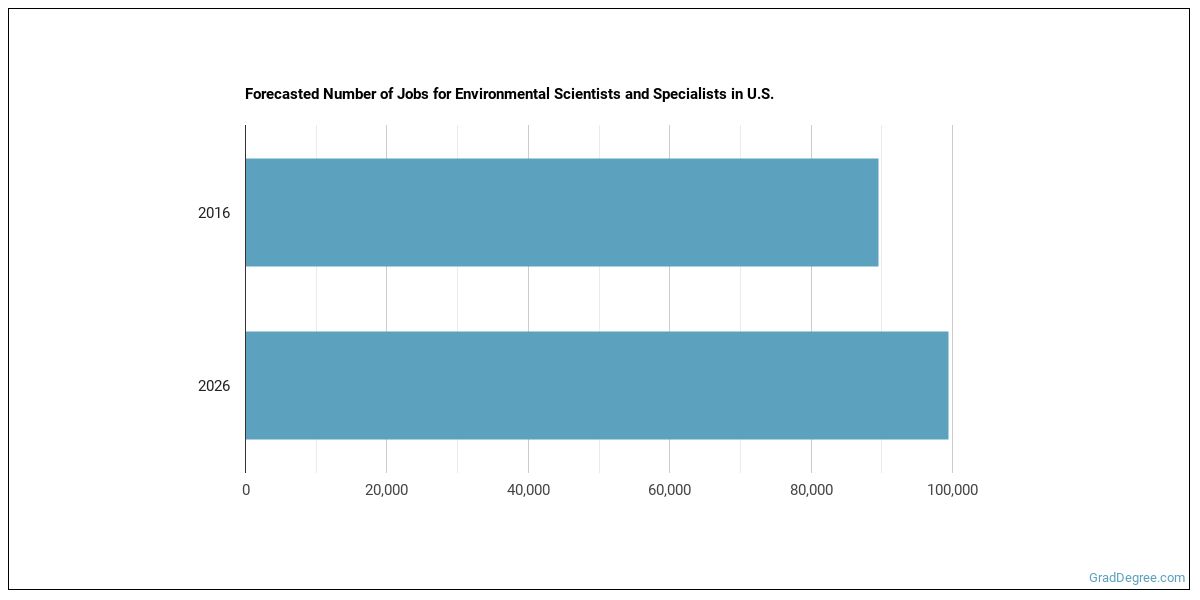
In 2016, there was an estimated number of 89,500 jobs in the United States for Environmental Scientist or Specialist. New jobs are being produced at a rate of 11.1% which is above the national average. The Bureau of Labor Statistics predicts 9,900 new jobs for Environmental Scientist or Specialist by 2026. Due to new job openings and attrition, there will be an average of 9,500 job openings in this field each year.
The states with the most job growth for Environmental Scientist or Specialist are Utah, Nevada, and Colorado. Watch out if you plan on working in Maine, Alaska, or Maryland. These states have the worst job growth for this type of profession.
Environmental Scientist or Specialist Average Salary
The typical yearly salary for Environmental Scientists and Specialists is somewhere between $42,520 and $124,620.

Environmental Scientists and Specialists who work in District of Columbia, California, or Colorado, make the highest salaries.
Below is a list of the median annual salaries for Environmental Scientists and Specialists in different U.S. states.
| State | Annual Mean Salary |
|---|---|
| Alabama | $67,630 |
| Alaska | $80,220 |
| Arizona | $72,150 |
| Arkansas | $58,540 |
| California | $91,890 |
| Colorado | $93,010 |
| Connecticut | $83,220 |
| Delaware | $59,890 |
| District of Columbia | $115,190 |
| Florida | $58,790 |
| Georgia | $72,860 |
| Hawaii | $69,780 |
| Idaho | $60,470 |
| Illinois | $78,640 |
| Indiana | $62,590 |
| Iowa | $74,140 |
| Kansas | $76,780 |
| Kentucky | $51,740 |
| Louisiana | $68,570 |
| Maine | $67,390 |
| Maryland | $77,300 |
| Massachusetts | $82,580 |
| Michigan | $69,430 |
| Minnesota | $74,880 |
| Missouri | $53,820 |
| Montana | $68,660 |
| Nebraska | $61,020 |
| Nevada | $63,920 |
| New Hampshire | $75,520 |
| New Jersey | $80,350 |
| New Mexico | $87,200 |
| New York | $79,340 |
| North Carolina | $64,850 |
| North Dakota | $72,860 |
| Ohio | $74,750 |
| Oklahoma | $65,490 |
| Oregon | $77,980 |
| Pennsylvania | $74,430 |
| Rhode Island | $82,160 |
| South Dakota | $61,250 |
| Tennessee | $72,470 |
| Texas | $80,880 |
| Utah | $68,480 |
| Vermont | $66,440 |
| Virginia | $85,550 |
| Washington | $85,090 |
| West Virginia | $56,380 |
| Wisconsin | $61,030 |
| Wyoming | $68,940 |
What Tools & Technology do Environmental Scientists and Specialists Use?
Although they’re not necessarily needed for all jobs, the following technologies are used by many Environmental Scientists and Specialists:
- Microsoft Excel
- Microsoft Word
- Microsoft Office
- Microsoft PowerPoint
- Microsoft Outlook
- Web browser software
- Microsoft Access
- Word processing software
- SAP
- Microsoft Project
- Autodesk AutoCAD
- Spreadsheet software
- Adobe Systems Adobe Acrobat
- Structured query language SQL
- Database software
- Microsoft Visual Basic
- Adobe Systems Adobe Illustrator
- IBM SPSS Statistics
- Geographic information system GIS software
- Graphics software
How to Become an Environmental Scientist or Specialist
What kind of Environmental Scientist or Specialist requirements are there?

How many years of work experience do I need?

Who Employs Environmental Scientists and Specialists?

The table below shows the approximate number of Environmental Scientists and Specialists employed by various industries.

Similar Careers
Those interested in being an Environmental Scientist or Specialist may also be interested in:
Career changers with experience as an Environmental Scientist or Specialist sometimes find work in one of the following fields:
References:
Image Credit: Lynn Betts via Photo by Lynn Betts, USDA Natural Resources Conservation Service
More about our data sources and methodologies.
Featured Schools

GradDegree.com provides higher-education, college and university, degree, program, career, salary, and other helpful information to students, faculty, institutions, and other internet audiences. Presented information and data are subject to change. Inclusion on this website does not imply or represent a direct relationship with the company, school, or brand. Information, though believed correct at time of publication, may not be correct, and no warranty is provided. Contact the schools to verify any information before relying on it. Financial aid may be available for those who qualify. The displayed options may include sponsored or recommended results, not necessarily based on your preferences.
© GradDegree.com – All Rights Reserved.