Marine Engineers and Naval Architects: Job Description
Design, develop, and evaluate the operation of marine vessels, ship machinery, and related equipment, such as power supply and propulsion systems.
Featured schools near , edit
What Do Marine Engineers and Naval Architects Perform?
The day-to-day responsibilities of marine engineers and naval architects include:
- Perform monitoring activities to ensure that ships comply with international regulations and standards for life-saving equipment and pollution preventatives.
- Design complete hull and superstructure according to specifications and test data, in conformity with standards of safety, efficiency, and economy.
- Conduct analyses of ships, such as stability, structural, weight, and vibration analyses.
- Study design proposals and specifications to establish basic characteristics of craft, such as size, weight, speed, propulsion, displacement, and draft.
- Maintain contact with, and formulate reports for, contractors and clients to ensure completion of work at minimum cost.
- Coordinate activities with regulatory bodies to ensure repairs and alterations are at minimum cost and consistent with safety.
- Check, test, and maintain automatic controls and alarm systems.
- Prepare technical reports for use by engineering, management, or sales personnel.
What Marine Engineers and Naval Architects Need to Know
Successful marine engineers and naval architects combine a mix of skills and domain knowledge.
Most Important Skills
The competencies most central to this role, rated on an importance scale of 0 to 5:
Knowledge Areas
Related Job Titles
This career also goes by job titles like:
- Architect Specialist
- Automation Engineer
- Boat Designer
- Consulting Marine Engineer
- Engineer
- Engineering Specialist
- Marine Architect
- Marine Civil Engineer
How Many Marine Engineers and Naval Architects Are There?
The U.S. employs around 242,075 marine engineers and naval architects working in the United States today. Demand is forecast to grow by +11.6% over the projection horizon.

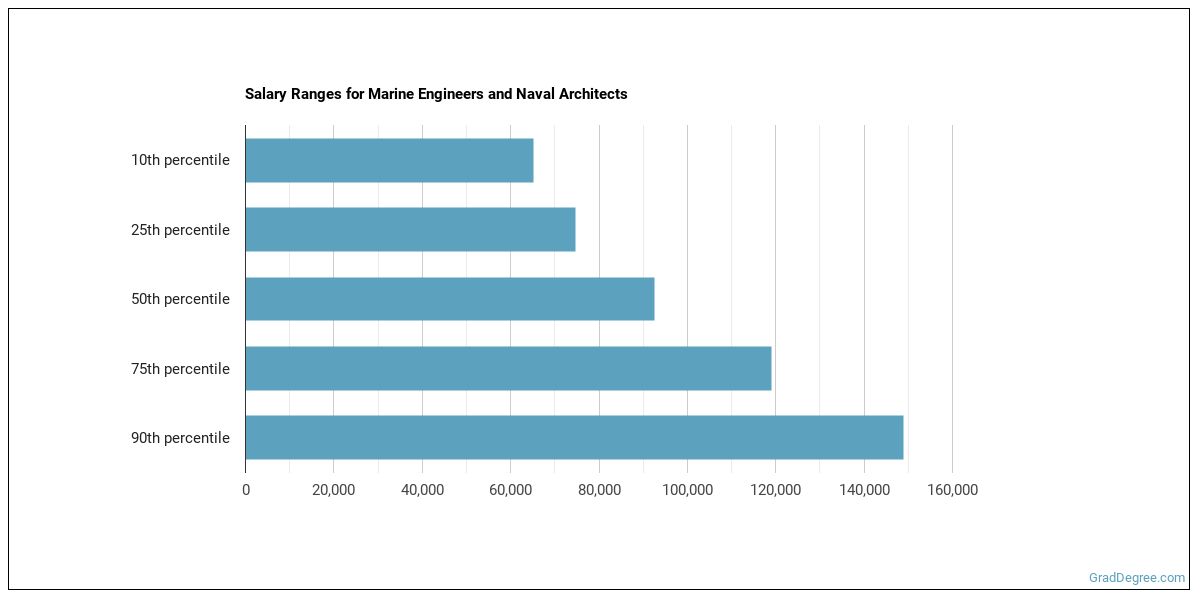
Marine Engineers and Naval Architects Pay
| Statistic | Value |
|---|---|
| Annual median | $121,581 |
| Hourly median | $58.45 |
| 10th percentile | $83,773 |
| 25th percentile | $102,677 |
| 75th percentile | $140,484 |
| 90th percentile | $159,388 |
Compensation varies based on experience, location, and industry.
Marine Engineers and Naval Architects Salary by State
| State | Annual median salary |
|---|---|
| District of Columbia | $166,750 |
| California | $128,750 |
| Texas | $128,470 |
| Maryland | $121,890 |
| South Carolina | $119,990 |
| Florida | $118,200 |
| New Jersey | $109,810 |
| New York | $109,040 |
| Washington | $107,100 |
| Louisiana | $106,500 |
| Hawaii | $102,190 |
| Virginia | $100,630 |
| Maine | $99,330 |
| Mississippi | $99,130 |
| Tennessee | $95,260 |
| Massachusetts | $93,490 |
| Michigan | $82,070 |
| Wisconsin | $78,950 |
| Georgia | $77,970 |
Top-Paying U.S. Regions
Pay for marine engineers and naval architects shift depending on where you work. These regions lead on median pay:
| Region | Median annual wage | Share of U.S. jobs | Location quotient |
|---|---|---|---|
| Southwest | $128,470 | 10.3% | 0.75 |
| Far Western US | $113,021 | 11.6% | 1.52 |
| Middle Atlantic | $106,861 | 18.5% | 4.91 |
| Southeast | $104,246 | 51.8% | 5.88 |
| New England | $99,330 | 5.6% | 9.03 |
| Great Lakes | $79,990 | 2.2% | 0.40 |
Where the Jobs Cluster
| Metro area | State | Median annual wage | Employment |
|---|---|---|---|
| Washington-Arlington-Alexandria, DC-VA-MD-WV | DC | $160,100 | 640 |
| San Francisco-Oakland-Fremont, CA | CA | $148,650 | 50 |
| Jacksonville, FL | FL | $135,850 | |
| Charleston-North Charleston, SC | SC | $134,430 | 40 |
| Miami-Fort Lauderdale-West Palm Beach, FL | FL | $131,820 | 210 |
| Houston-Pasadena-The Woodlands, TX | TX | $128,470 | 470 |
| San Diego-Chula Vista-Carlsbad, CA | CA | $128,420 | 80 |
| Seattle-Tacoma-Bellevue, WA | WA | $118,810 |
Industry Breakdown
The bulk of marine engineers and naval architects are concentrated in the following sectors:
| Industry | Employment | Median annual wage |
|---|---|---|
| Manufacturing | 4,430 | $101,820 |
| Professional, Scientific, and Technical Services | 2,290 | $110,680 |
| Transportation and Warehousing | 380 | $106,500 |
| Management of Companies and Enterprises | 90 | $126,780 |
| Educational Services | 40 | $89,390 |

The table below shows some of the most common industries where those employed in this career field work.

Tech Stack
- Document management software: Adobe Acrobat (hot technology)
- Computer aided design CAD software: Autodesk AutoCAD (hot technology)
- Computer aided design CAD software: Dassault Systemes SolidWorks (hot technology)
- Data base user interface and query software: Microsoft Access (hot technology)
- Spreadsheet software: Microsoft Excel (hot technology)
- Office suite software: Microsoft Office software (hot technology)
- Electronic mail software: Microsoft Outlook (hot technology)
- Presentation software: Microsoft PowerPoint (hot technology)
- Project management software: Microsoft Project (hot technology)
- Word processing software: Microsoft Word (hot technology)
- Enterprise resource planning ERP software: SAP software (hot technology)
- Analytical or scientific software: The MathWorks MATLAB (hot technology)
The Day-to-Day Environment
The on-the-job environment of marine engineers and naval architects tends to involve the following characteristics:
- Face-to-Face Discussions with Individuals and Within Teams
- Telephone Conversations
- Importance of Being Exact or Accurate
- Determine Tasks, Priorities and Goals
How to Become Marine Engineers and Naval Architects
Entry-level marine engineers and naval architects positions require a bachelor’s degree as the typical entry-level education. The role falls in Considerable Preparation Needed (Job Zone 4), reflecting the level of preparation typically expected.
Other Careers to Consider
Similar Occupations
- Architectural and Engineering Managers (Supplemental)
- Aerospace Engineers (Primary-Short)
- Civil Engineers (Primary-Long)
- Electrical Engineers (Primary-Long)
- Industrial Engineers (Primary-Long)
- Mechanical Engineers (Primary-Short)
- Aerospace Engineering and Operations Technologists and Technicians (Primary-Short)
- Civil Engineering Technologists and Technicians (Primary-Long)
Where to Study
Students preparing for marine engineers and naval architects commonly pursue programs in:
Engineering
1 programs across 1 majors
References
Data on this page comes from the following authoritative sources:
- U.S. Bureau of Labor Statistics — Occupational Employment and Wage Statistics (OEWS) for employment and wage data by state and industry.
- BLS Employment Projections for total employment and growth forecasts.
- O*NET (Occupational Information Network) for skills, knowledge, tasks, work activities, work context, technology, and education-zone data.
SOC code: 17-2121.00 (Marine Engineers and Naval Architects).

GradDegree.com provides higher-education, college and university, degree, program, career, salary, and other helpful information to students, faculty, institutions, and other internet audiences. Presented information and data are subject to change. Inclusion on this website does not imply or represent a direct relationship with the company, school, or brand. Information, though believed correct at time of publication, may not be correct, and no warranty is provided. Contact the schools to verify any information before relying on it. Financial aid may be available for those who qualify. The displayed options may include sponsored or recommended results, not necessarily based on your preferences.
© GradDegree.com – All Rights Reserved.