Doctor’s Degrees in Teacher Education Subject Specific
Featured schools near , edit
Education Levels of Subject Specific Ed Majors
During the most recent year for which data is available, 516 people earned their doctor's degree in subject specific ed. This earns it the #48 spot on the list of the most popular doctor's degree programs in the nation.
The following table shows the number of diplomas awarded in subject specific ed at each degree level.
| Education Level | Number of Grads |
|---|---|
| Master’s Degree | 17,793 |
| Graduate Certificate | 2,069 |
| Doctor’s Degree | 516 |
Earnings of Subject Specific Ed Majors With Doctor’s Degrees
The median salary for graduates holding a doctor's degree in subject specific ed is $61,723. A lot of factors can contribute to this number, such as the location of your workplace and the availability of other perks and bonuses. To get a better picture, earnings for this category of people can range from a low of $51,264 to a high of $76,722.

Student Debt
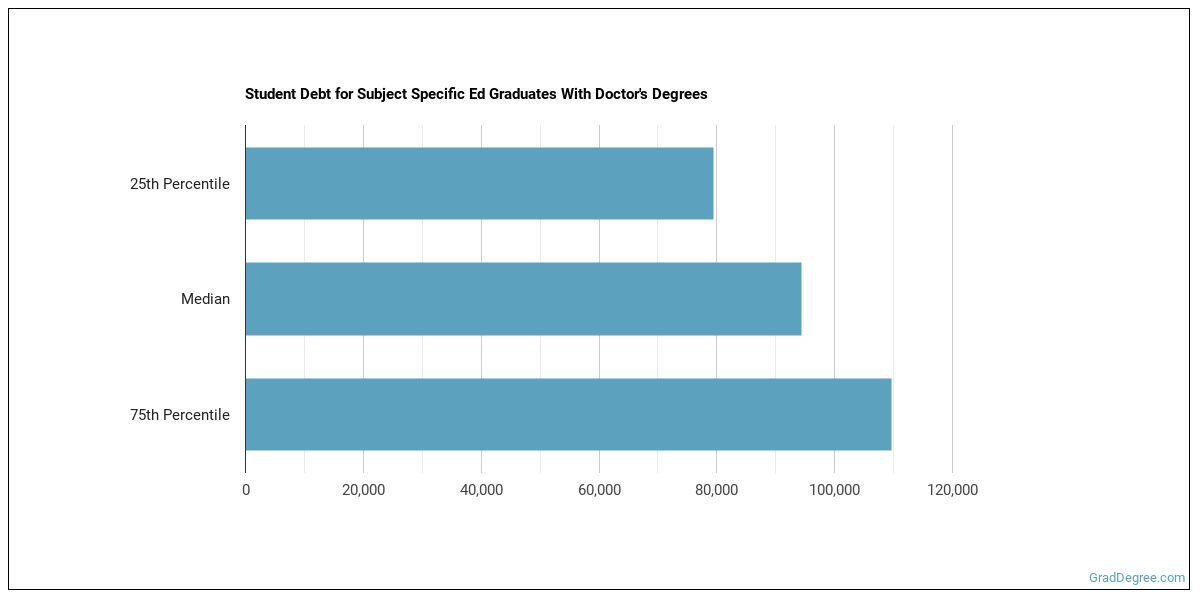
The median student debt for graduates holding a doctor's degree in subject specific ed is $85,723. The length of time it takes you to graduate and what college you attend can affect this number quite a bit. The chart below shows the range of accumulated debt loads. On the high side of the range, $87,270 is the debt load, and the debt load on the low side is $83,106.
Student Diversity
More women than men pursue their doctor's degree in subject specific ed. About 72.7% of graduates with this degree are female.
| Gender | Number of Grads |
|---|---|
| Men | 141 |
| Women | 375 |

The racial-ethnic distribution of subject specific ed doctor’s degree students is as follows:
| Race/Ethnicity | Number of Grads |
|---|---|
| Asian | 21 |
| Black or African American | 74 |
| Hispanic or Latino | 41 |
| White | 292 |
| International Students | 56 |
| Other Races/Ethnicities | 32 |

Most Popular Subject Specific Ed Programs for Doctor’s Degrees
There are 112 colleges that offer a doctor’s degree in subject specific ed. Learn more about the most popular 20 below:

Teachers College at Columbia University tops the list of the most popular school in the U.S. for subject specific ed majors who are seeking their doctor's degree. Roughly 4,500 attend the school each year. During the most recent year for which we have data, 50 people received their doctor's degree in subject specific ed from Teachers College. Of these students, 82% were women and 54% were members of underrepresented racial-ethnic groups.

University of Georgia is the 2nd most popular school in the nation for students seeking a doctor's degree in subject specific ed. Each year, around 39,100 students seeking various degrees attend the university. The average in-state tuition for full-time undergraduates is $9,790 per year, while in-state graduate students, on average, pay $8,878 per year. During the most recent year for which we have data, 28 people received their doctor's degree in subject specific ed from UGA. About 56% of this group were women, and 36% were students from an underrepresented racial-ethnic group.

St John's University - New York is the 3rd most popular school in the nation for students seeking a doctor's degree in subject specific ed. Each year, around 20,100 students seeking various degrees attend the university. The average in-state tuition for full-time undergraduates is $45,760 per year, while in-state graduate students, on average, pay $31,233 per year. During the most recent year for which we have data, 26 people received their doctor's degree in subject specific ed from STJ. Of these students, 92% were women and 23% were members of underrepresented racial-ethnic groups.

Auburn University is the 4th most popular school in the nation for students seeking a doctor's degree in subject specific ed. Each year, around 30,700 students seeking various degrees attend the university. The average in-state tuition for full-time undergraduates is $10,392 per year, while in-state graduate students, on average, pay $10,386 per year. During the most recent year for which we have data, 23 people received their doctor's degree in subject specific ed from Auburn. About 71% of this group were women, and 24% were students from an underrepresented racial-ethnic group.
Capella University comes in at #5 on our list of the most popular colleges offering doctor's degrees in subject specific ed. The average in-state tuition for full-time undergraduates is $14,328 per year, while in-state graduate students, on average, pay $14,826 per year. During the most recent year for which we have data, 22 people received their doctor's degree in subject specific ed from Capella University. Of these students, 100% were women and 60% were members of underrepresented racial-ethnic groups.

The 6th most popular school in the country for subject specific ed majors who are seeking their doctor's degree is Boston University. Roughly 32,700 attend the school each year. The average in-state tuition for full-time undergraduates is $61,050 per year, while in-state graduate students, on average, pay $61,050 per year. During the most recent year for which we have data, 21 people received their doctor's degree in subject specific ed from Boston U. About 57% of this group were women, and 24% were students from an underrepresented racial-ethnic group.

The 7th most popular school in the country for subject specific ed majors who are seeking their doctor's degree is Florida State University. Roughly 43,500 attend the school each year. The average in-state tuition for full-time undergraduates is $4,640 per year, while in-state graduate students, on average, pay $9,684 per year. During the most recent year for which we have data, 16 people received their doctor's degree in subject specific ed from Florida State. Around 50% of these students were from an underrepresented racial-ethnic group, and 57% were women.

Pennsylvania State University - Main Campus is the 7th most popular school in the nation for students seeking a doctor's degree in subject specific ed. Roughly 0 attend the school each year. The average in-state tuition for full-time undergraduates is $19,286 per year, while in-state graduate students, on average, pay $24,466 per year. During the most recent year for which we have data, 16 people received their doctor's degree in subject specific ed from Penn State University Park. Of these students, 65% were women and 24% were members of underrepresented racial-ethnic groups.

Texas A&M University - College Station is the 9th most popular school in the nation for students seeking a doctor's degree in subject specific ed. Each year, around 70,400 students seeking various degrees attend the university. The average in-state tuition for full-time undergraduates is $8,815 per year, while in-state graduate students, on average, pay $6,885 per year. During the most recent year for which we have data, 15 people received their doctor's degree in subject specific ed from Texas A&M College Station. Around 31% of these students were from an underrepresented racial-ethnic group, and 94% were women.

The 10th most popular school in the country for subject specific ed majors who are seeking their doctor's degree is Indiana University - Bloomington. Each year, around 43,000 students seeking various degrees attend the university. The average in-state tuition for full-time undergraduates is $10,012 per year, while in-state graduate students, on average, pay $10,033 per year. During the most recent year for which we have data, 14 people received their doctor's degree in subject specific ed from IU Bloomington. Around 14% of these students were from an underrepresented racial-ethnic group, and 57% were women.

The 11th most popular school in the country for subject specific ed majors who are seeking their doctor's degree is University of Arizona. Each year, around 45,600 students seeking various degrees attend the university. The average in-state tuition for full-time undergraduates is $11,210 per year, while in-state graduate students, on average, pay $12,348 per year. During the most recent year for which we have data, 11 people received their doctor's degree in subject specific ed from University of Arizona. About 75% of this group were women, and 13% were students from an underrepresented racial-ethnic group.

University of Florida comes in at #11 on our list of the most popular colleges offering doctor's degrees in subject specific ed. Each year, around 53,300 students seeking various degrees attend the university. The average in-state tuition for full-time undergraduates is $4,477 per year, while in-state graduate students, on average, pay $10,770 per year. During the most recent year for which we have data, 11 people received their doctor's degree in subject specific ed from UF. About 75% of this group were women, and 13% were students from an underrepresented racial-ethnic group.

University of Toledo comes in at #13 on our list of the most popular colleges offering doctor's degrees in subject specific ed. The average in-state tuition for full-time undergraduates is $9,391 per year, while in-state graduate students, on average, pay $15,053 per year. During the most recent year for which we have data, 10 people received their doctor's degree in subject specific ed from University of Toledo. Of these students, 100% were women and 100% were members of underrepresented racial-ethnic groups.

Sam Houston State University comes in at #13 on our list of the most popular colleges offering doctor's degrees in subject specific ed. Each year, around 21,900 students seeking various degrees attend the university. The average in-state tuition for full-time undergraduates is $5,856 per year, while in-state graduate students, on average, pay $5,765 per year. During the most recent year for which we have data, 10 people received their doctor's degree in subject specific ed from SHSU.

Georgia State University is the 15th most popular school in the nation for students seeking a doctor's degree in subject specific ed. Each year, around 36,300 students seeking various degrees attend the university. The average in-state tuition for full-time undergraduates is $7,158 per year, while in-state graduate students, on average, pay $7,164 per year. During the most recent year for which we have data, 9 people received their doctor's degree in subject specific ed from Georgia State. Around 60% of these students were from an underrepresented racial-ethnic group, and 60% were women.

Louisiana State University and Agricultural & Mechanical College is the 15th most popular school in the nation for students seeking a doctor's degree in subject specific ed. Each year, around 34,200 students seeking various degrees attend the university. The average in-state tuition for full-time undergraduates is $8,038 per year, while in-state graduate students, on average, pay $9,132 per year. During the most recent year for which we have data, 9 people received their doctor's degree in subject specific ed from Louisiana State University. About 80% of this group were women, and 20% were students from an underrepresented racial-ethnic group.

Washington State University comes in at #15 on our list of the most popular colleges offering doctor's degrees in subject specific ed. Each year, around 31,100 students seeking various degrees attend the university. The average in-state tuition for full-time undergraduates is $10,708 per year, while in-state graduate students, on average, pay $12,366 per year. During the most recent year for which we have data, 9 people received their doctor's degree in subject specific ed from Wazzu. About 75% of this group were women, and 38% were students from an underrepresented racial-ethnic group.

The 18th most popular school in the country for subject specific ed majors who are seeking their doctor's degree is Judson University. The average in-state tuition for full-time undergraduates is $29,850 per year, while in-state graduate students, on average, pay $16,306 per year. During the most recent year for which we have data, 8 people received their doctor's degree in subject specific ed from Judson.

Southern Illinois University Carbondale is the 18th most popular school in the nation for students seeking a doctor's degree in subject specific ed. Roughly 11,300 attend the school each year. The average in-state tuition for full-time undergraduates is $9,638 per year, while in-state graduate students, on average, pay $11,268 per year. During the most recent year for which we have data, 8 people received their doctor's degree in subject specific ed from SIUC. Around 17% of these students were from an underrepresented racial-ethnic group, and 67% were women.

University of Iowa comes in at #18 on our list of the most popular colleges offering doctor's degrees in subject specific ed. Roughly 30,300 attend the school each year. The average in-state tuition for full-time undergraduates is $8,711 per year, while in-state graduate students, on average, pay $10,875 per year. During the most recent year for which we have data, 8 people received their doctor's degree in subject specific ed from Iowa.
Subject Specific Ed Concentrations
| Major | Annual Degrees Awarded |
|---|---|
| 118 | |
| 80 | |
| 41 | |
| 41 | |
| 36 |
Explore Major by State
Alabama
Arkansas
Connecticut
Florida
Idaho
Iowa
Louisiana
Massachusetts
Mississippi
Nebraska
New Jersey
North Carolina
Oklahoma
Rhode Island
Tennessee
Vermont
West Virginia
Related Majors
Below are some popular majors that are similar to subject specific ed that offer doctor’s degrees.
| Major | Annual Degrees Awarded |
|---|---|
| 8,260 | |
| 2,369 | |
| 1,730 | |
| 453 | |
| 422 |
References
*The racial-ethnic minority student count is calculated by taking the total number of students and subtracting white students, international students, and students whose race/ethnicity was unknown. This number is then divided by the total number of students at the school to obtain the percentage of racial-ethnic minorities.
- College Factual
- National Center for Education Statistics
- O*NET Online
- Bureau of Labor Statistics
- Image Credit: By Aparajita Datta under License
More about our data sources and methodologies.
Featured Schools

GradDegree.com provides higher-education, college and university, degree, program, career, salary, and other helpful information to students, faculty, institutions, and other internet audiences. Presented information and data are subject to change. Inclusion on this website does not imply or represent a direct relationship with the company, school, or brand. Information, though believed correct at time of publication, may not be correct, and no warranty is provided. Contact the schools to verify any information before relying on it. Financial aid may be available for those who qualify. The displayed options may include sponsored or recommended results, not necessarily based on your preferences.
© GradDegree.com – All Rights Reserved.