Musicians and Singers: Job Description
Play one or more musical instruments or sing. May perform on stage, for broadcasting, or for sound or video recording.
Featured schools near , edit
What Tasks Do Musicians and Singers Take On?
The day-to-day responsibilities of musicians and singers cover:
- Perform before live audiences in concerts, recitals, educational presentations, and other social gatherings.
- Sing a cappella or with musical accompaniment.
- Interpret or modify music, applying knowledge of harmony, melody, rhythm, and voice production to individualize presentations and maintain audience interest.
- Specialize in playing a specific family of instruments or a particular type of music.
- Sing as a soloist or as a member of a vocal group.
- Observe choral leaders or prompters for cues or directions in vocal presentation.
- Memorize musical selections and routines, or sing following printed text, musical notation, or customer instructions.
- Play musical instruments as soloists, or as members or guest artists of musical groups such as orchestras, ensembles, or bands.
What Musicians and Singers Need to Know
Successful musicians and singers combine a mix of skills and domain knowledge.
Top Skills
These are the skills most central to this role, rated on an importance scale of 0 to 5:
Knowledge Areas
Types of Musicians and Singers Jobs
This career also goes by job titles like:
- Accompanist
- Bandperson
- Baritone
- Bass Player
- Bassoonist
- Bell Ringer
- Bugler
- Bull Fiddle Player
How Many Musicians and Singers Are There?
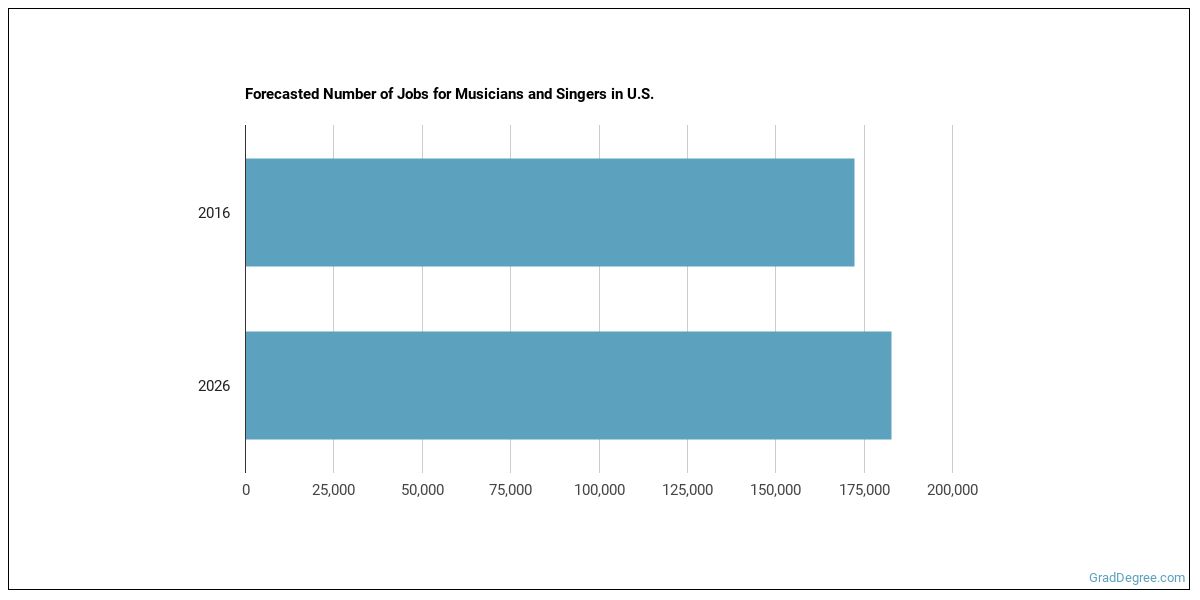
The U.S. employs around 41,578 musicians and singers working in the United States today. Employment is projected to grow by +7.2% over the projection horizon.
Musicians and Singers Pay
| Statistic | Value |
|---|---|
| Annual median | $96,571 |
| Hourly median | $46.43 |
| 10th percentile | $61,833 |
| 25th percentile | $79,202 |
| 75th percentile | $113,940 |
| 90th percentile | $131,308 |
Compensation varies based on experience, location, and industry.

Top Industries Employing Musicians and Singers
Most musicians and singers are found across these industries:
| Industry | Employment | Median annual wage |
|---|---|---|
| Arts, Entertainment, and Recreation | 24,770 | n/a |
| Other Services (except Public Administration) | 7,650 | n/a |
| Educational Services | 4,400 | n/a |
| Accommodation and Food Services | 450 | n/a |
| Information | 410 | n/a |
| Health Care and Social Assistance | 70 | n/a |
| Transportation and Warehousing | 60 | n/a |
| Professional, Scientific, and Technical Services | 60 | n/a |

Musicians and Singers work in the following industries:

Software Musicians and Singers Use
- Web page creation and editing software: Facebook (hot technology)
- Spreadsheet software: Microsoft Excel (hot technology)
- Office suite software: Microsoft Office software (hot technology)
- Word processing software: Microsoft Word (hot technology)
- Enterprise resource planning ERP software: SAP software (hot technology)
Work Environment
The on-the-job environment of musicians and singers tends to involve the following characteristics:
- Importance of Being Exact or Accurate
- Work With or Contribute to a Work Group or Team
- Physical Proximity
- Contact With Others
- Spend Time Sitting
Getting Started in This Career
Entry-level musicians and singers positions require a bachelor’s degree as the typical entry-level education. This occupation sits in Considerable Preparation Needed (Job Zone 4), indicating the level of preparation typically expected.
Similar Occupations
Similar Occupations
- Historians (Supplemental)
- Art, Drama, and Music Teachers, Postsecondary (Primary-Short)
- English Language and Literature Teachers, Postsecondary (Supplemental)
- Middle School Teachers, Except Special and Career/Technical Education (Supplemental)
- Secondary School Teachers, Except Special and Career/Technical Education (Supplemental)
- Self-Enrichment Teachers (Supplemental)
- Fine Artists, Including Painters, Sculptors, and Illustrators (Supplemental)
- Actors (Primary-Short)
Degree Programs
Aspiring musicians and singers typically earn programs in:
Visual and Performing Arts
12 programs across 2 majors
References
Data on this page comes from the following authoritative sources:
- U.S. Bureau of Labor Statistics — Occupational Employment and Wage Statistics (OEWS) for employment and wage data by state and industry.
- BLS Employment Projections for total employment and growth forecasts.
- O*NET (Occupational Information Network) for skills, knowledge, tasks, work activities, work context, technology, and education-zone data.
SOC code: 27-2042.00 (Musicians and Singers).

GradDegree.com provides higher-education, college and university, degree, program, career, salary, and other helpful information to students, faculty, institutions, and other internet audiences. Presented information and data are subject to change. Inclusion on this website does not imply or represent a direct relationship with the company, school, or brand. Information, though believed correct at time of publication, may not be correct, and no warranty is provided. Contact the schools to verify any information before relying on it. Financial aid may be available for those who qualify. The displayed options may include sponsored or recommended results, not necessarily based on your preferences.
© GradDegree.com – All Rights Reserved.