Hydrologists in Illinois
Want to work as a Hydrologists in Illinois? Here’s what the data says. Research the distribution, circulation, and physical properties of underground and surface waters; and study the form and intensity of precipitation and its rate of infiltration into the soil, movement through the earth, and return to the ocean and atmosphere.
What do Hydrologists Make in Illinois?
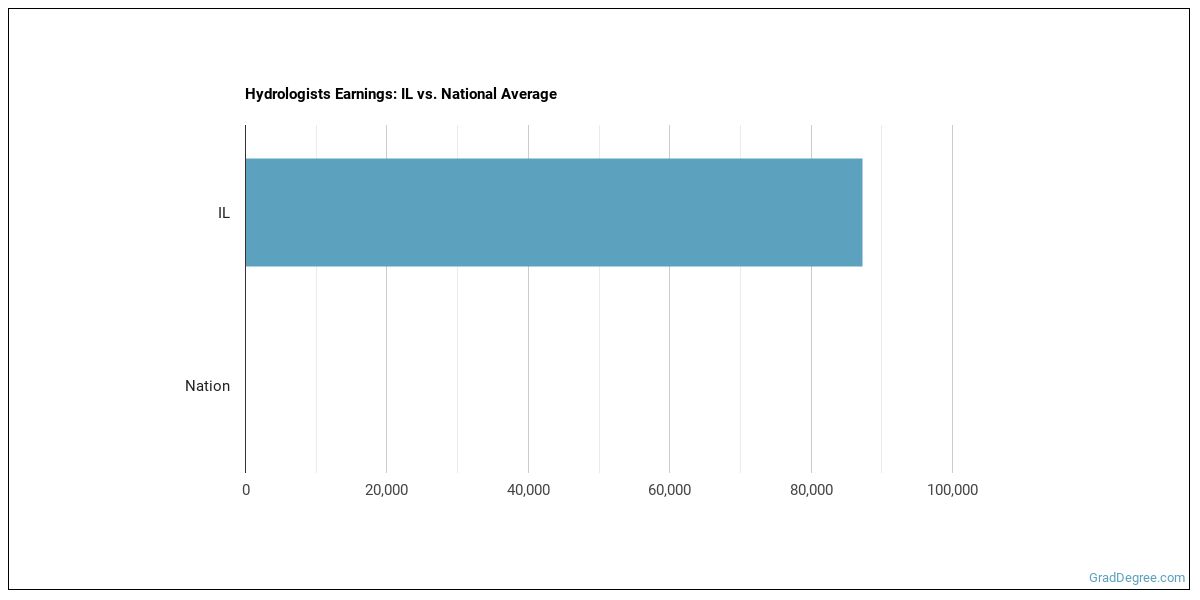
The hydrologists working in Illinois, the median annual wage is $79,790 per year (or roughly $38.36/hour).Earnings range from $56,530 at the 10th percentile to $130,830 at the 90th percentile.
| Wage Statistic | Annual | Hourly |
|---|---|---|
| 10th percentile | $56,530 | $27.18 |
| 25th percentile | $72,840 | $35.02 |
| Median (50th) | $79,790 | $38.36 |
| 75th percentile | $113,030 | $54.34 |
| 90th percentile | $130,830 | $62.90 |

Location quotient — how concentrated this career is in Illinois nationwide is 0.41, meaning fewer hydrologists per worker than the national average.
National Wage Comparison
Nationally, hydrologists earn a median of $96,513 per year ($46.40/hour), lower than the Illinois median.
Employment Outlook
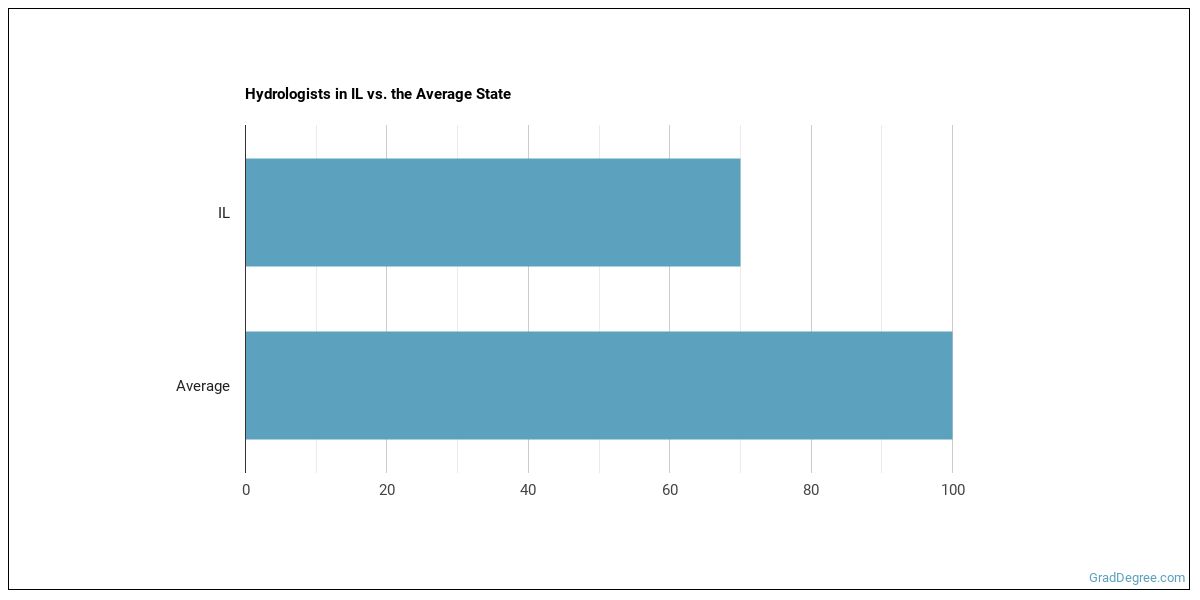
National employment for 54,483 hydrologists nationwide. In Illinois alone, about 90 people work in this role. That’s fewer than the typical state, which employs around 110 hydrologists.

Top Illinois Metros for Hydrologists
The largest metro-area employers of hydrologists in Illinois.
| Metro Area | Number Employed | Annual Median Salary |
|---|---|---|
| Champaign-Urbana, IL | 50 | $79,190 |
Top States for Hydrologists Employment
These states have the highest employment of hydrologists work.
| State | Number Employed |
|---|---|
| California | 670 |
| Arizona | 320 |
| Minnesota | 300 |
| Oregon | 280 |
| Washington | 270 |
| Colorado | 270 |
| Ohio | 260 |
| Florida | 250 |
| Texas | 250 |
| Pennsylvania | 230 |
| Nevada | 180 |
| New York | 180 |
| Wisconsin | 170 |
| Idaho | 170 |
| Montana | 170 |
| Massachusetts | 110 |
| South Carolina | 110 |
| New Mexico | 110 |
| Utah | 100 |
| Illinois | 90 |
Highest-Paying States for Hydrologists
These states pay the most for hydrologists.
| State | Annual Median Salary |
|---|---|
| Maryland | $134,410 |
| Virginia | $125,900 |
| California | $118,960 |
| Massachusetts | $116,750 |
| Colorado | $116,000 |
| New Jersey | $115,770 |
| Michigan | $111,860 |
| Missouri | $109,970 |
| Oklahoma | $104,330 |
| Washington | $100,000 |
Skills
Top hydrologists skills, rated on an importance scale of 0 to 5:
Knowledge Areas
Core knowledge areas for this occupation, rated on an importance scale of 0 to 5:
Abilities
The abilities that matter most for hydrologists, rated on an importance scale of 0 to 5:
Daily Tasks
Common tasks include:
- Prepare written and oral reports describing research results, using illustrations, maps, appendices, and other information.
- Design and conduct scientific hydrogeological investigations to ensure that accurate and appropriate information is available for use in water resource management decisions.
- Measure and graph phenomena such as lake levels, stream flows, and changes in water volumes.
- Conduct research and communicate information to promote the conservation and preservation of water resources.
- Coordinate and supervise the work of professional and technical staff, including research assistants, technologists, and technicians.
- Study public water supply issues, including flood and drought risks, water quality, wastewater, and impacts on wetland habitats.
- Apply research findings to help minimize the environmental impacts of pollution, waterborne diseases, erosion, and sedimentation.
- Study and document quantities, distribution, disposition, and development of underground and surface waters.
- Install, maintain, and calibrate instruments such as those that monitor water levels, rainfall, and sediments.
- Develop computer models for hydrologic predictions.
- Study and analyze the physical aspects of the earth in terms of hydrological components, including atmosphere, hydrosphere, and interior structure.
- Evaluate research data in terms of its impact on issues such as soil and water conservation, flood control planning, and water supply forecasting.
Work Activities
- Analyzing Data or Information
- Getting Information
- Working with Computers
- Making Decisions and Solving Problems
- Documenting/Recording Information
- Identifying Objects, Actions, and Events
- Processing Information
- Interpreting the Meaning of Information for Others
- Updating and Using Relevant Knowledge
- Communicating with Supervisors, Peers, or Subordinates
- Monitoring Processes, Materials, or Surroundings
- Thinking Creatively
Tools & Technology
Common tools and software used in this occupation include: Hot technologies: Autodesk AutoCAD, Autodesk AutoCAD Civil 3D In-demand technologies: Autodesk AutoCAD Civil 3D, ESRI ArcGIS software
What Major Will Prepare You For This Career?
Several college majors map to this occupation:
- Geological & Earth Sciences
- Environmental Geosciences
- Earth Systems Science
Featured schools near , edit
Related Careers
Careers similar to hydrologists include:
- Water Resource Specialists
- Brownfield Redevelopment Specialists and Site Managers
- Geodetic Surveyors
- Water/Wastewater Engineers
- Environmental Engineers
- Mining and Geological Engineers, Including Mining Safety Engineers
Also Known As
Groundwater Consultant, Hydraulic Engineer, Hydrogeologist, Hydrologic Engineer, Hydrologist, Isotope Hydrologist, Physical Scientist, Project Hydrogeologist, Research Hydrologist, Scientist, Seismologist, Source Water Protection Specialist, Surface Hydrologist, Volcanologist, Water Resources Scientist.
References
- U.S. Bureau of Labor Statistics, Occupational Employment and Wage Statistics — https://www.bls.gov/oes/
- O*NET Online — https://www.onetonline.org/
- BLS Employment Projections — https://www.bls.gov/emp/
- O*NET-SOC code: 19-2043.00

GradDegree.com provides higher-education, college and university, degree, program, career, salary, and other helpful information to students, faculty, institutions, and other internet audiences. Presented information and data are subject to change. Inclusion on this website does not imply or represent a direct relationship with the company, school, or brand. Information, though believed correct at time of publication, may not be correct, and no warranty is provided. Contact the schools to verify any information before relying on it. Financial aid may be available for those who qualify. The displayed options may include sponsored or recommended results, not necessarily based on your preferences.
© GradDegree.com – All Rights Reserved.