Human Factors Engineers and Ergonomists: Career Overview
Design objects, facilities, and environments to optimize human well-being and overall system performance, applying theory, principles, and data regarding the relationship between humans and respective technology. Investigate and analyze characteristics of human behavior and performance as it relates to the use of technology.
Featured schools near , edit
What Tasks Do Human Factors Engineers and Ergonomists Take On?
The core tasks performed by human factors engineers and ergonomists cover:
- Collect data through direct observation of work activities or witnessing the conduct of tests.
- Conduct interviews or surveys of users or customers to collect information on topics, such as requirements, needs, fatigue, ergonomics, or interfaces.
- Advocate for end users in collaboration with other professionals, including engineers, designers, managers, or customers.
- Inspect work sites to identify physical hazards.
- Prepare reports or presentations summarizing results or conclusions of human factors engineering or ergonomics activities, such as testing, investigation, or validation.
- Recommend workplace changes to improve health and safety, using knowledge of potentially harmful factors, such as heavy loads or repetitive motions.
- Perform functional, task, or anthropometric analysis, using tools, such as checklists, surveys, videotaping, or force measurement.
- Provide technical support to clients through activities, such as rearranging workplace fixtures to reduce physical hazards or discomfort or modifying task sequences to reduce cycle time.
What Human Factors Engineers and Ergonomists Need to Know
Top human factors engineers and ergonomists draw on a mix of skills and domain knowledge.
Top Skills
The competencies that matter most in this role, rated on an importance scale of 0 to 5:
Knowledge Areas
Related Job Titles
Common job titles for this role include:
- Board Certified Ergonomist
- Certified Professional Ergonomist
- Cognitive Engineer
- Engineer
- Engineering Psychologist
- Ergonomic Consultant
- Ergonomic Specialist
- Ergonomics Consultant
How Many Human Factors Engineers and Ergonomists Are There?
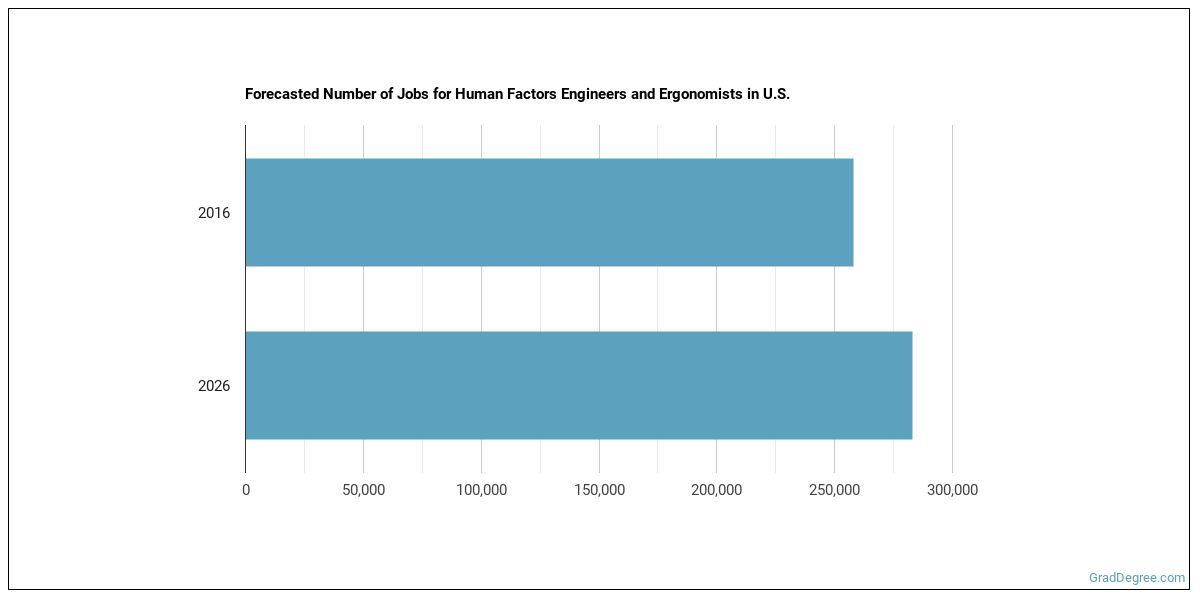
There are about 352,523 human factors engineers and ergonomists working in the United States today. Employment is projected to grow by +12.1% over the projection horizon.
How Much Do Human Factors Engineers and Ergonomists Make?
| Statistic | Value |
|---|---|
| Annual median | $128,495 |
| Hourly median | $61.78 |
| 10th percentile | $73,942 |
| 25th percentile | $101,218 |
| 75th percentile | $155,771 |
| 90th percentile | $183,047 |
Pay can vary substantially based on experience, location, and industry.

Pay by State
| State | Annual median salary |
|---|---|
| Alaska | $142,980 |
| Louisiana | $126,960 |
| Oregon | $124,560 |
| California | $123,070 |
| Wyoming | $122,540 |
| Washington | $119,670 |
| New Mexico | $119,390 |
| District of Columbia | $118,960 |
| Delaware | $118,670 |
| Idaho | $112,490 |
| Rhode Island | $110,470 |
| Arizona | $110,100 |
| Maryland | $109,560 |
| Massachusetts | $108,350 |
| Colorado | $106,980 |
| West Virginia | $104,610 |
| New Jersey | $103,880 |
| Texas | $103,430 |
| Florida | $103,340 |
| Montana | $103,210 |
| Vermont | $101,780 |
| New York | $101,770 |
| Minnesota | $101,600 |
| Connecticut | $101,020 |
| Utah | $100,710 |
| New Hampshire | $100,550 |
| Nevada | $100,170 |
| Illinois | $99,990 |
| Virginia | $99,990 |
| Iowa | $99,960 |
| Hawaii | $99,850 |
| Michigan | $99,680 |
| Ohio | $99,490 |
| Maine | $99,260 |
| Alabama | $99,120 |
| South Carolina | $98,830 |
| Georgia | $98,550 |
| Tennessee | $98,230 |
| North Carolina | $97,150 |
| Indiana | $97,080 |
| Kansas | $96,650 |
| Pennsylvania | $96,320 |
| Arkansas | $95,860 |
| Kentucky | $95,780 |
| Missouri | $95,610 |
| Oklahoma | $95,180 |
| Nebraska | $95,150 |
| Wisconsin | $95,090 |
| Mississippi | $93,110 |
| South Dakota | $89,450 |
| North Dakota | $84,610 |
| Puerto Rico | $80,120 |
Where Human Factors Engineers and Ergonomists Earn the Most
Pay for human factors engineers and ergonomists shift depending on where you work. Top regions by median wage:
| Region | Median annual wage | Share of U.S. jobs | Location quotient |
|---|---|---|---|
| Far Western US | $122,119 | 11.3% | 0.76 |
| Rocky Mountains | $105,362 | 3.3% | 0.90 |
| New England | $105,126 | 5.8% | 1.28 |
| Southwest | $104,420 | 11.4% | 0.92 |
| Middle Atlantic | $101,437 | 10.2% | 0.71 |
| Southeast | $99,872 | 21.1% | 0.98 |
| Plains States | $99,145 | 9.4% | 1.88 |
| Great Lakes | $98,771 | 26.7% | 2.14 |
Top Metro Areas
| Metro area | State | Median annual wage | Employment |
|---|---|---|---|
| Anchorage, AK | AK | $166,350 | 130 |
| Charleston, WV | WV | $141,900 | 150 |
| Vallejo, CA | CA | $140,500 | 230 |
| New Orleans-Metairie, LA | LA | $139,130 | 770 |
| Midland, TX | TX | $137,110 | 300 |
| San Jose-Sunnyvale-Santa Clara, CA | CA | $136,290 | 3,850 |
| San Francisco-Oakland-Fremont, CA | CA | $133,790 | 4,630 |
| Lexington Park, MD | MD | $132,020 | 170 |
Industry Breakdown
The largest employers of human factors engineers and ergonomists are found across these industries:
| Industry | Employment | Median annual wage |
|---|---|---|
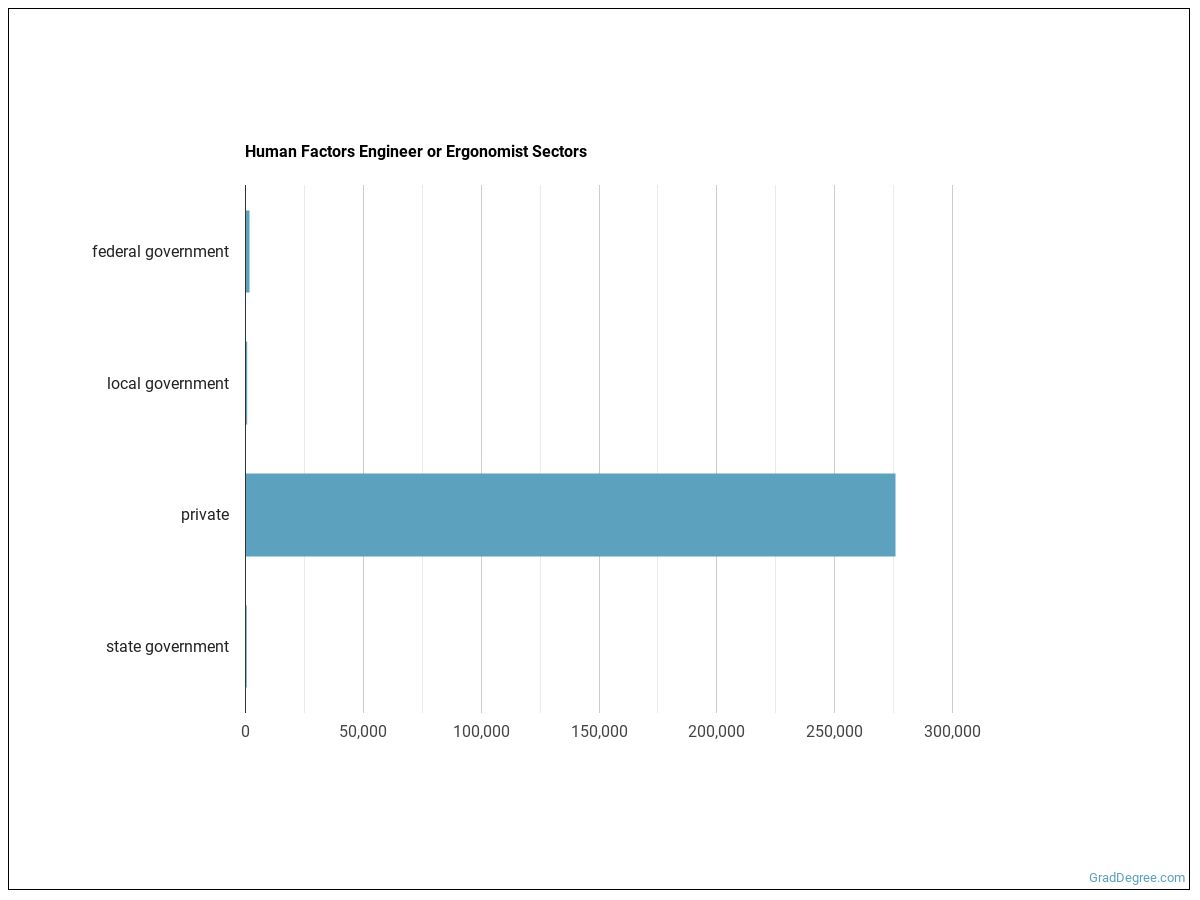
| Manufacturing | 237,030 | $100,060 |
| Professional, Scientific, and Technical Services | 50,290 | $106,420 |
| Management of Companies and Enterprises | 15,770 | $115,210 |
| Wholesale Trade | 15,570 | $101,700 |
| Transportation and Warehousing | 7,860 | $97,440 |
| Information | 2,170 | $128,220 |
| Mining, Quarrying, and Oil and Gas Extraction | 2,110 | $148,850 |
| Construction | 2,000 | $96,320 |
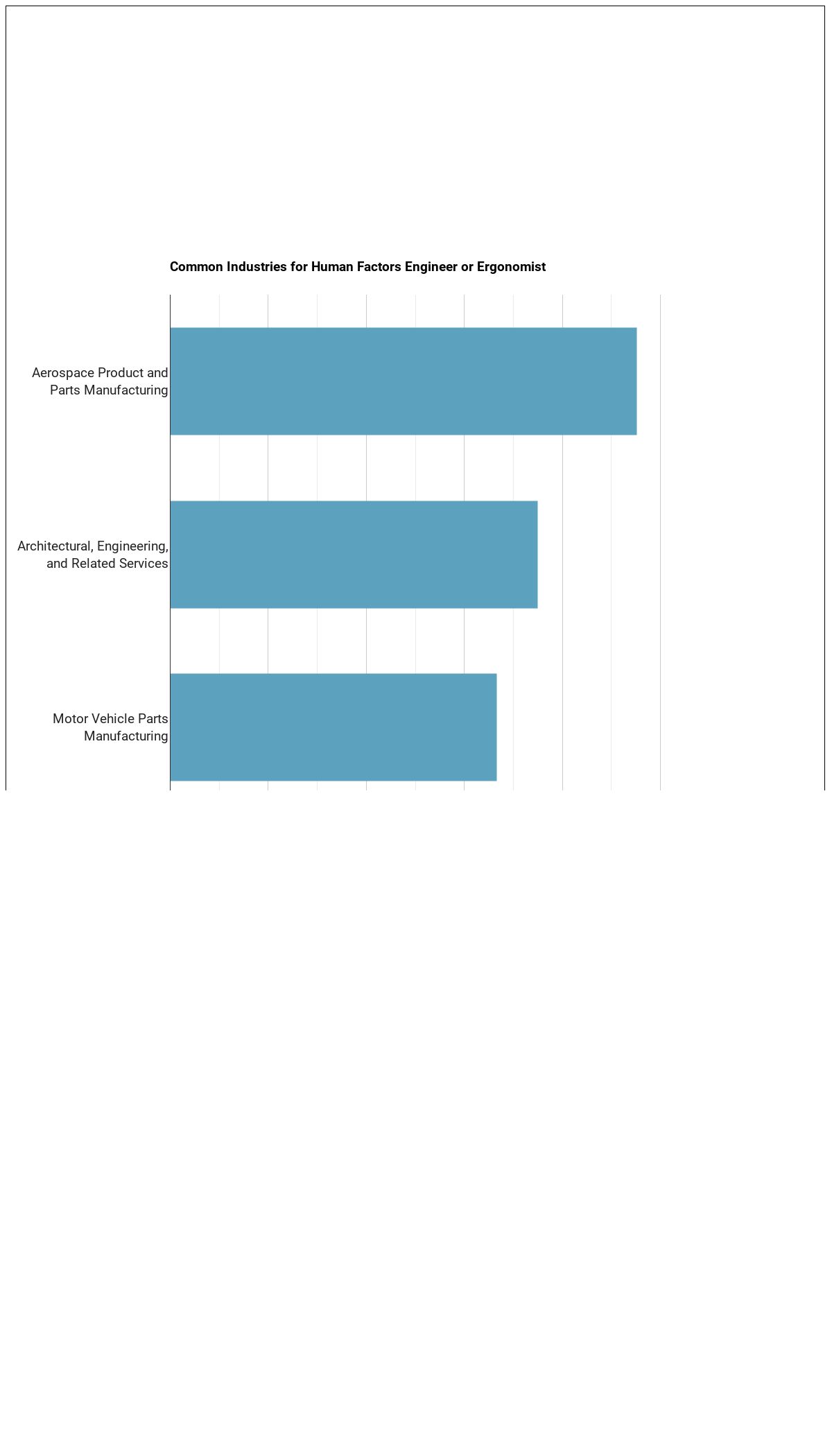
Below are examples of industries where human factors engineers and ergonomists work:
Software Human Factors Engineers and Ergonomists Use
- Document management software: Adobe Acrobat (hot technology)
- Graphics or photo imaging software: Adobe Creative Cloud software (hot technology)
- Graphics or photo imaging software: Adobe Illustrator (hot technology)
- Desktop publishing software: Adobe InDesign (hot technology)
- Graphics or photo imaging software: Adobe Photoshop (hot technology)
- Web platform development software: AJAX (hot technology)
- Internet browser software: Apple Safari (hot technology)
- Content workflow software: Atlassian JIRA (hot technology)
- Computer aided design CAD software: Autodesk AutoCAD (hot technology)
- Object or component oriented development software: C++ (hot technology)
- Web platform development software: Cascading style sheets CSS (hot technology)
- Computer aided design CAD software: Dassault Systemes SolidWorks (hot technology)
Work Environment
The on-the-job environment of human factors engineers and ergonomists tends to involve the following characteristics:
- Telephone Conversations
- Freedom to Make Decisions
- Face-to-Face Discussions with Individuals and Within Teams
- Determine Tasks, Priorities and Goals
Getting Started in This Career
Most human factors engineers and ergonomists positions require a doctoral or professional degree as the typical entry-level education. This career aligns with Extensive Preparation Needed (Job Zone 5), indicating the level of preparation typically expected.
Related Careers
Similar Occupations
- Health Informatics Specialists (Primary-Long)
- Computer and Information Research Scientists (Primary-Long)
- Software Quality Assurance Analysts and Testers (Supplemental)
- Penetration Testers (Supplemental)
- Data Scientists (Primary-Short)
- Clinical Data Managers (Supplemental)
- Bioengineers and Biomedical Engineers (Primary-Short)
- Health and Safety Engineers, Except Mining Safety Engineers and Inspectors (Primary-Short)
Degree Programs
Future human factors engineers and ergonomists commonly pursue programs in:
Engineering
3 programs across 3 majors
Engineering Technologies and Engineering-Related Fields
2 programs across 1 majors
References
This profile draws on the following authoritative sources:
- U.S. Bureau of Labor Statistics — Occupational Employment and Wage Statistics (OEWS) for employment and wage data by state and industry.
- BLS Employment Projections for total employment and growth forecasts.
- O*NET (Occupational Information Network) for skills, knowledge, tasks, work activities, work context, technology, and education-zone data.
SOC code: 17-2112.01 (Industrial Engineers).

GradDegree.com provides higher-education, college and university, degree, program, career, salary, and other helpful information to students, faculty, institutions, and other internet audiences. Presented information and data are subject to change. Inclusion on this website does not imply or represent a direct relationship with the company, school, or brand. Information, though believed correct at time of publication, may not be correct, and no warranty is provided. Contact the schools to verify any information before relying on it. Financial aid may be available for those who qualify. The displayed options may include sponsored or recommended results, not necessarily based on your preferences.
© GradDegree.com – All Rights Reserved.