Forest and Conservation Workers: Job Description
Under supervision, perform manual labor necessary to develop, maintain, or protect areas such as forests, forested areas, woodlands, wetlands, and rangelands through such activities as raising and transporting seedlings; combating insects, pests, and diseases harmful to plant life; and building structures to control water, erosion, and leaching of soil. Includes forester aides, seedling pullers, tree planters, and gatherers of nontimber forestry products such as pine straw.
Featured schools near , edit
What Do Forest and Conservation Workers Take On?
The day-to-day responsibilities of forest and conservation workers span:
- Check equipment to ensure that it is operating properly.
- Fight forest fires or perform prescribed burning tasks under the direction of fire suppression officers or forestry technicians.
- Perform fire protection or suppression duties, such as constructing fire breaks or disposing of brush.
- Confer with other workers to discuss issues, such as safety, cutting heights, or work needs.
Key Skills and Knowledge
Top forest and conservation workers draw on a mix of skills and domain knowledge.
Most Important Skills
These are the skills most important for this role, rated on an importance scale of 0 to 5:
Top Knowledge Areas
Other Forest and Conservation Workers Job Titles
Common job titles for this role include:
- Blister Rust Eradicator
- Box Chipper
- Box Cutter
- Brusher
- Chemical Sprayer
- Chopper
- Christmas Tree Farm Worker
- Christmas Tree Farmer
How Many Forest and Conservation Workers Are There?
The U.S. employs around 360,249 forest and conservation workers working in the United States today. Demand is forecast to grow by +11.1% over the projection horizon.

Salary for Forest and Conservation Workers
| Statistic | Value |
|---|---|
| Annual median | $22,542 |
| Hourly median | $10.84 |
| 10th percentile | $20,000 |
| 25th percentile | $22,000 |
| 75th percentile | $26,631 |
| 90th percentile | $30,720 |
Pay can vary substantially based on experience, location, and industry.

Pay by State
| State | Annual median salary |
|---|---|
| Illinois | $64,430 |
| Ohio | $53,350 |
| Pennsylvania | $49,160 |
| Arkansas | $46,110 |
| Idaho | $46,010 |
| Colorado | $45,420 |
| California | $43,680 |
| Massachusetts | $43,630 |
| Washington | $43,480 |
| Missouri | $43,330 |
| Oregon | $42,810 |
| New Jersey | $41,600 |
| Louisiana | $40,830 |
| Tennessee | $40,320 |
| Indiana | $40,140 |
| Texas | $38,720 |
| North Carolina | $38,000 |
| Georgia | $37,930 |
| South Dakota | $37,690 |
| Florida | $36,970 |
| South Carolina | $36,810 |
| New Mexico | $36,460 |
| Wisconsin | $35,320 |
| Connecticut | $35,300 |
| Iowa | $30,290 |
Pay by U.S. Region
Compensation for forest and conservation workers vary by region. The following regions pay the most:
| Region | Median annual wage | Share of U.S. jobs | Location quotient |
|---|---|---|---|
| Middle Atlantic | $47,540 | 5.9% | 0.88 |
| Rocky Mountains | $45,715 | 2.5% | 1.28 |
| Far Western US | $43,605 | 46.1% | 2.63 |
| Great Lakes | $42,671 | 9.7% | 1.71 |
| Southeast | $38,803 | 19.5% | 1.94 |
| Southwest | $38,720 | 1.1% | 0.11 |
| Plains States | $37,690 | 14.2% | 40.33 |
| New England | $35,300 | 1.1% | 0.79 |
Highest-Paying Metro Areas for Forest and Conservation Workers
| Metro area | State | Median annual wage | Employment |
|---|---|---|---|
| Chicago-Naperville-Elgin, IL-IN | IL | $55,790 | 70 |
| Harrisburg-Carlisle, PA | PA | $48,200 | 30 |
| Pittsburgh, PA | PA | $48,050 | 40 |
| Seattle-Tacoma-Bellevue, WA | WA | $44,720 | |
| Los Angeles-Long Beach-Anaheim, CA | CA | $43,680 | 310 |
| Oxnard-Thousand Oaks-Ventura, CA | CA | $43,680 | 160 |
| Riverside-San Bernardino-Ontario, CA | CA | $43,680 | 100 |
| Sacramento-Roseville-Folsom, CA | CA | $43,680 | 270 |
Top Industries Employing Forest and Conservation Workers
Most forest and conservation workers are found across these industries:
| Industry | Employment | Median annual wage |
|---|---|---|
| Other Services (except Public Administration) | 1,010 | $42,810 |
| Arts, Entertainment, and Recreation | 190 | $43,230 |
| Administrative and Support and Waste Management and Remediation Services | 120 | $37,930 |
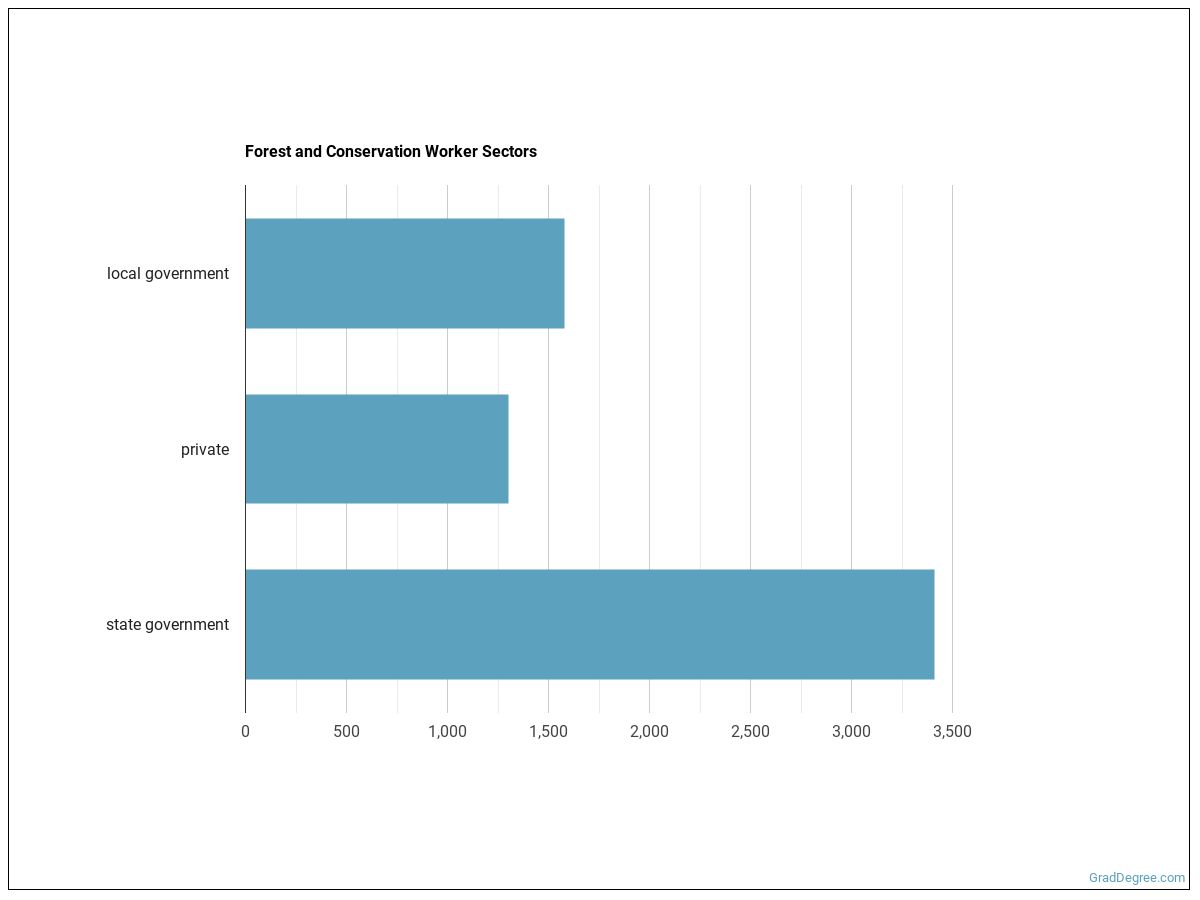
Forest and Conservation Workers work in the following industries:

Software Forest and Conservation Workers Use
- Geographic information system: ESRI ArcGIS software (hot technology)
- Data base user interface and query software: Microsoft Access (hot technology)
- Spreadsheet software: Microsoft Excel (hot technology)
- Office suite software: Microsoft Office software (hot technology)
- Electronic mail software: Microsoft Outlook (hot technology)
- Presentation software: Microsoft PowerPoint (hot technology)
- Project management software: Microsoft Project (hot technology)
- Operating system software: Microsoft Windows (hot technology)
- Word processing software: Microsoft Word (hot technology)
The Day-to-Day Environment
Daily working conditions for forest and conservation workers tends to involve the following characteristics:
- Face-to-Face Discussions with Individuals and Within Teams
- Outdoors, Exposed to All Weather Conditions
- Telephone Conversations
- In an Enclosed Vehicle or Operate Enclosed Equipment
Education and Training
Entry-level forest and conservation workers positions require a high school diploma or equivalent as the typical entry-level education. This career aligns with Some Preparation Needed (Job Zone 2), reflecting the level of preparation typically expected.
Other Careers to Consider
Similar Occupations
- Soil and Plant Scientists (Supplemental)
- Conservation Scientists (Primary-Long)
- Range Managers (Primary-Short)
- Foresters (Primary-Short)
- Environmental Scientists and Specialists, Including Health (Supplemental)
- Environmental Restoration Planners (Supplemental)
- Agricultural Technicians (Primary-Long)
- Forest and Conservation Technicians (Primary-Short)
Degree Programs
Students preparing for forest and conservation workers commonly pursue programs in:
Natural Resources and Conservation
3 programs across 1 majors
Agriculture, Agriculture Operations, and Related Sciences
1 programs across 1 majors
Sources
Statistics shown above are sourced from the following authoritative sources:
- U.S. Bureau of Labor Statistics — Occupational Employment and Wage Statistics (OEWS) for employment and wage data by state and industry.
- BLS Employment Projections for total employment and growth forecasts.
- O*NET (Occupational Information Network) for skills, knowledge, tasks, work activities, work context, technology, and education-zone data.
SOC code: 45-4011.00 (Forest and Conservation Workers).

GradDegree.com provides higher-education, college and university, degree, program, career, salary, and other helpful information to students, faculty, institutions, and other internet audiences. Presented information and data are subject to change. Inclusion on this website does not imply or represent a direct relationship with the company, school, or brand. Information, though believed correct at time of publication, may not be correct, and no warranty is provided. Contact the schools to verify any information before relying on it. Financial aid may be available for those who qualify. The displayed options may include sponsored or recommended results, not necessarily based on your preferences.
© GradDegree.com – All Rights Reserved.