Doctor’s Degrees in Rehabilitation & Therapeutic Professions
Featured schools near , edit
Education Levels of Rehabilitation Majors
During the most recent year for which data is available, 16,296 people earned their doctor's degree in rehabilitation. This earns it the #3 spot on the list of the most popular doctor's degree programs in the nation.
The following table shows the number of diplomas awarded in rehabilitation at each degree level.
| Education Level | Number of Grads |
|---|---|
| Doctor’s Degree | 16,296 |
| Master’s Degree | 9,069 |
| Graduate Certificate | 465 |
Earnings of Rehabilitation Majors With Doctor’s Degrees
The median salary for graduates holding a doctor's degree in rehabilitation is $70,114. This number may vary for a lot of reasons. For instance, you may decide to move to a location where people with your degree are rare and make more money. A better approximation of salary is to look at the typical range of salaries. In this case the low is $67,616 and the high is $72,605.

Student Debt
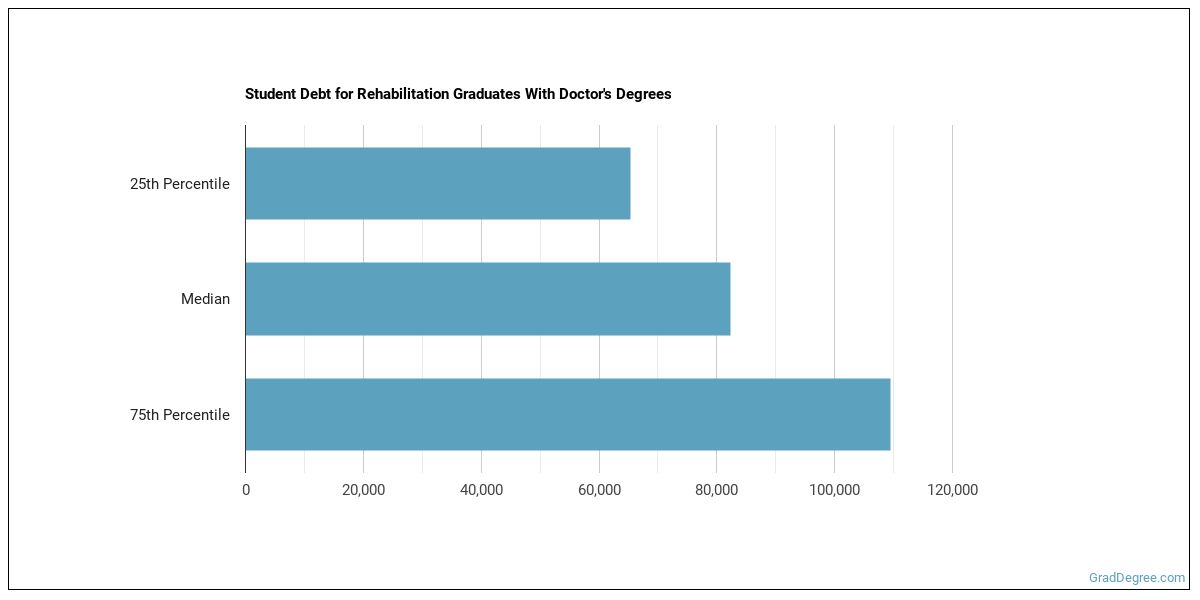
The median student debt for graduates holding a doctor's degree in rehabilitation is $89,164. The length of time it takes you to graduate and what college you attend can affect this number quite a bit. The chart below shows the range of accumulated debt loads. On the high side of the range, $130,247 is the debt load, and the debt load on the low side is $71,054.
Student Diversity
More women than men pursue their doctor's degree in rehabilitation. About 67.6% of graduates with this degree are female.
| Gender | Number of Grads |
|---|---|
| Men | 5,274 |
| Women | 11,022 |

The racial-ethnic distribution of rehabilitation doctor’s degree students is as follows:
| Race/Ethnicity | Number of Grads |
|---|---|
| Asian | 1,692 |
| Black or African American | 623 |
| Hispanic or Latino | 1,300 |
| White | 10,720 |
| International Students | 352 |
| Other Races/Ethnicities | 1,609 |

Most Popular Rehabilitation Programs for Doctor’s Degrees
There are 293 colleges that offer a doctor’s degree in rehabilitation. Learn more about the most popular 20 below:
University of St. Augustine for Health Sciences tops the list of the most popular school in the U.S. for rehabilitation majors who are seeking their doctor's degree. Each year, around 4,700 students seeking various degrees attend the university. During the most recent year for which we have data, 1,020 people received their doctor's degree in rehabilitation from USAHS. Of these students, 63% were women and 44% were members of underrepresented racial-ethnic groups.

The University of Montana is the 2nd most popular school in the nation for students seeking a doctor's degree in rehabilitation. Roughly 9,800 attend the school each year. The average in-state tuition for full-time undergraduates is $5,515 per year, while in-state graduate students, on average, pay $5,166 per year. During the most recent year for which we have data, 394 people received their doctor's degree in rehabilitation from UM. Around 62% of these students were from an underrepresented racial-ethnic group, and 63% were women.

The 3rd most popular school in the country for rehabilitation majors who are seeking their doctor's degree is Arcadia University. Roughly 3,300 attend the school each year. The average in-state tuition for full-time undergraduates is $46,430 per year, while in-state graduate students, on average, pay $27,457 per year. During the most recent year for which we have data, 285 people received their doctor's degree in rehabilitation from Arcadia. About 74% of this group were women, and 9% were students from an underrepresented racial-ethnic group.

University of Southern California comes in at #4 on our list of the most popular colleges offering doctor's degrees in rehabilitation. Each year, around 46,200 students seeking various degrees attend the university. The average in-state tuition for full-time undergraduates is $63,468 per year, while in-state graduate students, on average, pay $63,468 per year. During the most recent year for which we have data, 213 people received their doctor's degree in rehabilitation from USC. Of these students, 72% were women and 61% were members of underrepresented racial-ethnic groups.

Creighton University is the 5th most popular school in the nation for students seeking a doctor's degree in rehabilitation. Each year, around 8,700 students seeking various degrees attend the university. The average in-state tuition for full-time undergraduates is $43,684 per year, while in-state graduate students, on average, pay $17,496 per year. During the most recent year for which we have data, 198 people received their doctor's degree in rehabilitation from Creighton. Around 14% of these students were from an underrepresented racial-ethnic group, and 83% were women.

The College of Saint Scholastica comes in at #6 on our list of the most popular colleges offering doctor's degrees in rehabilitation. Each year, around 3,700 students seeking various degrees attend the university. The average in-state tuition for full-time undergraduates is $38,750 per year, while in-state graduate students, on average, pay $13,551 per year. During the most recent year for which we have data, 164 people received their doctor's degree in rehabilitation from St. Scholastica. Around 32% of these students were from an underrepresented racial-ethnic group, and 61% were women.
A T Still University of Health Sciences comes in at #7 on our list of the most popular colleges offering doctor's degrees in rehabilitation. Roughly 3,900 attend the school each year. During the most recent year for which we have data, 157 people received their doctor's degree in rehabilitation from A T Still University of Health Sciences. About 75% of this group were women, and 30% were students from an underrepresented racial-ethnic group.

The 8th most popular school in the country for rehabilitation majors who are seeking their doctor's degree is Utica College. Each year, around 4,600 students seeking various degrees attend the university. The average in-state tuition for full-time undergraduates is $23,208 per year, while in-state graduate students, on average, pay $26,158 per year. During the most recent year for which we have data, 151 people received their doctor's degree in rehabilitation from Utica College. Around 27% of these students were from an underrepresented racial-ethnic group, and 69% were women.

Boston University is the 9th most popular school in the nation for students seeking a doctor's degree in rehabilitation. Roughly 32,700 attend the school each year. The average in-state tuition for full-time undergraduates is $61,050 per year, while in-state graduate students, on average, pay $61,050 per year. During the most recent year for which we have data, 141 people received their doctor's degree in rehabilitation from Boston U. Around 30% of these students were from an underrepresented racial-ethnic group, and 81% were women.

Loma Linda University is the 10th most popular school in the nation for students seeking a doctor's degree in rehabilitation. Each year, around 4,400 students seeking various degrees attend the university. The average in-state tuition for full-time undergraduates is $33,552 per year, while in-state graduate students, on average, pay $28,000 per year. During the most recent year for which we have data, 140 people received their doctor's degree in rehabilitation from Loma Linda University. Around 46% of these students were from an underrepresented racial-ethnic group, and 57% were women.

Northern Arizona University is the 11th most popular school in the nation for students seeking a doctor's degree in rehabilitation. Roughly 29,500 attend the school each year. The average in-state tuition for full-time undergraduates is $10,644 per year, while in-state graduate students, on average, pay $11,103 per year. During the most recent year for which we have data, 139 people received their doctor's degree in rehabilitation from NAU. Of these students, 63% were women and 29% were members of underrepresented racial-ethnic groups.

Stony Brook University comes in at #11 on our list of the most popular colleges offering doctor's degrees in rehabilitation. Roughly 26,700 attend the school each year. The average in-state tuition for full-time undergraduates is $7,070 per year, while in-state graduate students, on average, pay $11,310 per year. During the most recent year for which we have data, 139 people received their doctor's degree in rehabilitation from SUNY Stony Brook. Of these students, 59% were women and 35% were members of underrepresented racial-ethnic groups.
Nova Southeastern University is the 13th most popular school in the nation for students seeking a doctor's degree in rehabilitation. Roughly 20,800 attend the school each year. The average in-state tuition for full-time undergraduates is $34,500 per year, while in-state graduate students, on average, pay $22,062 per year. During the most recent year for which we have data, 138 people received their doctor's degree in rehabilitation from NUS Florida. About 74% of this group were women, and 43% were students from an underrepresented racial-ethnic group.

The 14th most popular school in the country for rehabilitation majors who are seeking their doctor's degree is Baylor University. Each year, around 19,200 students seeking various degrees attend the university. The average in-state tuition for full-time undergraduates is $51,738 per year, while in-state graduate students, on average, pay $38,772 per year. During the most recent year for which we have data, 135 people received their doctor's degree in rehabilitation from Baylor. Of these students, 58% were women and 24% were members of underrepresented racial-ethnic groups.

University of Pittsburgh - Pittsburgh Campus comes in at #15 on our list of the most popular colleges offering doctor's degrees in rehabilitation. Roughly 32,200 attend the school each year. The average in-state tuition for full-time undergraduates is $19,760 per year, while in-state graduate students, on average, pay $24,962 per year. During the most recent year for which we have data, 125 people received their doctor's degree in rehabilitation from Pitt. About 77% of this group were women, and 9% were students from an underrepresented racial-ethnic group.

The 17th most popular school in the country for rehabilitation majors who are seeking their doctor's degree is Gannon University. Each year, around 4,200 students seeking various degrees attend the university. The average in-state tuition for full-time undergraduates is $35,620 per year, while in-state graduate students, on average, pay $20,610 per year. During the most recent year for which we have data, 116 people received their doctor's degree in rehabilitation from Gannon. Around 19% of these students were from an underrepresented racial-ethnic group, and 73% were women.

The 18th most popular school in the country for rehabilitation majors who are seeking their doctor's degree is MGH Institute of Health Professions. Each year, around 1,200 students seeking various degrees attend the university. The average in-state tuition for full-time undergraduates is $80,300 per year, while in-state graduate students, on average, pay $70,020 per year. During the most recent year for which we have data, 114 people received their doctor's degree in rehabilitation from MGH Institute of Health Professions. Around 39% of these students were from an underrepresented racial-ethnic group, and 80% were women.

Texas Woman's University comes in at #19 on our list of the most popular colleges offering doctor's degrees in rehabilitation. Roughly 16,400 attend the school each year. The average in-state tuition for full-time undergraduates is $5,616 per year, while in-state graduate students, on average, pay $5,112 per year. During the most recent year for which we have data, 112 people received their doctor's degree in rehabilitation from TWU. Around 33% of these students were from an underrepresented racial-ethnic group, and 77% were women.
Rocky Mountain University of Health Professions comes in at #19 on our list of the most popular colleges offering doctor's degrees in rehabilitation. Each year, around 1,100 students seeking various degrees attend the university. During the most recent year for which we have data, 112 people received their doctor's degree in rehabilitation from RMUoHP. Around 17% of these students were from an underrepresented racial-ethnic group, and 55% were women.
Rehabilitation Focus Areas
| Major | Annual Degrees Awarded |
|---|---|
| 13,289 | |
| 2,888 | |
| 60 | |
| 30 | |
| 25 |
Explore Major by State
Alabama
Arkansas
Connecticut
Florida
Idaho
Iowa
Louisiana
Massachusetts
Mississippi
Nebraska
New Jersey
North Carolina
Oklahoma
Rhode Island
Tennessee
Vermont
West Virginia
Related Majors
Below are some popular majors that are similar to rehabilitation that offer doctor’s degrees.
| Major | Annual Degrees Awarded |
|---|---|
| 29,080 | |
| 14,696 | |
| 12,107 | |
| 6,731 | |
| 2,881 |
References
*The racial-ethnic minority student count is calculated by taking the total number of students and subtracting white students, international students, and students whose race/ethnicity was unknown. This number is then divided by the total number of students at the school to obtain the percentage of racial-ethnic minorities.
- College Factual
- National Center for Education Statistics
- O*NET Online
- Bureau of Labor Statistics
- Image Credit: By Barbara E. Carver under License
More about our data sources and methodologies.
Featured Schools

GradDegree.com provides higher-education, college and university, degree, program, career, salary, and other helpful information to students, faculty, institutions, and other internet audiences. Presented information and data are subject to change. Inclusion on this website does not imply or represent a direct relationship with the company, school, or brand. Information, though believed correct at time of publication, may not be correct, and no warranty is provided. Contact the schools to verify any information before relying on it. Financial aid may be available for those who qualify. The displayed options may include sponsored or recommended results, not necessarily based on your preferences.
© GradDegree.com – All Rights Reserved.