Master’s Degrees in Health Sciences & Services
Featured schools near , edit
Education Levels of Health Science Majors
During the most recent year for which data is available, 1,374 people earned their master's degree in health science. This earns it the #94 spot on the list of the most popular master's degree programs in the nation.
The following table shows the number of diplomas awarded in health science at each degree level.
| Education Level | Number of Grads |
|---|---|
| Master’s Degree | 1,374 |
| Doctor’s Degree | 258 |
| Graduate Certificate | 217 |
Earnings of Health Science Majors With Master’s Degrees
The median salary for graduates holding a master's degree in health science is $45,782. However, this can depend on a number of factors, such as where you live and the number of years experience you have. To get a better picture, earnings for this category of people can range from a low of $38,510 to a high of $58,176.

Student Debt
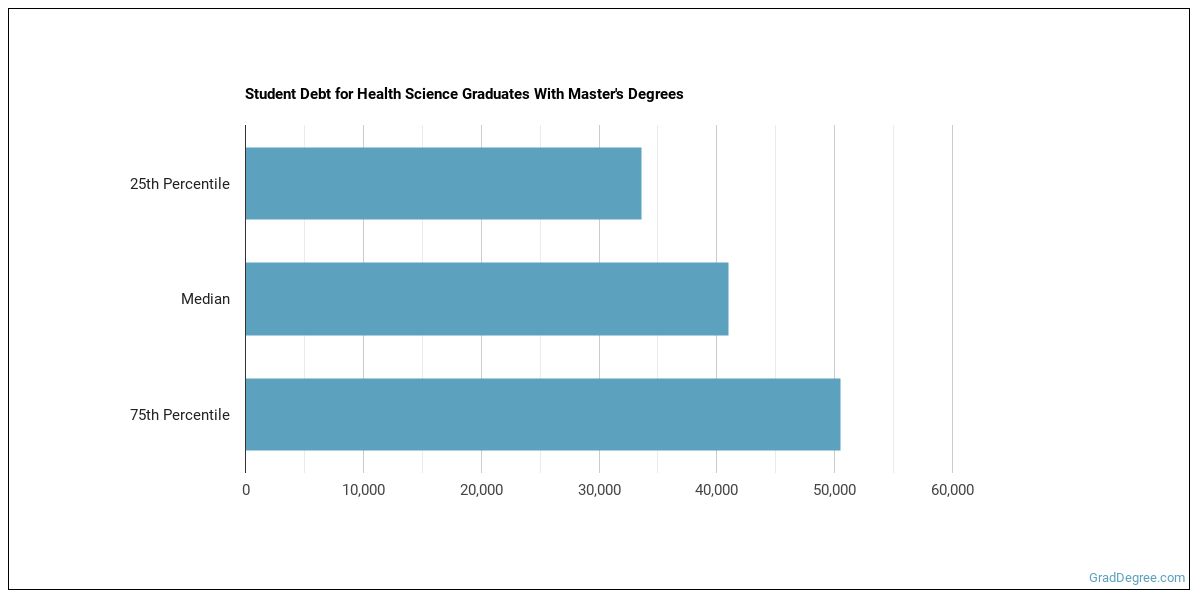
The median student debt for graduates holding a master's degree in health science is $34,570. The length of time it takes you to graduate and what college you attend can affect this number quite a bit. The chart below shows the range of accumulated debt loads. On the high side of the range, $43,500 is the debt load, and the debt load on the low side is $28,006.
Student Diversity
More women than men pursue their master's degree in health science. About 74.5% of graduates with this degree are female.
| Gender | Number of Grads |
|---|---|
| Men | 350 |
| Women | 1,024 |

The racial-ethnic distribution of health science master’s degree students is as follows:
| Race/Ethnicity | Number of Grads |
|---|---|
| Asian | 138 |
| Black or African American | 277 |
| Hispanic or Latino | 261 |
| White | 541 |
| International Students | 16 |
| Other Races/Ethnicities | 141 |

Most Popular Health Science Programs for Master’s Degrees
There are 67 colleges that offer a master’s degree in health science. Learn more about the most popular 20 below:

The most popular school in the United States for health science students seekinga master's degree is The University of Texas Rio Grande Valley. Each year, around 32,400 students seeking various degrees attend the university. The average in-state tuition for full-time undergraduates is $7,857 per year, while in-state graduate students, on average, pay $7,002 per year. During the most recent year for which we have data, 158 people received their master's degree in health science from UT Rio Grande Valley. Around 90% of these students were from an underrepresented racial-ethnic group, and 79% were women.

Meharry Medical College comes in at #2 on our list of the most popular colleges offering master's degrees in health science. Roughly 900 attend the school each year. During the most recent year for which we have data, 122 people received their master's degree in health science from Meharry Medical College. Around 99% of these students were from an underrepresented racial-ethnic group, and 70% were women.

The 3rd most popular school in the country for health science majors who are seeking their master's degree is University of Central Florida. Roughly 71,800 attend the school each year. The average in-state tuition for full-time undergraduates is $4,478 per year, while in-state graduate students, on average, pay $6,916 per year. During the most recent year for which we have data, 121 people received their master's degree in health science from UCF. About 65% of this group were women, and 58% were students from an underrepresented racial-ethnic group.
The 4th most popular school in the country for health science majors who are seeking their master's degree is American College of Healthcare Sciences. Roughly 800 attend the school each year. The average in-state tuition for full-time undergraduates is $8,928 per year, while in-state graduate students, on average, pay $10,404 per year. During the most recent year for which we have data, 67 people received their master's degree in health science from American College of Healthcare Sciences. Around 23% of these students were from an underrepresented racial-ethnic group, and 89% were women.
Touro University California comes in at #5 on our list of the most popular colleges offering master's degrees in health science. Each year, around 1,300 students seeking various degrees attend the university. During the most recent year for which we have data, 55 people received their master's degree in health science from TUC. Around 79% of these students were from an underrepresented racial-ethnic group, and 52% were women.
The 6th most popular school in the country for health science majors who are seeking their master's degree is Touro University Worldwide. Each year, around 2,100 students seeking various degrees attend the university. The average in-state tuition for full-time undergraduates is $14,440 per year, while in-state graduate students, on average, pay $9,000 per year. During the most recent year for which we have data, 52 people received their master's degree in health science from TUW. Of these students, 58% were women and 32% were members of underrepresented racial-ethnic groups.

University of California - Davis comes in at #7 on our list of the most popular colleges offering master's degrees in health science. Each year, around 39,000 students seeking various degrees attend the university. The average in-state tuition for full-time undergraduates is $11,564 per year, while in-state graduate students, on average, pay $11,700 per year. During the most recent year for which we have data, 47 people received their master's degree in health science from UC Davis. Of these students, 85% were women and 63% were members of underrepresented racial-ethnic groups.

University of the Cumberlands comes in at #8 on our list of the most popular colleges offering master's degrees in health science. Each year, around 19,100 students seeking various degrees attend the university. The average in-state tuition for full-time undergraduates is $9,875 per year, while in-state graduate students, on average, pay $4,282 per year. During the most recent year for which we have data, 45 people received their master's degree in health science from Cumberlands. Around 13% of these students were from an underrepresented racial-ethnic group, and 42% were women.
The 9th most popular school in the country for health science majors who are seeking their master's degree is Touro University Nevada. Each year, around 1,600 students seeking various degrees attend the university. The average in-state tuition for full-time undergraduates is $10,080 per year, while in-state graduate students, on average, pay $44,520 per year. During the most recent year for which we have data, 43 people received their master's degree in health science from Touro University Nevada. Of these students, 64% were women and 66% were members of underrepresented racial-ethnic groups.
University of St. Augustine for Health Sciences comes in at #10 on our list of the most popular colleges offering master's degrees in health science. Each year, around 4,700 students seeking various degrees attend the university. During the most recent year for which we have data, 34 people received their master's degree in health science from USAHS. About 86% of this group were women, and 57% were students from an underrepresented racial-ethnic group.
The 11th most popular school in the country for health science majors who are seeking their master's degree is Nova Southeastern University. Roughly 20,800 attend the school each year. The average in-state tuition for full-time undergraduates is $34,500 per year, while in-state graduate students, on average, pay $22,062 per year. During the most recent year for which we have data, 33 people received their master's degree in health science from NUS Florida. Of these students, 91% were women and 44% were members of underrepresented racial-ethnic groups.
The 12th most popular school in the country for health science majors who are seeking their master's degree is Towson University. Each year, around 21,900 students seeking various degrees attend the university. The average in-state tuition for full-time undergraduates is $7,238 per year, while in-state graduate students, on average, pay $8,676 per year. During the most recent year for which we have data, 32 people received their master's degree in health science from Towson. Around 67% of these students were from an underrepresented racial-ethnic group, and 96% were women.
The 12th most popular school in the country for health science majors who are seeking their master's degree is University of North Texas Health Science Center. Roughly 2,300 attend the school each year. The average in-state tuition for full-time undergraduates is $8,750 per year, while in-state graduate students, on average, pay $6,012 per year. During the most recent year for which we have data, 32 people received their master's degree in health science from UNT Health Science Center. About 80% of this group were women, and 53% were students from an underrepresented racial-ethnic group.

West Virginia University is the 12th most popular school in the nation for students seeking a master's degree in health science. Each year, around 26,200 students seeking various degrees attend the university. The average in-state tuition for full-time undergraduates is $9,360 per year, while in-state graduate students, on average, pay $10,602 per year. During the most recent year for which we have data, 32 people received their master's degree in health science from WVU. Of these students, 70% were women and 27% were members of underrepresented racial-ethnic groups.

Northwestern University is the 15th most popular school in the nation for students seeking a master's degree in health science. Roughly 22,600 attend the school each year. The average in-state tuition for full-time undergraduates is $62,391 per year, while in-state graduate students, on average, pay $51,869 per year. During the most recent year for which we have data, 31 people received their master's degree in health science from Northwestern. Of these students, 79% were women and 44% were members of underrepresented racial-ethnic groups.

Regis College is the 16th most popular school in the nation for students seeking a master's degree in health science. Each year, around 3,400 students seeking various degrees attend the university. The average in-state tuition for full-time undergraduates is $46,150 per year, while in-state graduate students, on average, pay $24,968 per year. During the most recent year for which we have data, 30 people received their master's degree in health science from Regis College. Around 19% of these students were from an underrepresented racial-ethnic group, and 87% were women.

The 16th most popular school in the country for health science majors who are seeking their master's degree is New Jersey City University. Each year, around 7,500 students seeking various degrees attend the university. The average in-state tuition for full-time undergraduates is $13,384 per year, while in-state graduate students, on average, pay $14,346 per year. During the most recent year for which we have data, 30 people received their master's degree in health science from NJCU. Around 67% of these students were from an underrepresented racial-ethnic group, and 79% were women.
California State University - Dominguez Hills is the 18th most popular school in the nation for students seeking a master's degree in health science. Each year, around 18,600 students seeking various degrees attend the university. The average in-state tuition for full-time undergraduates is $5,742 per year, while in-state graduate students, on average, pay $7,176 per year. During the most recent year for which we have data, 27 people received their master's degree in health science from CSUDH. About 47% of this group were women, and 47% were students from an underrepresented racial-ethnic group.

The 19th most popular school in the country for health science majors who are seeking their master's degree is Georgia College & State University. Each year, around 6,800 students seeking various degrees attend the university. The average in-state tuition for full-time undergraduates is $7,508 per year, while in-state graduate students, on average, pay $5,292 per year. During the most recent year for which we have data, 23 people received their master's degree in health science from Georgia College. Of these students, 73% were women and 33% were members of underrepresented racial-ethnic groups.

Merrimack College is the 20th most popular school in the nation for students seeking a master's degree in health science. Roughly 5,400 attend the school each year. The average in-state tuition for full-time undergraduates is $45,815 per year, while in-state graduate students, on average, pay $32,896 per year. During the most recent year for which we have data, 22 people received their master's degree in health science from Merrimack. About 71% of this group were women, and 29% were students from an underrepresented racial-ethnic group.
Health Science Focus Areas
| Major | Annual Degrees Awarded |
|---|---|
| 939 | |
| 435 |
Explore Major by State
Alabama
Arkansas
Connecticut
Florida
Idaho
Iowa
Louisiana
Massachusetts
Mississippi
Nebraska
New Jersey
North Carolina
Oklahoma
Rhode Island
Tennessee
Vermont
West Virginia
Related Majors
Below are some popular majors that are similar to health science that offer master’s degrees.
| Major | Annual Degrees Awarded |
|---|---|
| 51,725 | |
| 17,036 | |
| 15,994 | |
| 15,775 | |
| 13,307 |
References
*The racial-ethnic minority student count is calculated by taking the total number of students and subtracting white students, international students, and students whose race/ethnicity was unknown. This number is then divided by the total number of students at the school to obtain the percentage of racial-ethnic minorities.
- College Factual
- National Center for Education Statistics
- O*NET Online
- Bureau of Labor Statistics
- Image Credit: By Sandra M. Palumbo under License
More about our data sources and methodologies.
Featured Schools

GradDegree.com provides higher-education, college and university, degree, program, career, salary, and other helpful information to students, faculty, institutions, and other internet audiences. Presented information and data are subject to change. Inclusion on this website does not imply or represent a direct relationship with the company, school, or brand. Information, though believed correct at time of publication, may not be correct, and no warranty is provided. Contact the schools to verify any information before relying on it. Financial aid may be available for those who qualify. The displayed options may include sponsored or recommended results, not necessarily based on your preferences.
© GradDegree.com – All Rights Reserved.