Demography & Population Studies at Princeton University
Every demography & population studies school has its own distinct culture and strengths. We've pulled together some statistics and other details to help you see how the demography and population studies program at Princeton University stacks up to those at other schools.Princeton is located in Princeton, New Jersey and has a total student population of 7,853.
Want to know more about the career opportunities in this field? Check out the Careers in Demography & Population Studies section at the bottom of this page.
Princeton Demography & Population Studies Degrees Available
- Master’s Degree in Demography and Population Studies
Princeton Demography & Population Studies Rankings
There were 2 students who received their doctoral degrees in demography and population studies, making the school the #1 most popular school in the United States for this category of students.
Demography and Population Studies Student Demographics at Princeton
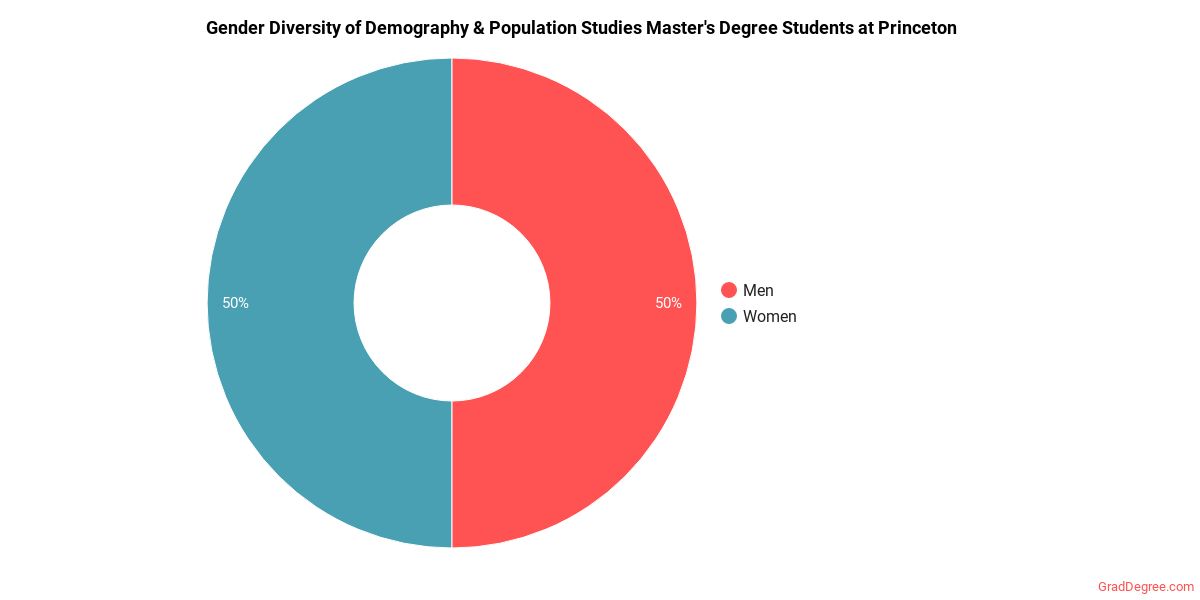
Take a look at the following statistics related to the make-up of the demography and population studies majors at Princeton University.
Princeton Demography & Population Studies Master’s Program
The following table and chart show the race/ethnicity for students who recently graduated from Princeton University with a master's in demography and population studies.

| Race/Ethnicity | Number of Students |
|---|---|
| Asian | 0 |
| Black or African American | 0 |
| Hispanic or Latino | 0 |
| White | 0 |
| International Students | 1 |
| Other Races/Ethnicities | 0 |
Related Majors
Careers That Demography and Population Studies Grads May Go Into
A degree in demography and population studies can lead to the following careers. Since job numbers and average salaries can vary by geographic location, we have only included the numbers for NJ, the home state for Princeton University.
| Occupation | Jobs in NJ | Average Salary in NJ |
|---|---|---|
| Managers | 18,370 | $138,820 |
| Social Scientists | 460 | $88,350 |
| Sociologists | 40 | $106,470 |
References
*The racial-ethnic minorities count is calculated by taking the total number of students and subtracting white students, international students, and students whose race/ethnicity was unknown. This number is then divided by the total number of students at the school to obtain the racial-ethnic minorities percentage.
- College Factual
- National Center for Education Statistics
- O*NET Online
- Image Credit: By Quantockgoblin under License
More about our data sources and methodologies.

GradDegree.com provides higher-education, college and university, degree, program, career, salary, and other helpful information to students, faculty, institutions, and other internet audiences. Presented information and data are subject to change. Inclusion on this website does not imply or represent a direct relationship with the company, school, or brand. Information, though believed correct at time of publication, may not be correct, and no warranty is provided. Contact the schools to verify any information before relying on it. Financial aid may be available for those who qualify. The displayed options may include sponsored or recommended results, not necessarily based on your preferences.
© GradDegree.com – All Rights Reserved.