Beaufort County Community College Graduate Programs
Located in Washington, North Carolina, Beaufort County Community College is a public institution. The rural area surrounding the school is great for students who prefer living in a country setting.
Featured schools near , edit
Where Is Beaufort County Community College?

Contact details for Beaufort County Community College are given below.
| Contact Details | |
|---|---|
| Address: | 5337 Us Highway 264 East, Washington, NC 27889 |
| Phone: | 252-946-6194 |
| Website: | www.beaufortccc.edu |
Online Learning at Beaufort County Community College
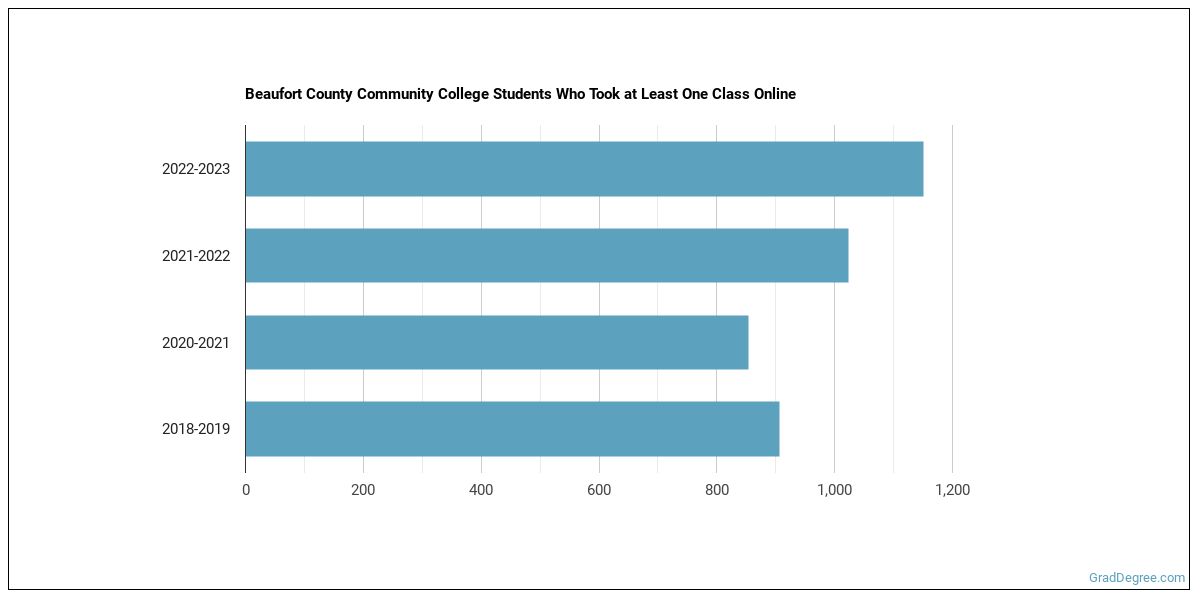
The following chart shows how the online learning population at Beaufort County Community College has changed over the last few years.
The following table shows the 1-year growth rate of Beaufort County Community College majors that offer at least one online course. This table only includes majors with positive growth.
| Major | 1-Year Growth Rate |
|---|---|
| Business, Management & Marketing | 53% |
| Foreign Languages & Linguistics | 50% |
| Health Professions | 30% |
Beaufort County Community College Graduate Concentrations
The table below shows the number of awards for each concentration.
References
*The racial-ethnic minorities count is calculated by taking the total number of students and subtracting white students, international students, and students whose race/ethnicity was unknown. This number is then divided by the total number of students at the school to obtain the racial-ethnic minorities percentage.
More about our data sources and methodologies.
Featured Schools
 Request Info
|
Southern New Hampshire University You have goals. Southern New Hampshire University can help you get there. Whether you need a bachelor's degree to get into a career or want a master's degree to move up in your current career, SNHU has an online program for you. Find your degree from over 200 online programs. Learn More > |

GradDegree.com provides higher-education, college and university, degree, program, career, salary, and other helpful information to students, faculty, institutions, and other internet audiences. Presented information and data are subject to change. Inclusion on this website does not imply or represent a direct relationship with the company, school, or brand. Information, though believed correct at time of publication, may not be correct, and no warranty is provided. Contact the schools to verify any information before relying on it. Financial aid may be available for those who qualify. The displayed options may include sponsored or recommended results, not necessarily based on your preferences.
© GradDegree.com – All Rights Reserved.