Personal Financial Advisors: Career Overview
Advise clients on financial plans using knowledge of tax and investment strategies, securities, insurance, pension plans, and real estate. Duties include assessing clients' assets, liabilities, cash flow, insurance coverage, tax status, and financial objectives. May also buy and sell financial assets for clients.
Featured schools near , edit
The Daily Work of Personal Financial Advisors Perform?
The day-to-day responsibilities of personal financial advisors cover:
- Interview clients to determine their current income, expenses, insurance coverage, tax status, financial objectives, risk tolerance, or other information needed to develop a financial plan.
- Analyze financial information obtained from clients to determine strategies for meeting clients' financial objectives.
- Answer clients' questions about the purposes and details of financial plans and strategies.
- Review clients' accounts and plans regularly to determine whether life changes, economic changes, environmental concerns, or financial performance indicate a need for plan reassessment.
- Manage client portfolios, keeping client plans up-to-date.
- Recommend to clients strategies in cash management, insurance coverage, investment planning, or other areas to help them achieve their financial goals.
- Recommend financial products, such as stocks, bonds, mutual funds, or insurance.
- Implement financial planning recommendations, or refer clients to someone who can assist them with plan implementation.
Skills and Knowledge
Effective personal financial advisors draw on a mix of skills and domain knowledge.
Most Important Skills
These are the skills most central to this role, rated on an importance scale of 0 to 5:
Top Knowledge Areas
Types of Personal Financial Advisors Jobs
People in this occupation may also be known by titles such as:
- Account Manager
- Asset Analyst
- Asset Manager
- Budget Counselor
- Certified Financial Planner (CFP)
- Chartered Financial Analyst (CFA)
- Client Advisor
- Credit Counselor
How Many Personal Financial Advisors Are There?
There are about 291,292 personal financial advisors working in the United States today. This occupation is expected to grow by +6.8% over the projection horizon.

Salary for Personal Financial Advisors
| Statistic | Value |
|---|---|
| Annual median | $91,777 |
| Hourly median | $44.12 |
| 10th percentile | $66,161 |
| 25th percentile | $78,969 |
| 75th percentile | $104,585 |
| 90th percentile | $117,393 |
Wages vary widely based on experience, location, and industry.

How Much Do Personal Financial Advisors Make in Different U.S. States?
| State | Annual median salary |
|---|---|
| New York | $167,970 |
| Idaho | $136,440 |
| California | $128,650 |
| Delaware | $128,170 |
| New Jersey | $123,690 |
| South Dakota | $123,380 |
| Maryland | $122,510 |
| Wisconsin | $115,680 |
| Washington | $112,020 |
| Connecticut | $107,030 |
| Illinois | $104,310 |
| Pennsylvania | $103,290 |
| Indiana | $101,670 |
| Massachusetts | $101,320 |
| Rhode Island | $100,880 |
| District of Columbia | $100,840 |
| Kansas | $100,810 |
| Virginia | $99,990 |
| North Dakota | $98,990 |
| South Carolina | $98,900 |
| Michigan | $98,830 |
| Georgia | $98,490 |
| Montana | $96,670 |
| Minnesota | $94,420 |
| Tennessee | $89,390 |
| Florida | $88,040 |
| Colorado | $85,580 |
| Arizona | $85,150 |
| Missouri | $84,040 |
| New Hampshire | $82,530 |
| Texas | $82,180 |
| Ohio | $82,100 |
| Nevada | $81,940 |
| Iowa | $81,790 |
| Vermont | $81,360 |
| Oregon | $80,190 |
| Alabama | $79,600 |
| Kentucky | $79,100 |
| Louisiana | $78,150 |
| West Virginia | $77,790 |
| New Mexico | $77,710 |
| Hawaii | $75,680 |
| Arkansas | $75,150 |
| Nebraska | $74,040 |
| Oklahoma | $73,020 |
| Utah | $67,210 |
| Mississippi | $65,150 |
| Puerto Rico | $47,330 |
Top-Paying U.S. Regions
Compensation for personal financial advisors shift depending on where you work. Top regions by median wage:
| Region | Median annual wage | Share of U.S. jobs | Location quotient |
|---|---|---|---|
| Middle Atlantic | $142,020 | 20.2% | 1.41 |
| Far Western US | $121,718 | 16.5% | 1.03 |
| Great Lakes | $98,555 | 13.7% | 0.97 |
| New England | $94,907 | 5.8% | 1.23 |
| Plains States | $90,393 | 7.2% | 1.07 |
| Rocky Mountains | $83,597 | 3.8% | 1.00 |
| Southwest | $82,424 | 9.8% | 0.85 |
| Southeast | $71,079 | 22.8% | 1.05 |
Highest-Paying Metro Areas for Personal Financial Advisors
| Metro area | State | Median annual wage | Employment |
|---|---|---|---|
| New York-Newark-Jersey City, NY-NJ | NY | $168,350 | 28,950 |
| Boise City, ID | ID | $167,940 | 530 |
| San Francisco-Oakland-Fremont, CA | CA | $157,510 | 8,830 |
| Pinehurst-Southern Pines, NC | NC | $155,950 | 60 |
| Barnstable Town, MA | MA | $135,000 | 110 |
| Pittsfield, MA | MA | $132,170 | 70 |
| Macon-Bibb County, GA | GA | $131,420 | 110 |
| Bridgeport-Stamford-Danbury, CT | CT | $130,290 | 2,040 |
Industry Breakdown
The bulk of personal financial advisors work in these industries:
| Industry | Employment | Median annual wage |
|---|---|---|
| Finance and Insurance | 252,560 | $103,200 |
| Professional, Scientific, and Technical Services | 8,940 | $85,000 |
| Management of Companies and Enterprises | 4,490 | $85,750 |
| Health Care and Social Assistance | 1,430 | $50,050 |
| Other Services (except Public Administration) | 300 | $96,260 |
| Educational Services | 220 | $46,070 |
| Retail Trade | 210 | $78,180 |
| Information | 130 | $81,600 |
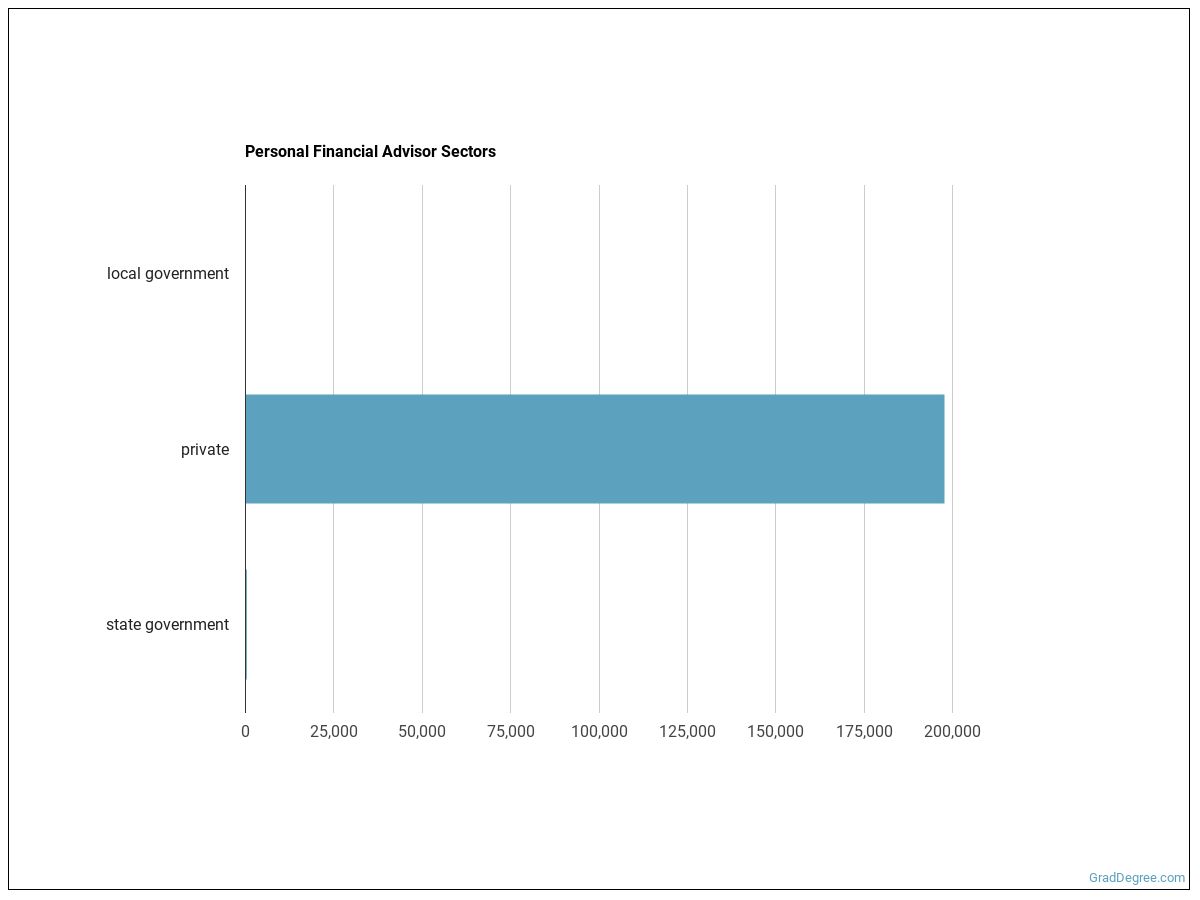
Personal Financial Advisors work in the following industries:

Tools and Technology
- Data base user interface and query software: Microsoft Access (hot technology)
- Spreadsheet software: Microsoft Excel (hot technology)
- Office suite software: Microsoft Office software (hot technology)
- Electronic mail software: Microsoft Outlook (hot technology)
- Presentation software: Microsoft PowerPoint (hot technology)
- Project management software: Microsoft Project (hot technology)
- Data base user interface and query software: Microsoft SQL Server (hot technology)
- Development environment software: Microsoft Visual Basic (hot technology)
- Word processing software: Microsoft Word (hot technology)
- Customer relationship management CRM software: Salesforce software (hot technology)
- Data base user interface and query software: Structured query language SQL (hot technology)
- Object or component oriented development software: Swift (hot technology)
The Day-to-Day Environment
The on-the-job environment of personal financial advisors reflects the following characteristics:
- Indoors, Environmentally Controlled
- Importance of Being Exact or Accurate
- Telephone Conversations
- Spend Time Sitting
How to Become Personal Financial Advisors
Entry-level personal financial advisors positions require a bachelor’s degree as the typical entry-level education. This career aligns with Considerable Preparation Needed (Job Zone 4), reflecting the level of preparation typically expected.
Related Careers
Similar Occupations
- Financial Managers (Primary-Long)
- Treasurers and Controllers (Supplemental)
- Investment Fund Managers (Primary-Short)
- Management Analysts (Supplemental)
- Accountants and Auditors (Primary-Long)
- Budget Analysts (Supplemental)
- Credit Analysts (Supplemental)
- Financial and Investment Analysts (Primary-Short)
Where to Study
Students preparing for personal financial advisors often complete programs in:
Business, Management, Marketing, and Related Support Services
2 programs across 1 majors
Family and Consumer Sciences/Human Sciences
1 programs across 1 majors
About the Data
This profile draws on the following authoritative sources:
- U.S. Bureau of Labor Statistics — Occupational Employment and Wage Statistics (OEWS) for employment and wage data by state and industry.
- BLS Employment Projections for total employment and growth forecasts.
- O*NET (Occupational Information Network) for skills, knowledge, tasks, work activities, work context, technology, and education-zone data.
SOC code: 13-2052.00 (Personal Financial Advisors).

GradDegree.com provides higher-education, college and university, degree, program, career, salary, and other helpful information to students, faculty, institutions, and other internet audiences. Presented information and data are subject to change. Inclusion on this website does not imply or represent a direct relationship with the company, school, or brand. Information, though believed correct at time of publication, may not be correct, and no warranty is provided. Contact the schools to verify any information before relying on it. Financial aid may be available for those who qualify. The displayed options may include sponsored or recommended results, not necessarily based on your preferences.
© GradDegree.com – All Rights Reserved.