Orthoptists: Career Overview
Diagnose and treat visual system disorders such as binocular vision and eye movement impairments.
Featured schools near , edit
What Tasks Do Orthoptists Perform?
Typical responsibilities of orthoptists span:
- Examine patients with problems related to ocular motility, binocular vision, amblyopia, or strabismus.
- Evaluate, diagnose, or treat disorders of the visual system with an emphasis on binocular vision or abnormal eye movements.
- Provide instructions to patients or family members concerning diagnoses or treatment plans.
- Perform diagnostic tests or measurements, such as motor testing, visual acuity testing, lensometry, retinoscopy, and color vision testing.
- Provide nonsurgical interventions, including corrective lenses, patches, drops, fusion exercises, or stereograms, to treat conditions such as strabismus, heterophoria, and convergence insufficiency.
- Develop nonsurgical treatment plans for patients with conditions such as strabismus, nystagmus, and other visual disorders.
- Interpret clinical or diagnostic test results.
- Develop or use special test and communication techniques to facilitate diagnosis and treatment of children or patients with disabilities.
What Orthoptists Need to Know
Effective orthoptists combine a mix of skills and domain knowledge.
Key Skills
These are the skills most central to this role, rated on an importance scale of 0 to 5:
Core Knowledge
Types of Orthoptists Jobs
Common job titles for this role include:
- Certified Orthoptist
- Clinical Orthoptist (CO)
- Orthoptist
Employment and Demand
There are about 2,797,992 orthoptists working in the United States today. Employment is projected to grow by +4.8% over the projection horizon.

How Much Do Orthoptists Make?
| Statistic | Value |
|---|---|
| Annual median | $135,811 |
| Hourly median | $65.29 |
| 10th percentile | $80,891 |
| 25th percentile | $108,351 |
| 75th percentile | $163,270 |
| 90th percentile | $190,730 |
Pay can vary substantially based on experience, location, and industry.

How Much Do Orthoptists Make in Different U.S. States?
| State | Annual median salary |
|---|---|
| Maryland | $160,560 |
| District of Columbia | $145,480 |
| Virginia | $128,940 |
| Montana | $124,550 |
| Georgia | $123,840 |
| California | $118,210 |
| New York | $117,190 |
| Hawaii | $116,800 |
| Utah | $113,730 |
| North Carolina | $112,590 |
| Missouri | $111,050 |
| Maine | $108,020 |
| Washington | $107,100 |
| Massachusetts | $104,770 |
| Wisconsin | $104,330 |
| Minnesota | $104,100 |
| Connecticut | $102,150 |
| Texas | $101,420 |
| New Jersey | $100,900 |
| Wyoming | $99,570 |
| Nevada | $98,740 |
| Ohio | $96,700 |
| New Mexico | $96,660 |
| Vermont | $94,450 |
| Alaska | $94,000 |
| Alabama | $92,750 |
| West Virginia | $92,750 |
| Kentucky | $89,860 |
| Nebraska | $89,380 |
| Illinois | $88,730 |
| Michigan | $88,000 |
| Rhode Island | $87,050 |
| Tennessee | $86,940 |
| North Dakota | $86,940 |
| Iowa | $86,830 |
| Colorado | $86,740 |
| Oregon | $85,840 |
| Louisiana | $84,640 |
| Kansas | $83,510 |
| Mississippi | $82,220 |
| Puerto Rico | $81,890 |
| Pennsylvania | $80,720 |
| Arizona | $79,990 |
| Indiana | $79,790 |
| Arkansas | $79,790 |
| South Dakota | $79,790 |
| New Hampshire | $79,730 |
| South Carolina | $66,950 |
Where Orthoptists Earn the Most
Pay for orthoptists shift depending on where you work. The following regions pay the most:
| Region | Median annual wage | Share of U.S. jobs | Location quotient |
|---|---|---|---|
| Middle Atlantic | $145,220 | 29.7% | 8.73 |
| Southeast | $110,915 | 21.9% | 1.94 |
| Far Western US | $108,986 | 12.1% | 0.83 |
| Rocky Mountains | $97,978 | 4.2% | 1.19 |
| Plains States | $97,753 | 4.9% | 0.69 |
| New England | $95,500 | 8.5% | 4.06 |
| Great Lakes | $91,446 | 11.3% | 0.74 |
| Southwest | $88,248 | 7.1% | 0.56 |
Where the Jobs Cluster
| Metro area | State | Median annual wage | Employment |
|---|---|---|---|
| Raleigh-Cary, NC | NC | $179,960 | 190 |
| Missoula, MT | MT | $177,610 | 30 |
| Washington-Arlington-Alexandria, DC-VA-MD-WV | DC | $162,610 | 6,330 |
| Hartford-West Hartford-East Hartford, CT | CT | $149,070 | |
| San Jose-Sunnyvale-Santa Clara, CA | CA | $137,240 | 220 |
| Dallas-Fort Worth-Arlington, TX | TX | $137,180 | 240 |
| New York-Newark-Jersey City, NY-NJ | NY | $132,790 | |
| Atlanta-Sandy Springs-Roswell, GA | GA | $131,120 | 2,530 |
Top Industries Employing Orthoptists
The largest employers of orthoptists are concentrated in the following sectors:
| Industry | Employment | Median annual wage |
|---|---|---|
| Educational Services | 1,010 | $78,630 |
| Finance and Insurance | 130 | $111,260 |
| Administrative and Support and Waste Management and Remediation Services | 100 | $67,000 |
| Management of Companies and Enterprises | 90 | $90,250 |
| Manufacturing | 40 | $105,930 |
| Wholesale Trade | 30 | $134,830 |
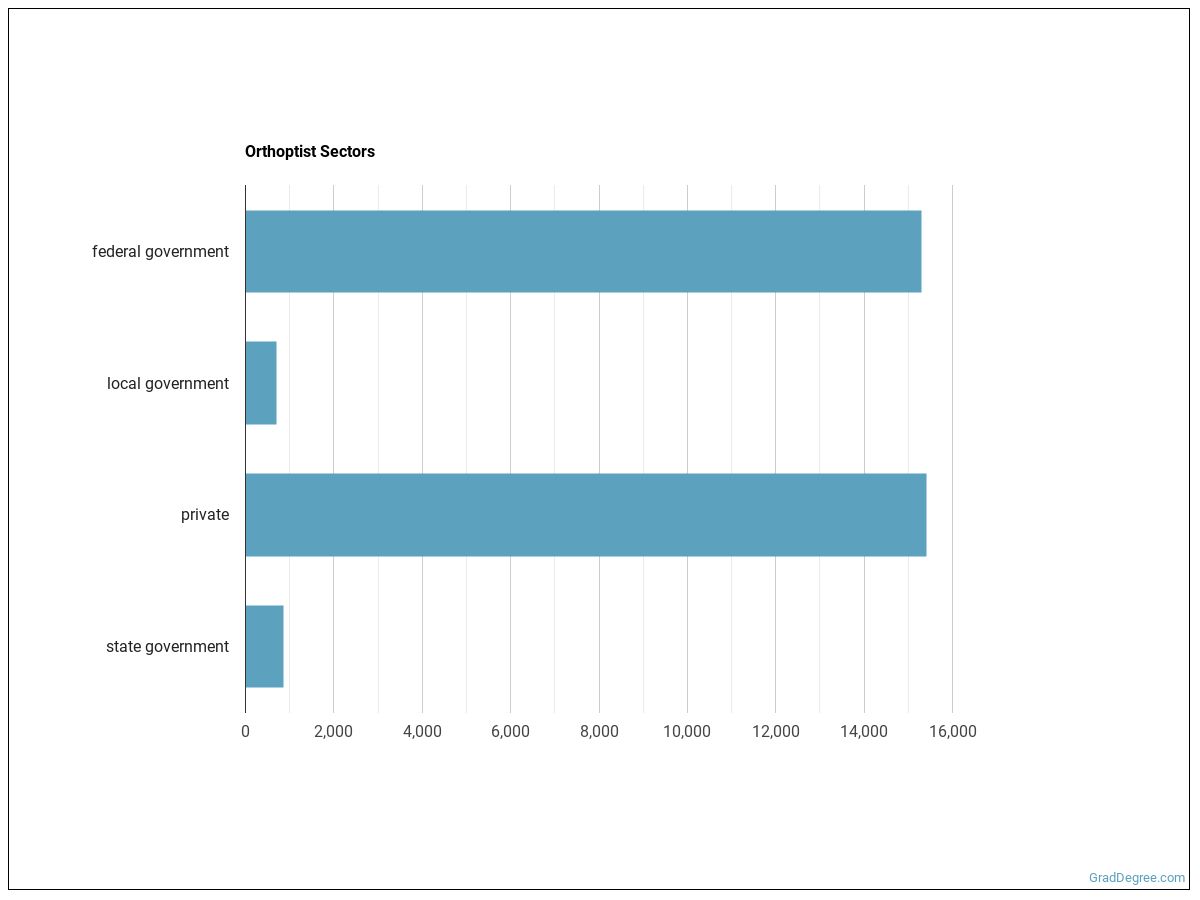
The table below shows some of the most common industries where those employed in this career field work.

Tech Stack
- Spreadsheet software: Microsoft Excel (hot technology)
- Presentation software: Microsoft PowerPoint (hot technology)
- Word processing software: Microsoft Word (hot technology)
The Day-to-Day Environment
Daily working conditions for orthoptists is shaped by the following characteristics:
- Face-to-Face Discussions with Individuals and Within Teams
- Indoors, Environmentally Controlled
- Contact With Others
- Work With or Contribute to a Work Group or Team
How to Become Orthoptists
Typical orthoptists positions require a master’s degree as the typical entry-level education. The role falls in Extensive Preparation Needed (Job Zone 5), signaling the level of preparation typically expected.
Similar Occupations
Similar Occupations
- Optometrists (Primary-Short)
- Physician Assistants (Primary-Long)
- Respiratory Therapists (Supplemental)
- Clinical Nurse Specialists (Supplemental)
- Nurse Practitioners (Supplemental)
- Anesthesiologists (Supplemental)
- Dermatologists (Primary-Long)
- Emergency Medicine Physicians (Primary-Short)
Top Programs to Study For This Career
Aspiring orthoptists typically earn programs in:
Health Professions and Related Programs
14 programs across 3 majors
References
Data on this page comes from the following authoritative sources:
- U.S. Bureau of Labor Statistics — Occupational Employment and Wage Statistics (OEWS) for employment and wage data by state and industry.
- BLS Employment Projections for total employment and growth forecasts.
- O*NET (Occupational Information Network) for skills, knowledge, tasks, work activities, work context, technology, and education-zone data.
SOC code: 29-1299.02 (Healthcare Diagnosing or Treating Practitioners, All Other).

GradDegree.com provides higher-education, college and university, degree, program, career, salary, and other helpful information to students, faculty, institutions, and other internet audiences. Presented information and data are subject to change. Inclusion on this website does not imply or represent a direct relationship with the company, school, or brand. Information, though believed correct at time of publication, may not be correct, and no warranty is provided. Contact the schools to verify any information before relying on it. Financial aid may be available for those who qualify. The displayed options may include sponsored or recommended results, not necessarily based on your preferences.
© GradDegree.com – All Rights Reserved.