Logistics Analysts: Career Overview
Analyze product delivery or supply chain processes to identify or recommend changes. May manage route activity including invoicing, electronic bills, and shipment tracing.
Featured schools near , edit
What Do Logistics Analysts Perform?
Typical responsibilities of logistics analysts span:
- Maintain databases of logistics information.
- Remotely monitor the flow of vehicles or inventory, using Web-based logistics information systems to track vehicles or containers.
- Communicate with or monitor service providers, such as ocean carriers, air freight forwarders, global consolidators, customs brokers, or trucking companies.
- Track product flow from origin to final delivery.
- Interpret data on logistics elements, such as availability, maintainability, reliability, supply chain management, strategic sourcing or distribution, supplier management, or transportation.
- Recommend improvements to existing or planned logistics processes.
- Apply analytic methods or tools to understand, predict, or control logistics operations or processes.
- Prepare reports on logistics performance measures.
Key Skills and Knowledge
Successful logistics analysts draw on a mix of skills and domain knowledge.
Top Skills
These are the skills most central to this role, rated on an importance scale of 0 to 5:
Top Knowledge Areas
Other Logistics Analysts Job Titles
Common job titles for this role include:
- Acquisition Analyst
- Acquisitions Logistics Analyst
- Demand Planner
- Demand Planning Analyst
- Global Logistics Analyst
- Inventory Analyst
- Inventory Control Analyst
- Logistics Analyst
Employment and Demand
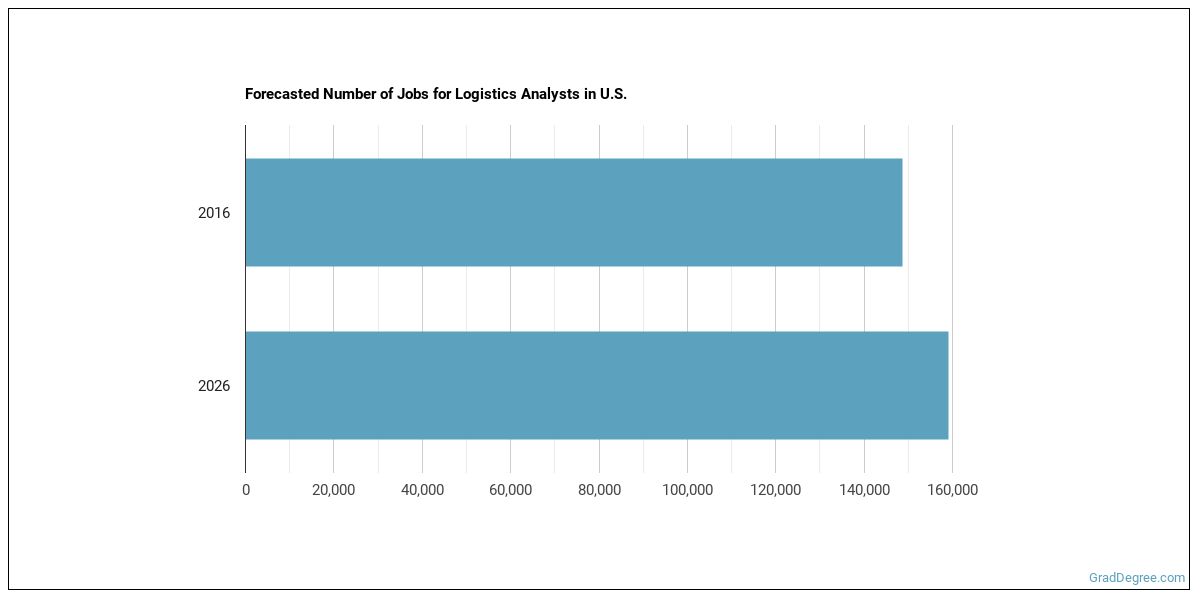
The U.S. employs around 678,038 logistics analysts working in the United States today. Employment is projected to grow by +1.5% over the projection horizon.
Logistics Analysts Pay
| Statistic | Value |
|---|---|
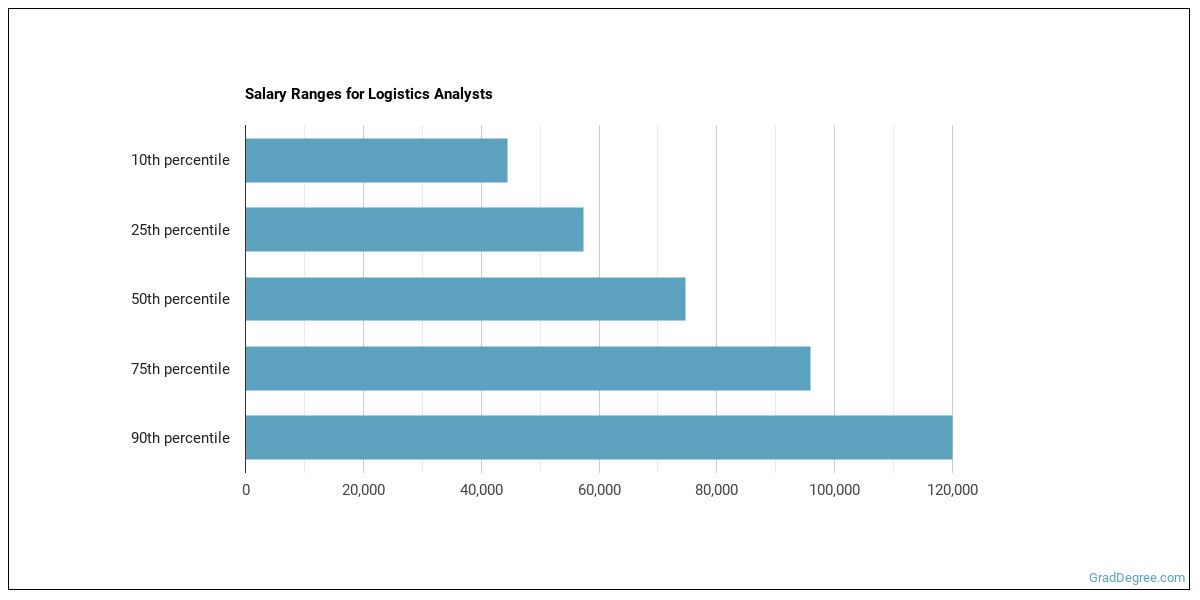
| Annual median | $73,737 |
| Hourly median | $35.45 |
| 10th percentile | $46,019 |
| 25th percentile | $59,878 |
| 75th percentile | $87,596 |
| 90th percentile | $101,454 |
Compensation varies based on experience, location, and industry.
How Much Do Logistics Analysts Make in Different U.S. States?
| State | Annual median salary |
|---|---|
| District of Columbia | $117,500 |
| Maryland | $102,000 |
| Washington | $101,830 |
| Virginia | $98,620 |
| Colorado | $96,860 |
| Hawaii | $96,700 |
| Massachusetts | $96,630 |
| Wyoming | $95,640 |
| Alabama | $95,030 |
| New Jersey | $93,710 |
| California | $90,950 |
| Oregon | $89,920 |
| Delaware | $89,840 |
| New Mexico | $87,960 |
| Maine | $86,700 |
| Oklahoma | $85,840 |
| Utah | $84,000 |
| Alaska | $83,390 |
| New York | $83,070 |
| Vermont | $82,980 |
| South Dakota | $82,220 |
| Minnesota | $82,020 |
| Arizona | $81,680 |
| Ohio | $81,400 |
| Connecticut | $81,390 |
| Michigan | $80,000 |
| Iowa | $79,730 |
| Indiana | $78,430 |
| Rhode Island | $77,830 |
| Pennsylvania | $77,740 |
| Montana | $77,380 |
| North Carolina | $77,030 |
| North Dakota | $77,020 |
| South Carolina | $76,920 |
| Wisconsin | $76,590 |
| Illinois | $76,550 |
| Nevada | $76,350 |
| Mississippi | $76,280 |
| Texas | $75,360 |
| Louisiana | $74,230 |
| Georgia | $73,880 |
| Arkansas | $73,710 |
| Missouri | $72,850 |
| New Hampshire | $72,810 |
| West Virginia | $70,690 |
| Idaho | $69,910 |
| Kentucky | $69,630 |
| Florida | $68,990 |
| Guam | $64,190 |
| Nebraska | $63,040 |
| Tennessee | $61,440 |
| Kansas | $51,430 |
| Puerto Rico | $45,650 |
Top-Paying U.S. Regions
Earnings for logistics analysts vary by region. These regions lead on median pay:
| Region | Median annual wage | Share of U.S. jobs | Location quotient |
|---|---|---|---|
| Far Western US | $92,001 | 16.4% | 1.00 |
| New England | $90,359 | 4.1% | 0.90 |
| Rocky Mountains | $89,193 | 4.1% | 1.18 |
| Middle Atlantic | $88,832 | 13.2% | 1.04 |
| Great Lakes | $78,840 | 16.7% | 1.23 |
| Southwest | $77,949 | 12.4% | 1.02 |
| Southeast | $77,754 | 26.9% | 1.19 |
| Plains States | $71,520 | 5.9% | 0.92 |
Where the Jobs Cluster
| Metro area | State | Median annual wage | Employment |
|---|---|---|---|
| Rapid City, SD | SD | $146,690 | 100 |
| Lexington Park, MD | MD | $128,940 | 1,370 |
| San Jose-Sunnyvale-Santa Clara, CA | CA | $121,260 | 2,570 |
| Huntsville, AL | AL | $110,550 | 3,050 |
| Pueblo, CO | CO | $107,860 | 80 |
| San Francisco-Oakland-Fremont, CA | CA | $107,420 | 4,950 |
| Washington-Arlington-Alexandria, DC-VA-MD-WV | DC | $106,660 | 6,760 |
| Oxnard-Thousand Oaks-Ventura, CA | CA | $104,480 | 1,000 |
Which Industries Hire Logistics Analysts
The bulk of logistics analysts are found across these industries:
| Industry | Employment | Median annual wage |
|---|---|---|
| Manufacturing | 54,140 | $83,720 |
| Professional, Scientific, and Technical Services | 35,170 | $82,330 |
| Transportation and Warehousing | 27,970 | $62,710 |
| Management of Companies and Enterprises | 25,500 | $84,960 |
| Wholesale Trade | 25,260 | $73,090 |
| Administrative and Support and Waste Management and Remediation Services | 9,070 | $63,510 |
| Health Care and Social Assistance | 4,680 | $64,310 |
| Information | 3,810 | $96,120 |

Below are examples of industries where logistics analysts work:

Tech Stack
- Data base user interface and query software: Amazon Redshift (hot technology)
- Analytical or scientific software: IBM SPSS Statistics (hot technology)
- Data base user interface and query software: Microsoft Access (hot technology)
- Spreadsheet software: Microsoft Excel (hot technology)
- Office suite software: Microsoft Office software (hot technology)
- Electronic mail software: Microsoft Outlook (hot technology)
- Business intelligence and data analysis software: Microsoft Power BI (hot technology)
- Presentation software: Microsoft PowerPoint (hot technology)
- Project management software: Microsoft Project (hot technology)
- Document management software: Microsoft SharePoint (hot technology)
- Data base user interface and query software: Microsoft SQL Server (hot technology)
- Process mapping and design software: Microsoft Visio (hot technology)
What the Workplace Is Like
The work environment for logistics analysts tends to involve the following characteristics:
- Telephone Conversations
- Indoors, Environmentally Controlled
- Contact With Others
- Spend Time Sitting
Education and Training
Typical logistics analysts positions require a bachelor’s degree as the typical entry-level education. This occupation sits in Considerable Preparation Needed (Job Zone 4), indicating the level of preparation typically expected.
Other Careers to Consider
Similar Occupations
- Industrial Production Managers (Primary-Long)
- Purchasing Managers (Primary-Short)
- Transportation, Storage, and Distribution Managers (Primary-Short)
- Supply Chain Managers (Primary-Short)
- Purchasing Agents, Except Wholesale, Retail, and Farm Products (Primary-Long)
- Logisticians (Primary-Short)
- Logistics Engineers (Primary-Short)
- Project Management Specialists (Supplemental)
Where to Study
Students preparing for logistics analysts commonly pursue programs in:
Business, Management, Marketing, and Related Support Services
3 programs across 1 majors
About the Data
Data on this page comes from the following authoritative sources:
- U.S. Bureau of Labor Statistics — Occupational Employment and Wage Statistics (OEWS) for employment and wage data by state and industry.
- BLS Employment Projections for total employment and growth forecasts.
- O*NET (Occupational Information Network) for skills, knowledge, tasks, work activities, work context, technology, and education-zone data.
SOC code: 13-1081.02 (Logisticians).

GradDegree.com provides higher-education, college and university, degree, program, career, salary, and other helpful information to students, faculty, institutions, and other internet audiences. Presented information and data are subject to change. Inclusion on this website does not imply or represent a direct relationship with the company, school, or brand. Information, though believed correct at time of publication, may not be correct, and no warranty is provided. Contact the schools to verify any information before relying on it. Financial aid may be available for those who qualify. The displayed options may include sponsored or recommended results, not necessarily based on your preferences.
© GradDegree.com – All Rights Reserved.