Interpreters and Translators: Career Profile
Interpret oral or sign language, or translate written text from one language into another.
Featured schools near , edit
The Daily Work of Interpreters and Translators Take On?
The day-to-day responsibilities of interpreters and translators span:
- Follow ethical codes that protect the confidentiality of information.
- Translate messages simultaneously or consecutively into specified languages, orally or by using hand signs, maintaining message content, context, and style as much as possible.
- Listen to speakers' statements to determine meanings and to prepare translations, using electronic listening systems as necessary.
- Compile terminology and information to be used in translations, including technical terms such as those for legal or medical material.
- Refer to reference materials, such as dictionaries, lexicons, encyclopedias, and computerized terminology banks, as needed to ensure translation accuracy.
- Check translations of technical terms and terminology to ensure that they are accurate and remain consistent throughout translation revisions.
- Identify and resolve conflicts related to the meanings of words, concepts, practices, or behaviors.
- Compile information on content and context of information to be translated and on intended audience.
Skills and Knowledge
Effective interpreters and translators combine a mix of skills and domain knowledge.
Most Important Skills
The abilities most important for this role, rated on an importance scale of 0 to 5:
Knowledge Areas
Related Job Titles
Common job titles for this role include:
- American Sign Language Interpreter (ASL Interpreter)
- Arabic Translator
- Bilingual Interpreter
- Bilingual Secretary
- Braille Transcriber
- Braille Translator
- Community Interpreter
- Contract Translator
Employment and Demand
There are roughly 378,567 interpreters and translators working in the United States today. Employment is projected to grow by +12.2% over the projection horizon.

How Much Do Interpreters and Translators Make?
| Statistic | Value |
|---|---|
| Annual median | $52,627 |
| Hourly median | $25.30 |
| 10th percentile | $35,589 |
| 25th percentile | $44,108 |
| 75th percentile | $61,145 |
| 90th percentile | $69,664 |
Compensation varies based on experience, location, and industry.
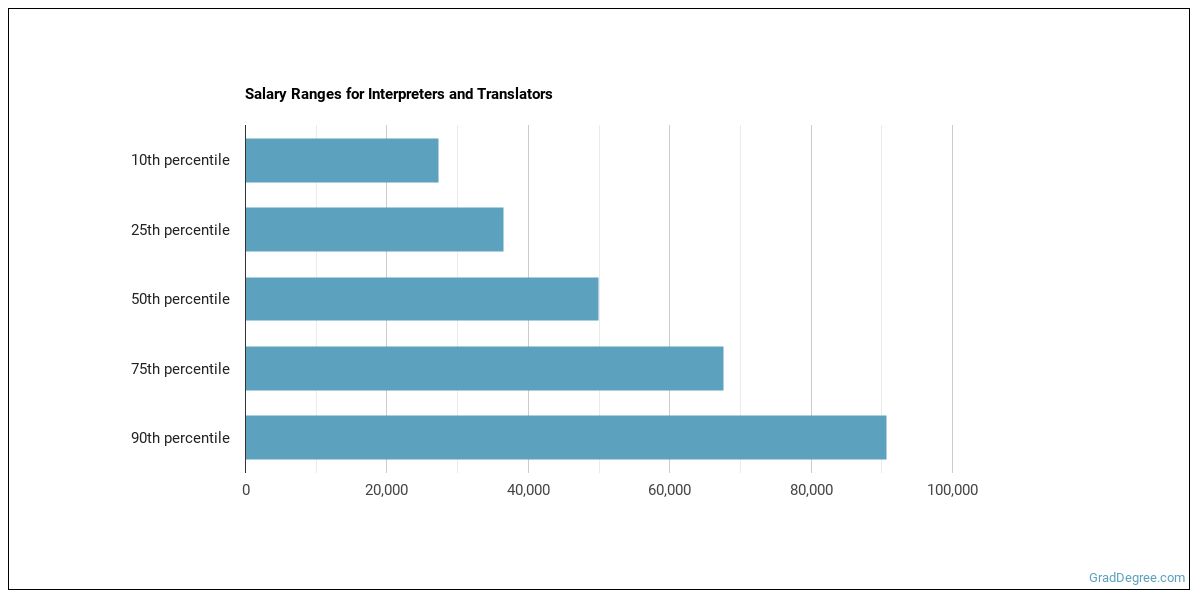
Interpreters and Translators Salary by State
| State | Annual median salary |
|---|---|
| New York | $84,650 |
| District of Columbia | $81,140 |
| Maryland | $78,350 |
| Virginia | $74,250 |
| California | $73,510 |
| Washington | $69,620 |
| Colorado | $66,590 |
| Utah | $65,990 |
| Massachusetts | $65,490 |
| West Virginia | $63,750 |
| Minnesota | $63,440 |
| Georgia | $61,610 |
| Oregon | $61,520 |
| Wisconsin | $61,000 |
| Vermont | $60,210 |
| Alaska | $59,280 |
| New Mexico | $59,010 |
| Ohio | $57,850 |
| Connecticut | $57,700 |
| Wyoming | $57,700 |
| Idaho | $56,340 |
| Maine | $54,890 |
| New Hampshire | $54,650 |
| Illinois | $53,870 |
| Kentucky | $53,820 |
| Michigan | $52,240 |
| Missouri | $52,080 |
| Arkansas | $50,880 |
| North Carolina | $50,830 |
| Iowa | $50,110 |
| Delaware | $49,790 |
| South Dakota | $49,630 |
| Tennessee | $49,270 |
| Nebraska | $49,070 |
| Pennsylvania | $49,010 |
| Arizona | $48,200 |
| Nevada | $47,890 |
| Kansas | $47,830 |
| Hawaii | $47,580 |
| Indiana | $47,470 |
| South Carolina | $47,060 |
| Puerto Rico | $46,700 |
| Oklahoma | $46,640 |
| Florida | $46,320 |
| Montana | $46,240 |
| North Dakota | $46,150 |
| Alabama | $45,760 |
| Texas | $45,610 |
| New Jersey | $45,120 |
| Louisiana | $45,060 |
| Mississippi | $43,410 |
Pay by U.S. Region
Earnings for interpreters and translators differ across the country. These regions lead on median pay:
| Region | Median annual wage | Share of U.S. jobs | Location quotient |
|---|---|---|---|
| Middle Atlantic | $71,670 | 12.9% | 0.92 |
| Far Western US | $70,000 | 19.0% | 1.18 |
| Rocky Mountains | $64,063 | 3.7% | 0.98 |
| New England | $59,432 | 5.5% | 1.54 |
| Great Lakes | $55,136 | 11.7% | 0.89 |
| Southeast | $55,124 | 24.6% | 1.22 |
| Plains States | $54,225 | 6.0% | 1.06 |
| Southwest | $46,972 | 16.2% | 1.35 |
Top Metro Areas
| Metro area | State | Median annual wage | Employment |
|---|---|---|---|
| Santa Cruz-Watsonville, CA | CA | $98,910 | 30 |
| San Jose-Sunnyvale-Santa Clara, CA | CA | $96,510 | 340 |
| Bridgeport-Stamford-Danbury, CT | CT | $85,660 | 40 |
| Washington-Arlington-Alexandria, DC-VA-MD-WV | DC | $85,590 | 2,000 |
| San Francisco-Oakland-Fremont, CA | CA | $84,670 | 840 |
| New York-Newark-Jersey City, NY-NJ | NY | $83,740 | 3,060 |
| Crestview-Fort Walton Beach-Destin, FL | FL | $81,600 | 60 |
| Salinas, CA | CA | $80,120 | 760 |
Industry Breakdown
Most interpreters and translators are concentrated in the following sectors:
| Industry | Employment | Median annual wage |
|---|---|---|
| Professional, Scientific, and Technical Services | 21,060 | $59,020 |
| Educational Services | 12,180 | $60,560 |
| Health Care and Social Assistance | 9,180 | $57,530 |
| Information | 2,350 | $80,120 |
| Administrative and Support and Waste Management and Remediation Services | 2,190 | $33,670 |
| Manufacturing | 600 | $49,600 |
| Finance and Insurance | 470 | $51,490 |
| Other Services (except Public Administration) | 420 | $49,900 |
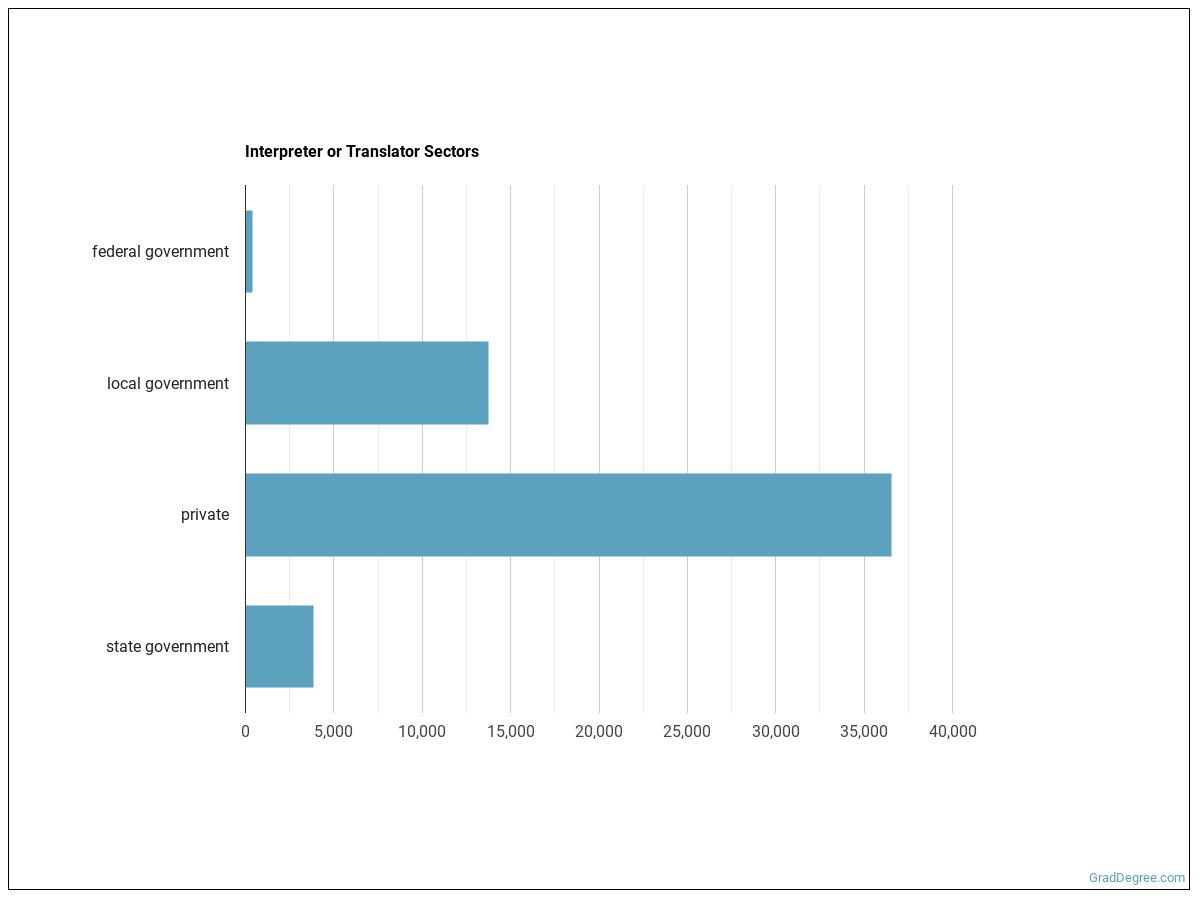
Interpreters and Translators work in the following industries:

Software Interpreters and Translators Use
- Web platform development software: Hypertext markup language HTML (hot technology)
- Data base user interface and query software: Microsoft Access (hot technology)
- Spreadsheet software: Microsoft Excel (hot technology)
- Office suite software: Microsoft Office software (hot technology)
- Electronic mail software: Microsoft Outlook (hot technology)
- Presentation software: Microsoft PowerPoint (hot technology)
- Word processing software: Microsoft Word (hot technology)
- Project management software: Productivity software (in demand)
The Day-to-Day Environment
The work environment for interpreters and translators reflects the following characteristics:
- Importance of Being Exact or Accurate
- Work With or Contribute to a Work Group or Team
- Face-to-Face Discussions with Individuals and Within Teams
- Contact With Others
How to Become Interpreters and Translators
Typical interpreters and translators positions require a bachelor’s degree as the typical entry-level education. This career aligns with Considerable Preparation Needed (Job Zone 4), reflecting the level of preparation typically expected.
Other Careers to Consider
Similar Occupations
- Social Science Research Assistants (Primary-Long)
- English Language and Literature Teachers, Postsecondary (Primary-Short)
- Foreign Language and Literature Teachers, Postsecondary (Primary-Short)
- Elementary School Teachers, Except Special Education (Supplemental)
- Middle School Teachers, Except Special and Career/Technical Education (Supplemental)
- Secondary School Teachers, Except Special and Career/Technical Education (Primary-Long)
- Special Education Teachers, Middle School (Supplemental)
- Adult Basic Education, Adult Secondary Education, and English as a Second Language Instructors (Primary-Short)
Degree Programs
Future interpreters and translators often complete programs in:
Foreign Languages, Literatures, and Linguistics
82 programs across 18 majors
- Romance Languages
- Linguistics & Literature
- American Sign Language
- East Asian Languages
- Classical Languages & Literature
- Germanic Languages
- Other Foreign Language & Literature
- Middle Eastern Semitic Languages
- Slavic, Baltic & Albanian Languages
- Native American Languages
- Southeast Asian & Pacific Languages
- South Asian Languages
- Celtic Language & Literature
- African Languages
- Iranian & Persian Languages
- Greek Language & Literature
- Turkic & Central Asian Languages
- Armenian Languages, Literatures, and Linguistics
Multi/Interdisciplinary Studies
2 programs across 2 majors
Area, Ethnic, Cultural, Gender, and Group Studies
1 programs across 1 majors
Education
1 programs across 1 majors
Legal Professions and Studies
1 programs across 1 majors
About the Data
This profile draws on the following authoritative sources:
- U.S. Bureau of Labor Statistics — Occupational Employment and Wage Statistics (OEWS) for employment and wage data by state and industry.
- BLS Employment Projections for total employment and growth forecasts.
- O*NET (Occupational Information Network) for skills, knowledge, tasks, work activities, work context, technology, and education-zone data.
SOC code: 27-3091.00 (Interpreters and Translators).

GradDegree.com provides higher-education, college and university, degree, program, career, salary, and other helpful information to students, faculty, institutions, and other internet audiences. Presented information and data are subject to change. Inclusion on this website does not imply or represent a direct relationship with the company, school, or brand. Information, though believed correct at time of publication, may not be correct, and no warranty is provided. Contact the schools to verify any information before relying on it. Financial aid may be available for those who qualify. The displayed options may include sponsored or recommended results, not necessarily based on your preferences.
© GradDegree.com – All Rights Reserved.