Database Architects: Job Description
Design strategies for enterprise databases, data warehouse systems, and multidimensional networks. Set standards for database operations, programming, query processes, and security. Model, design, and construct large relational databases or data warehouses. Create and optimize data models for warehouse infrastructure and workflow. Integrate new systems with existing warehouse structure and refine system performance and functionality.
Featured schools near , edit
What Do Database Architects Take On?
The core tasks performed by database architects include:
- Develop and document database architectures.
- Collaborate with system architects, software architects, design analysts, and others to understand business or industry requirements.
- Develop database architectural strategies at the modeling, design and implementation stages to address business or industry requirements.
- Design databases to support business applications, ensuring system scalability, security, performance, and reliability.
- Develop data models for applications, metadata tables, views or related database structures.
- Design database applications, such as interfaces, data transfer mechanisms, global temporary tables, data partitions, and function-based indexes to enable efficient access of the generic database structure.
- Develop methods for integrating different products so they work properly together, such as customizing commercial databases to fit specific needs.
- Create and enforce database development standards.
What Database Architects Need to Know
Top database architects combine a mix of skills and domain knowledge.
Most Important Skills
These are the skills most central to this role, rated on an importance scale of 0 to 5:
Knowledge Areas
Types of Database Architects Jobs
People in this occupation may also be known by titles such as:
- ADP Planner (Automatic Data Processing Planner)
- Big Data Architect
- Big Data Engineer
- Cloud Architect
- Cloud Infrastructure Architect
- Computer Architect
- DBMS Specialist (Database Management System Specialist)
- Data Analyst
Employment and Demand
There are about 322,075 database architects working in the United States today. Demand is forecast to grow by +4.3% over the projection horizon.

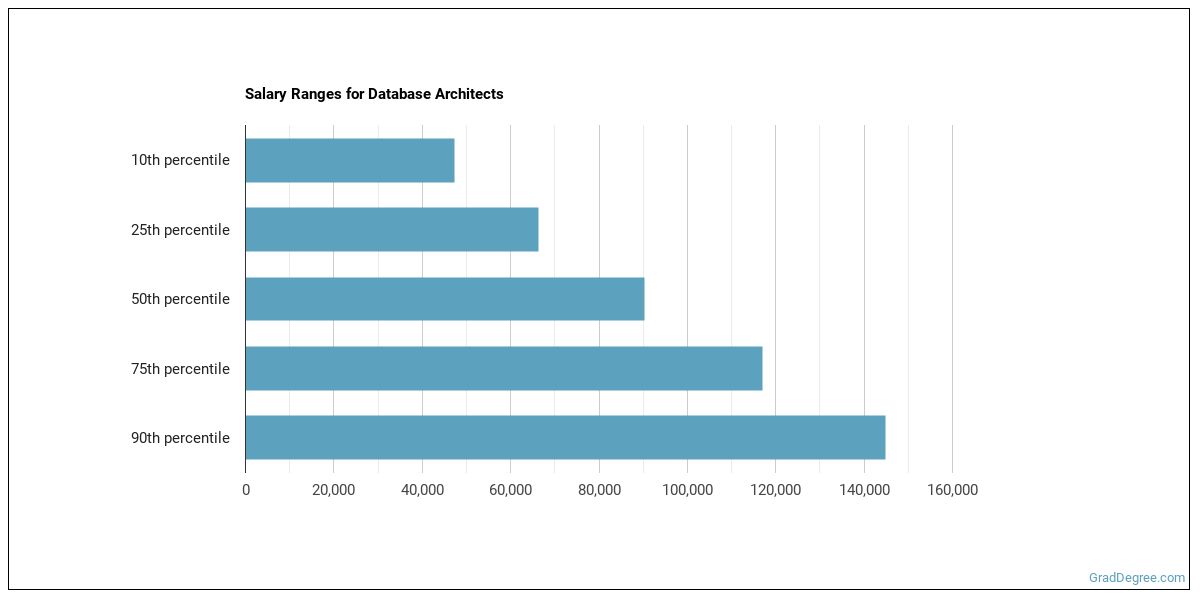
Database Architects Pay
| Statistic | Value |
|---|---|
| Annual median | $148,480 |
| Hourly median | $71.38 |
| 10th percentile | $101,810 |
| 25th percentile | $125,145 |
| 75th percentile | $171,815 |
| 90th percentile | $195,150 |
Compensation varies based on experience, location, and industry.
Pay by State
| State | Annual median salary |
|---|---|
| Massachusetts | $161,160 |
| California | $159,130 |
| West Virginia | $157,590 |
| District of Columbia | $157,080 |
| Maine | $154,790 |
| Colorado | $151,460 |
| Hawaii | $149,500 |
| Connecticut | $147,400 |
| Delaware | $146,430 |
| Washington | $144,050 |
| New Jersey | $143,900 |
| Maryland | $140,710 |
| Oregon | $139,660 |
| Wisconsin | $138,930 |
| Rhode Island | $136,510 |
| Georgia | $135,280 |
| Illinois | $134,490 |
| Texas | $133,800 |
| Indiana | $133,150 |
| Florida | $133,040 |
| Oklahoma | $132,360 |
| Nebraska | $132,320 |
| Iowa | $131,370 |
| Arizona | $130,620 |
| North Carolina | $130,560 |
| Minnesota | $130,420 |
| Nevada | $130,360 |
| Ohio | $129,840 |
| Kansas | $129,060 |
| Pennsylvania | $129,040 |
| South Carolina | $128,440 |
| Tennessee | $128,440 |
| New York | $128,270 |
| Utah | $127,770 |
| South Dakota | $127,460 |
| Idaho | $126,030 |
| Michigan | $120,810 |
| New Mexico | $120,120 |
| Montana | $116,250 |
| North Dakota | $116,120 |
| Alaska | $113,800 |
| Alabama | $111,330 |
| Missouri | $108,820 |
| Kentucky | $102,560 |
| Arkansas | $101,000 |
| Mississippi | $90,980 |
| Puerto Rico | $77,300 |
| Wyoming | $62,760 |
Top-Paying U.S. Regions
Earnings for database architects shift depending on where you work. Top regions by median wage:
| Region | Median annual wage | Share of U.S. jobs | Location quotient |
|---|---|---|---|
| New England | $152,924 | 4.5% | 1.05 |
| Far Western US | $152,477 | 14.7% | 1.00 |
| Rocky Mountains | $140,212 | 5.1% | 1.46 |
| Middle Atlantic | $135,609 | 17.3% | 1.23 |
| Southwest | $133,111 | 12.5% | 1.03 |
| Great Lakes | $130,162 | 9.1% | 0.70 |
| Plains States | $120,764 | 6.4% | 1.13 |
| Southeast | $79,735 | 30.2% | 2.31 |
Top Metro Areas
| Metro area | State | Median annual wage | Employment |
|---|---|---|---|
| Washington-Arlington-Alexandria, DC-VA-MD-WV | DC | $188,120 | 6,710 |
| Boulder, CO | CO | $174,880 | 260 |
| Bridgeport-Stamford-Danbury, CT | CT | $170,960 | 130 |
| San Francisco-Oakland-Fremont, CA | CA | $170,700 | 1,540 |
| Tulsa, OK | OK | $167,760 | 230 |
| San Jose-Sunnyvale-Santa Clara, CA | CA | $166,210 | 930 |
| Waterbury-Shelton, CT | CT | $163,730 | 60 |
| Boston-Cambridge-Newton, MA-NH | MA | $162,310 | 1,430 |
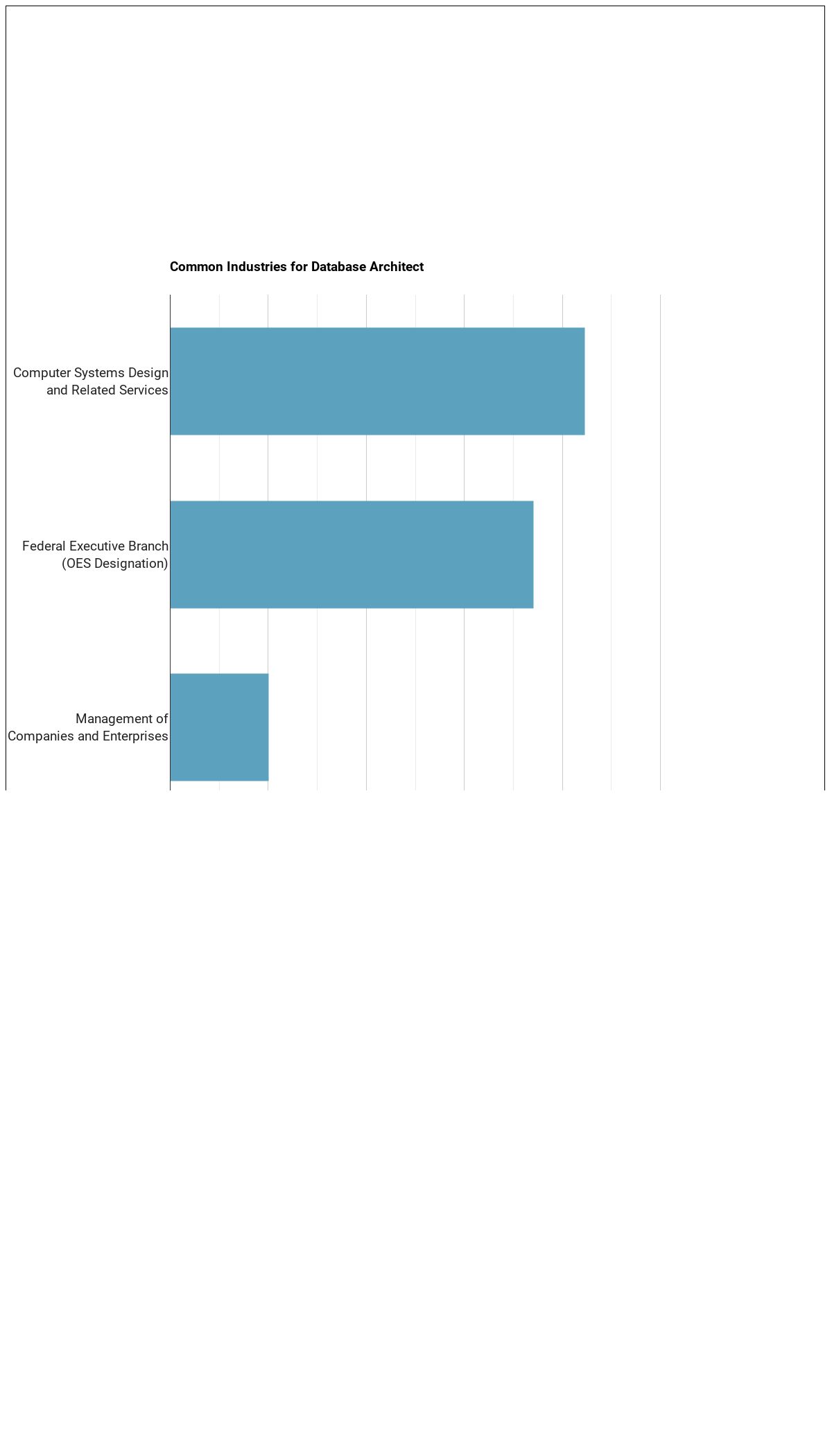
Top Industries Employing Database Architects
The largest employers of database architects work in these industries:
| Industry | Employment | Median annual wage |
|---|---|---|
| Professional, Scientific, and Technical Services | 24,380 | $138,610 |
| Finance and Insurance | 9,580 | $138,540 |
| Information | 8,510 | $151,460 |
| Management of Companies and Enterprises | 6,710 | $134,330 |
| Administrative and Support and Waste Management and Remediation Services | 3,560 | $136,890 |
| Wholesale Trade | 2,900 | $129,820 |
| Health Care and Social Assistance | 2,020 | $123,410 |
| Manufacturing | 1,900 | $129,460 |

Below are examples of industries where database architects work:
Tech Stack
- Document management software: Adobe Acrobat (hot technology)
- Web platform development software: AJAX (hot technology)
- Data base management system software: Amazon DynamoDB (hot technology)
- Data base user interface and query software: Amazon Elastic Compute Cloud EC2 (hot technology)
- Data base user interface and query software: Amazon Redshift (hot technology)
- Cloud-based management software: Amazon Web Services AWS CloudFormation (hot technology)
- Data base user interface and query software: Amazon Web Services AWS software (hot technology)
- Expert system software: Ansible software (hot technology)
- Procedure management software: Apache Airflow (hot technology)
- Data base management system software: Apache Cassandra (hot technology)
- Data base management system software: Apache Hadoop (hot technology)
- Data base user interface and query software: Apache Hive (hot technology)
What the Workplace Is Like
Daily working conditions for database architects tends to involve the following characteristics:
- Spend Time Sitting
- Telephone Conversations
- Face-to-Face Discussions with Individuals and Within Teams
- Work With or Contribute to a Work Group or Team
Getting Started in This Career
Entry-level database architects positions require a bachelor’s degree as the typical entry-level education. This career aligns with Considerable Preparation Needed (Job Zone 4), indicating the level of preparation typically expected.
Related Careers
Similar Occupations
- Computer and Information Systems Managers (Supplemental)
- Project Management Specialists (Supplemental)
- Computer Systems Analysts (Primary-Short)
- Computer Network Architects (Primary-Long)
- Database Administrators (Primary-Short)
- Data Warehousing Specialists (Primary-Short)
- Network and Computer Systems Administrators (Primary-Long)
- Computer Programmers (Supplemental)
Degree Programs
Aspiring database architects often complete programs in:
Computer and Information Sciences and Support Services
8 programs across 7 majors
- Computer Information Systems
- Computer Science
- Information Technology
- Information Science
- Computer Software Applications
- Computer Systems Analysis
- Computer Systems Networking
Engineering
3 programs across 2 majors
Multi/Interdisciplinary Studies
2 programs across 1 majors
Business, Management, Marketing, and Related Support Services
1 programs across 1 majors
About the Data
This profile draws on the following authoritative sources:
- U.S. Bureau of Labor Statistics — Occupational Employment and Wage Statistics (OEWS) for employment and wage data by state and industry.
- BLS Employment Projections for total employment and growth forecasts.
- O*NET (Occupational Information Network) for skills, knowledge, tasks, work activities, work context, technology, and education-zone data.
SOC code: 15-1243.00 (Database Architects).

GradDegree.com provides higher-education, college and university, degree, program, career, salary, and other helpful information to students, faculty, institutions, and other internet audiences. Presented information and data are subject to change. Inclusion on this website does not imply or represent a direct relationship with the company, school, or brand. Information, though believed correct at time of publication, may not be correct, and no warranty is provided. Contact the schools to verify any information before relying on it. Financial aid may be available for those who qualify. The displayed options may include sponsored or recommended results, not necessarily based on your preferences.
© GradDegree.com – All Rights Reserved.