Coroners: Career Profile
Direct activities such as autopsies, pathological and toxicological analyses, and inquests relating to the investigation of deaths occurring within a legal jurisdiction to determine cause of death or to fix responsibility for accidental, violent, or unexplained deaths.
Featured schools near , edit
What Tasks Do Coroners Take On?
The day-to-day responsibilities of coroners span:
- Complete death certificates, including the assignment of cause and manner of death.
- Perform medicolegal examinations and autopsies, conducting preliminary examinations of the body to identify victims, locate signs of trauma, and identify factors that would indicate time of death.
- Interview persons present at death scenes to obtain information useful in determining the manner of death.
- Observe and record the positions and conditions of bodies and related evidence.
- Provide information concerning the circumstances of death to relatives of the deceased.
- Remove or supervise removal of bodies from death scenes, using the proper equipment and supplies, and arrange for transportation to morgues.
- Inquire into the cause, manner, and circumstances of human deaths and establish the identities of deceased persons.
- Observe, record, and preserve any objects or personal property related to deaths, including objects such as medication containers and suicide notes.
What Coroners Need to Know
Top coroners combine a mix of skills and domain knowledge.
Top Skills
The competencies that matter most in this role, rated on an importance scale of 0 to 5:
Top Knowledge Areas
Types of Coroners Jobs
People in this occupation may also be known by titles such as:
- Autopsy Facilities Manager
- Certified Medical Examiner
- Coroner
- Coroner Investigator
- County Coroner
- Death Investigator
- Examiner
- Forensic Medical Examiner
How Many Coroners Are There?
There are roughly 525,763 coroners working in the United States today. Demand is forecast to decline by -4.9% over the projection horizon.

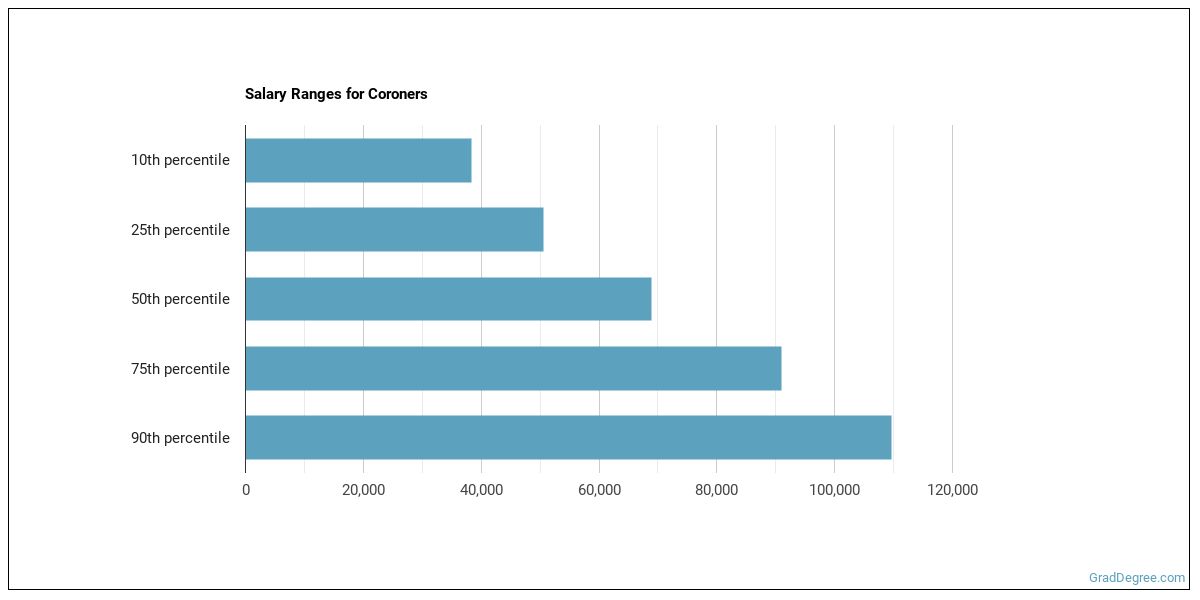
How Much Do Coroners Make?
| Statistic | Value |
|---|---|
| Annual median | $110,095 |
| Hourly median | $52.93 |
| 10th percentile | $77,825 |
| 25th percentile | $93,960 |
| 75th percentile | $126,231 |
| 90th percentile | $142,366 |
Wages vary widely based on experience, location, and industry.
Pay by State
| State | Annual median salary |
|---|---|
| District of Columbia | $103,010 |
| New Jersey | $93,520 |
| Massachusetts | $92,890 |
| California | $92,350 |
| Alaska | $88,730 |
| Vermont | $88,550 |
| Delaware | $88,450 |
| Maryland | $87,580 |
| Connecticut | $87,210 |
| Maine | $86,940 |
| New York | $86,880 |
| Washington | $86,200 |
| Minnesota | $85,220 |
| Oregon | $84,210 |
| Rhode Island | $83,200 |
| New Hampshire | $82,530 |
| Virginia | $80,990 |
| Hawaii | $80,930 |
| Colorado | $80,590 |
| Wyoming | $80,150 |
| Illinois | $79,350 |
| Nevada | $78,940 |
| North Dakota | $78,450 |
| South Carolina | $76,200 |
| Wisconsin | $75,780 |
| Michigan | $75,300 |
| Ohio | $75,030 |
| North Carolina | $74,810 |
| Pennsylvania | $73,840 |
| Iowa | $73,530 |
| Arizona | $73,070 |
| Texas | $72,050 |
| Indiana | $71,980 |
| South Dakota | $71,700 |
| Florida | $70,460 |
| Alabama | $70,190 |
| New Mexico | $67,640 |
| Kentucky | $67,490 |
| Kansas | $66,980 |
| Nebraska | $65,960 |
| Idaho | $65,350 |
| Virgin Islands | $65,210 |
| Mississippi | $65,150 |
| Missouri | $64,960 |
| Utah | $64,730 |
| West Virginia | $64,040 |
| Georgia | $63,990 |
| Tennessee | $63,760 |
| Louisiana | $63,730 |
| Arkansas | $63,560 |
| Montana | $63,330 |
| Oklahoma | $61,730 |
| Puerto Rico | $46,570 |
Where Coroners Earn the Most
Pay for coroners differ across the country. Top regions by median wage:
| Region | Median annual wage | Share of U.S. jobs | Location quotient |
|---|---|---|---|
| Far Western US | $89,808 | 17.1% | 1.04 |
| New England | $89,791 | 5.3% | 1.22 |
| Middle Atlantic | $86,241 | 16.5% | 1.15 |
| Great Lakes | $75,873 | 10.3% | 0.74 |
| Rocky Mountains | $73,182 | 3.7% | 0.94 |
| Plains States | $72,241 | 6.5% | 0.97 |
| Southwest | $71,347 | 14.4% | 1.17 |
| Southeast | $70,480 | 24.9% | 1.08 |
Top Metro Areas
| Metro area | State | Median annual wage | Employment |
|---|---|---|---|
| San Jose-Sunnyvale-Santa Clara, CA | CA | $118,490 | 2,690 |
| Lexington Park, MD | MD | $105,610 | 150 |
| Brunswick-St. Simons, GA | GA | $104,330 | 640 |
| San Francisco-Oakland-Fremont, CA | CA | $104,000 | 7,350 |
| Washington-Arlington-Alexandria, DC-VA-MD-WV | DC | $102,500 | 14,110 |
| Bellingham, WA | WA | $101,870 | 650 |
| El Centro, CA | CA | $101,110 | 850 |
| San Diego-Chula Vista-Carlsbad, CA | CA | $98,190 | 6,000 |
Industry Breakdown
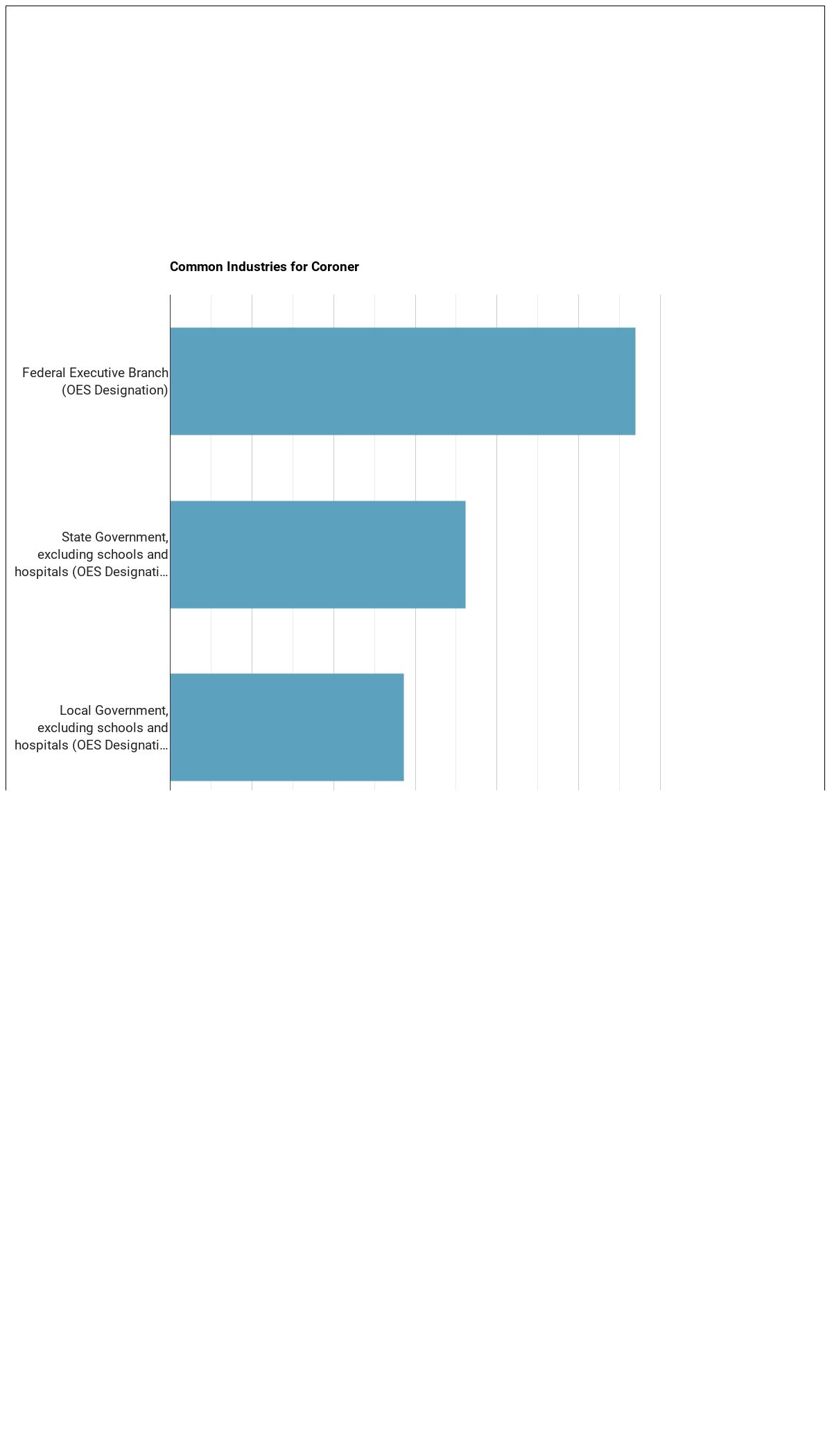
The bulk of coroners work in these industries:
| Industry | Employment | Median annual wage |
|---|---|---|
| Finance and Insurance | 46,410 | $79,920 |
| Professional, Scientific, and Technical Services | 38,020 | $90,990 |
| Health Care and Social Assistance | 32,070 | $68,590 |
| Management of Companies and Enterprises | 22,870 | $89,740 |
| Administrative and Support and Waste Management and Remediation Services | 18,660 | $60,800 |
| Manufacturing | 18,630 | $85,040 |
| Educational Services | 15,080 | $74,650 |
| Transportation and Warehousing | 14,480 | $63,430 |

Coroners work in the following industries:
Software Coroners Use
- File versioning software: Git (hot technology)
- Operating system software: Google Android (hot technology)
- Operating system software: Linux (hot technology)
- Spreadsheet software: Microsoft Excel (hot technology)
- Office suite software: Microsoft Office software (hot technology)
- Presentation software: Microsoft PowerPoint (hot technology)
- Data base reporting software: Microsoft SQL Server Reporting Services SSRS (hot technology)
- Word processing software: Microsoft Word (hot technology)
- Data base user interface and query software: Structured query language SQL (hot technology)
- Data base user interface and query software: Transact-SQL (hot technology)
- Operating system software: UNIX (hot technology)
- Video conferencing software: Zoom (hot technology)
The Day-to-Day Environment
The work environment for coroners reflects the following characteristics:
- Telephone Conversations
- Deal With External Customers or the Public in General
- Face-to-Face Discussions with Individuals and Within Teams
- Contact With Others
Education and Training
Entry-level coroners positions require a bachelor’s degree as the typical entry-level education. The role falls in Medium Preparation Needed (Job Zone 3), reflecting the level of preparation typically expected.
Similar Occupations
Similar Occupations
- Medical and Health Services Managers (Supplemental)
- Clinical Research Coordinators (Supplemental)
- Claims Adjusters, Examiners, and Investigators (Supplemental)
- Compliance Officers (Primary-Long)
- Regulatory Affairs Specialists (Primary-Long)
- Forensic Science Technicians (Primary-Short)
- Administrative Law Judges, Adjudicators, and Hearing Officers (Supplemental)
- Clinical Nurse Specialists (Supplemental)
Degree Programs
Students preparing for coroners commonly pursue programs in:
Natural Resources and Conservation
4 programs across 2 majors
Health Professions and Related Programs
3 programs across 2 majors
Business, Management, Marketing, and Related Support Services
2 programs across 1 majors
Multi/Interdisciplinary Studies
1 programs across 1 majors
Homeland Security, Law Enforcement, Firefighting and Related Protective Services
1 programs across 1 majors
References
Statistics shown above are sourced from the following authoritative sources:
- U.S. Bureau of Labor Statistics — Occupational Employment and Wage Statistics (OEWS) for employment and wage data by state and industry.
- BLS Employment Projections for total employment and growth forecasts.
- O*NET (Occupational Information Network) for skills, knowledge, tasks, work activities, work context, technology, and education-zone data.
SOC code: 13-1041.06 (Compliance Officers).

GradDegree.com provides higher-education, college and university, degree, program, career, salary, and other helpful information to students, faculty, institutions, and other internet audiences. Presented information and data are subject to change. Inclusion on this website does not imply or represent a direct relationship with the company, school, or brand. Information, though believed correct at time of publication, may not be correct, and no warranty is provided. Contact the schools to verify any information before relying on it. Financial aid may be available for those who qualify. The displayed options may include sponsored or recommended results, not necessarily based on your preferences.
© GradDegree.com – All Rights Reserved.