Life As a Conservation Scientist
Conservation Scientist Definition Manage, improve, and protect natural resources to maximize their use without damaging the environment. May conduct soil surveys and develop plans to eliminate soil erosion or to protect rangelands. May instruct farmers, agricultural production managers, or ranchers in best ways to use crop rotation, contour plowing, or terracing to conserve soil and water; in the number and kind of livestock and forage plants best suited to particular ranges; and in range and farm improvements, such as fencing and reservoirs for stock watering.
Featured schools near , edit
Types of Conservation Scientist Jobs
- Soil Conservationist
- Water Conservationist
- Land Reclamation Specialist
- Conservation Science Officer
- Grassland Conservationist
What Kind of Conservation Scientist Job Opportunities Are There?
There were about 22,300 jobs for Conservation Scientist in 2016 (in the United States). New jobs are being produced at a rate of 6.3% which is above the national average. The Bureau of Labor Statistics predicts 1,400 new jobs for Conservation Scientist by 2026. Due to new job openings and attrition, there will be an average of 2,000 job openings in this field each year.

The states with the most job growth for Conservation Scientist are Colorado, New Hampshire, and Utah. Watch out if you plan on working in Rhode Island, New Mexico, or Maryland. These states have the worst job growth for this type of profession.
Do Conservation Scientists Make A Lot Of Money?
The average yearly salary of a Conservation Scientist ranges between $34,020 and $98,450.
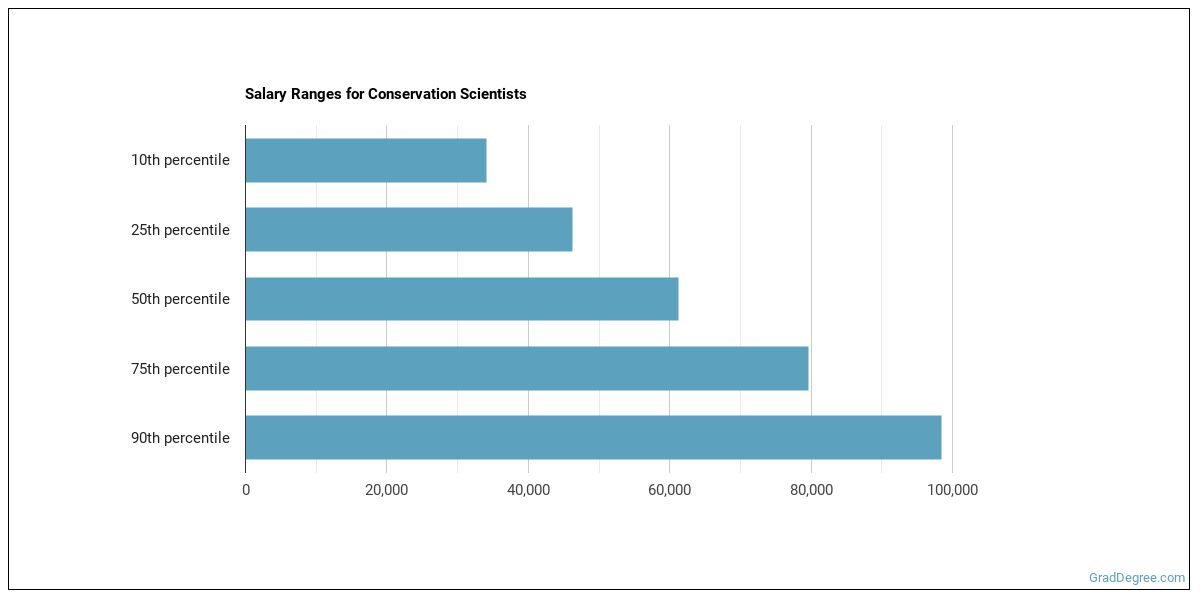
Conservation Scientists who work in Connecticut, Alaska, or New Jersey, make the highest salaries.
How much do Conservation Scientists make in each U.S. state?
| State | Annual Mean Salary |
|---|---|
| Alabama | $59,310 |
| Alaska | $93,390 |
| Arizona | $71,190 |
| Arkansas | $70,630 |
| California | $75,980 |
| Colorado | $71,170 |
| Connecticut | $87,710 |
| Delaware | $55,300 |
| Florida | $40,620 |
| Georgia | $69,390 |
| Hawaii | $68,360 |
| Idaho | $66,510 |
| Illinois | $63,840 |
| Indiana | $63,320 |
| Iowa | $56,820 |
| Kansas | $68,910 |
| Kentucky | $67,440 |
| Louisiana | $61,430 |
| Maine | $61,970 |
| Maryland | $79,070 |
| Massachusetts | $72,200 |
| Michigan | $63,460 |
| Minnesota | $72,650 |
| Mississippi | $54,870 |
| Missouri | $57,580 |
| Montana | $64,480 |
| Nebraska | $65,300 |
| Nevada | $61,670 |
| New Hampshire | $72,160 |
| New Jersey | $85,360 |
| New Mexico | $68,710 |
| North Carolina | $61,780 |
| North Dakota | $64,900 |
| Ohio | $55,550 |
| Oklahoma | $64,330 |
| Oregon | $76,790 |
| Pennsylvania | $55,200 |
| South Carolina | $56,220 |
| South Dakota | $62,390 |
| Tennessee | $68,440 |
| Texas | $57,990 |
| Utah | $63,720 |
| Vermont | $55,150 |
| Virginia | $75,370 |
| Washington | $65,120 |
| West Virginia | $50,210 |
| Wisconsin | $65,610 |
| Wyoming | $71,180 |
Where Conservation Scientists Are Employed

The table below shows some of the most common industries where those employed in this career field work.

References:
More about our data sources and methodologies.
Featured Schools

GradDegree.com provides higher-education, college and university, degree, program, career, salary, and other helpful information to students, faculty, institutions, and other internet audiences. Presented information and data are subject to change. Inclusion on this website does not imply or represent a direct relationship with the company, school, or brand. Information, though believed correct at time of publication, may not be correct, and no warranty is provided. Contact the schools to verify any information before relying on it. Financial aid may be available for those who qualify. The displayed options may include sponsored or recommended results, not necessarily based on your preferences.
© GradDegree.com – All Rights Reserved.