Camera Operators, Television, Video, and Film: Career Overview
Operate television, video, or film camera to record images or scenes for television, video, or film productions.
Featured schools near , edit
What Do Camera Operators, Television, Video, and Film Do?
The core tasks performed by camera operators, television, video, and film cover:
- Compose and frame each shot, applying the technical aspects of light, lenses, film, filters, and camera settings to achieve the effects sought by directors.
- Operate television or motion picture cameras to record scenes for television broadcasts, advertising, or motion pictures.
- Adjust positions and controls of cameras, printers, and related equipment to change focus, exposure, and lighting.
- Confer with directors, sound and lighting technicians, electricians, and other crew members to discuss assignments and determine filming sequences, desired effects, camera movements, and lighting requirements.
- Operate zoom lenses, changing images according to specifications and rehearsal instructions.
- Observe sets or locations for potential problems and to determine filming and lighting requirements.
- Set up and perform live shots for broadcast.
- Use cameras in any of several different camera mounts, such as stationary, track-mounted, or crane-mounted.
Key Skills and Knowledge
Successful camera operators, television, video, and film combine a mix of skills and domain knowledge.
Most Important Skills
The competencies most central to this role, rated on an importance scale of 0 to 5:
Core Knowledge
Types of Camera Operators, Television, Video, and Film Jobs
People in this occupation may also be known by titles such as:
- Advanced Air Mobility Operator (AAM Operator)
- Advanced Air Mobility Pilot (AAM Pilot)
- Advanced Air Mobility Technician (AAM Technician)
- Aerial Camera Operator
- Animation Camera Operator
- Camera Engineer
- Camera Operator
- Camera Person
Job Outlook
There are roughly 96,991 camera operators, television, video, and film working in the United States today. Employment is projected to grow by +10.9% over the projection horizon.

Salary for Camera Operators, Television, Video, and Film
| Statistic | Value |
|---|---|
| Annual median | $92,043 |
| Hourly median | $44.25 |
| 10th percentile | $66,468 |
| 25th percentile | $79,256 |
| 75th percentile | $104,831 |
| 90th percentile | $117,618 |
Compensation varies based on experience, location, and industry.

Camera Operators, Television, Video, and Film Salary by State
| State | Annual median salary |
|---|---|
| California | $101,610 |
| District of Columbia | $100,940 |
| Oregon | $93,610 |
| New York | $89,960 |
| New Jersey | $85,560 |
| Illinois | $82,950 |
| Arizona | $74,830 |
| Colorado | $74,350 |
| Virginia | $71,760 |
| Maryland | $67,580 |
| Ohio | $67,040 |
| Texas | $64,430 |
| Connecticut | $63,950 |
| North Carolina | $62,130 |
| Georgia | $61,500 |
| Nevada | $61,020 |
| Florida | $61,020 |
| South Carolina | $59,690 |
| Louisiana | $58,860 |
| Missouri | $58,080 |
| Idaho | $56,880 |
| Indiana | $56,800 |
| Tennessee | $56,540 |
| Mississippi | $55,810 |
| Minnesota | $55,120 |
| Michigan | $54,910 |
| Washington | $53,340 |
| Pennsylvania | $50,830 |
| Massachusetts | $49,670 |
| New Hampshire | $48,780 |
| North Dakota | $48,460 |
| Vermont | $48,350 |
| Iowa | $48,110 |
| Wisconsin | $47,080 |
| Utah | $46,600 |
| Kansas | $46,490 |
| New Mexico | $46,420 |
| Kentucky | $46,110 |
| Oklahoma | $45,310 |
| Alabama | $45,180 |
| Hawaii | $41,850 |
| West Virginia | $39,470 |
| South Dakota | $39,470 |
| Nebraska | $39,070 |
| Maine | $36,040 |
| Montana | $35,080 |
| Arkansas | $32,510 |
Where Camera Operators, Television, Video, and Film Earn the Most
Earnings for camera operators, television, video, and film shift depending on where you work. These regions lead on median pay:
| Region | Median annual wage | Share of U.S. jobs | Location quotient |
|---|---|---|---|
| Far Western US | $93,571 | 28.7% | 1.79 |
| Middle Atlantic | $84,038 | 21.4% | 1.91 |
| Great Lakes | $67,114 | 9.6% | 0.71 |
| Southwest | $62,383 | 11.7% | 1.20 |
| Southeast | $59,936 | 17.0% | 0.85 |
| Rocky Mountains | $55,058 | 3.5% | 1.21 |
| New England | $51,977 | 3.8% | 0.95 |
| Plains States | $50,830 | 4.1% | 0.59 |
Top Metro Areas
| Metro area | State | Median annual wage | Employment |
|---|---|---|---|
| Portland-Vancouver-Hillsboro, OR-WA | OR | $103,930 | 200 |
| Los Angeles-Long Beach-Anaheim, CA | CA | $102,310 | 3,790 |
| Tucson, AZ | AZ | $99,510 | 100 |
| Rochester, NY | NY | $98,020 | 60 |
| Jacksonville, FL | FL | $96,950 | 100 |
| New York-Newark-Jersey City, NY-NJ | NY | $89,960 | 3,170 |
| San Francisco-Oakland-Fremont, CA | CA | $88,760 | 760 |
| Bridgeport-Stamford-Danbury, CT | CT | $85,610 | 80 |
Which Industries Hire Camera Operators, Television, Video, and Film
Most camera operators, television, video, and film are found across these industries:
| Industry | Employment | Median annual wage |
|---|---|---|
| Information | 14,840 | $78,650 |
| Professional, Scientific, and Technical Services | 3,580 | $64,090 |
| Administrative and Support and Waste Management and Remediation Services | 1,560 | $102,550 |
| Arts, Entertainment, and Recreation | 1,250 | $54,810 |
| Educational Services | 780 | $50,300 |
| Other Services (except Public Administration) | 340 | $60,000 |
| Retail Trade | 260 | $54,130 |
| Management of Companies and Enterprises | 250 | $65,980 |
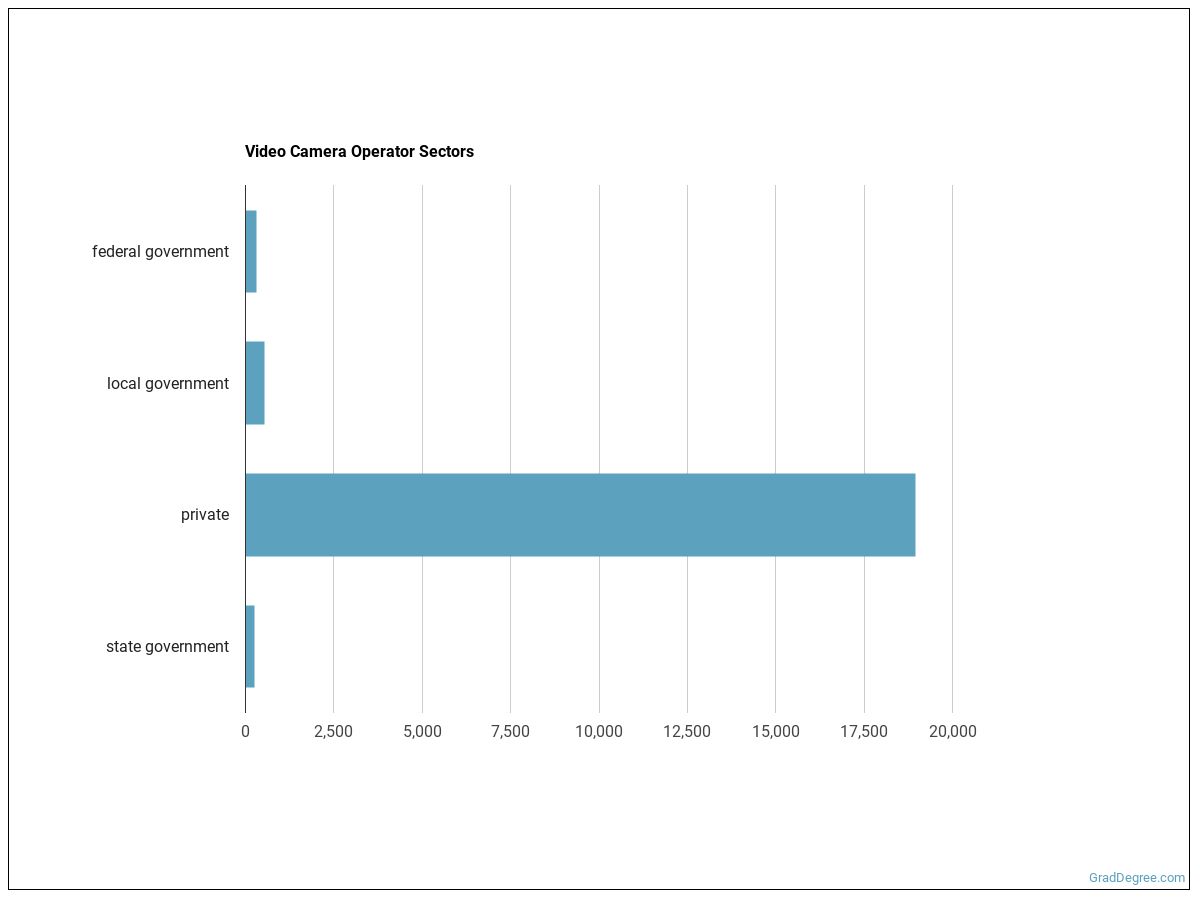
Below are examples of industries where camera operators, television, video, and film work:

Software Camera Operators, Television, Video, and Film Use
- Document management software: Adobe Acrobat (hot technology)
- Video creation and editing software: Adobe After Effects (hot technology)
- Graphics or photo imaging software: Adobe Creative Cloud software (hot technology)
- Graphics or photo imaging software: Adobe Illustrator (hot technology)
- Desktop publishing software: Adobe InDesign (hot technology)
- Graphics or photo imaging software: Adobe Photoshop (hot technology)
- Spreadsheet software: Microsoft Excel (hot technology)
- Office suite software: Microsoft Office software (hot technology)
- Presentation software: Microsoft PowerPoint (hot technology)
- Word processing software: Microsoft Word (hot technology)
- Video creation and editing software: TikTok (hot technology)
- Video creation and editing software: Adobe Premiere Pro (in demand)
The Day-to-Day Environment
Daily working conditions for camera operators, television, video, and film reflects the following characteristics:
- Face-to-Face Discussions with Individuals and Within Teams
- Contact With Others
- Work With or Contribute to a Work Group or Team
- Spend Time Using Your Hands to Handle, Control, or Feel Objects, Tools, or Controls
How to Become Camera Operators, Television, Video, and Film
Entry-level camera operators, television, video, and film positions require an associate’s degree as the typical entry-level education. This career aligns with Medium Preparation Needed (Job Zone 3), indicating the level of preparation typically expected.
Other Careers to Consider
Similar Occupations
- Aerospace Engineering and Operations Technologists and Technicians (Supplemental)
- Electrical and Electronic Engineering Technologists and Technicians (Supplemental)
- Electro-Mechanical and Mechatronics Technologists and Technicians (Primary-Short)
- Robotics Technicians (Supplemental)
- Calibration Technologists and Technicians (Supplemental)
- Remote Sensing Scientists and Technologists (Supplemental)
- Remote Sensing Technicians (Supplemental)
- Producers and Directors (Supplemental)
Where to Study
Future camera operators, television, video, and film typically earn programs in:
Visual and Performing Arts
2 programs across 1 majors
Communications Technologies/Technicians and Support Services
2 programs across 1 majors
About the Data
Data on this page comes from the following authoritative sources:
- U.S. Bureau of Labor Statistics — Occupational Employment and Wage Statistics (OEWS) for employment and wage data by state and industry.
- BLS Employment Projections for total employment and growth forecasts.
- O*NET (Occupational Information Network) for skills, knowledge, tasks, work activities, work context, technology, and education-zone data.
SOC code: 27-4031.00 (Camera Operators, Television, Video, and Film).

GradDegree.com provides higher-education, college and university, degree, program, career, salary, and other helpful information to students, faculty, institutions, and other internet audiences. Presented information and data are subject to change. Inclusion on this website does not imply or represent a direct relationship with the company, school, or brand. Information, though believed correct at time of publication, may not be correct, and no warranty is provided. Contact the schools to verify any information before relying on it. Financial aid may be available for those who qualify. The displayed options may include sponsored or recommended results, not necessarily based on your preferences.
© GradDegree.com – All Rights Reserved.