What You Need to Know About Aerospace Engineering or Operations Technician
Occupation Description Operate, install, calibrate, and maintain integrated computer/communications systems, consoles, simulators, and other data acquisition, test, and measurement instruments and equipment, which are used to launch, track, position, and evaluate air and space vehicles. May record and interpret test data.
What Do Aerospace Engineering and Operations Technicians Do On a Daily Basis?
- Exchange cooling system components in various vehicles.
- Operate and calibrate computer systems and devices to comply with test requirements and to perform data acquisition and analysis.
- Test aircraft systems under simulated operational conditions, performing systems readiness tests and pre- and post-operational checkouts, to establish design or fabrication parameters.
- Fabricate and install parts and systems to be tested in test equipment, using hand tools, power tools, and test instruments.
- Finish vehicle instrumentation and deinstrumentation.
- Construct and maintain test facilities for aircraft parts and systems, according to specifications.
Featured schools near , edit
Aerospace Engineering or Operations Technician Needed Skills
When polled, Aerospace Engineering and Operations Technicians say the following skills are most frequently used in their jobs:
Critical Thinking: Using logic and reasoning to identify the strengths and weaknesses of alternative solutions, conclusions or approaches to problems.
Quality Control Analysis: Conducting tests and inspections of products, services, or processes to evaluate quality or performance.
Operation Monitoring: Watching gauges, dials, or other indicators to make sure a machine is working properly.
Reading Comprehension: Understanding written sentences and paragraphs in work related documents.
Speaking: Talking to others to convey information effectively.
Active Listening: Giving full attention to what other people are saying, taking time to understand the points being made, asking questions as appropriate, and not interrupting at inappropriate times.
Other Aerospace Engineering or Operations Technician Job Titles
- Field Service Engineer
- Communication Technician
- Flight Technician
- Avionics Technician
- Test Specialist
What Kind of Aerospace Engineering or Operations Technician Job Opportunities Are There?
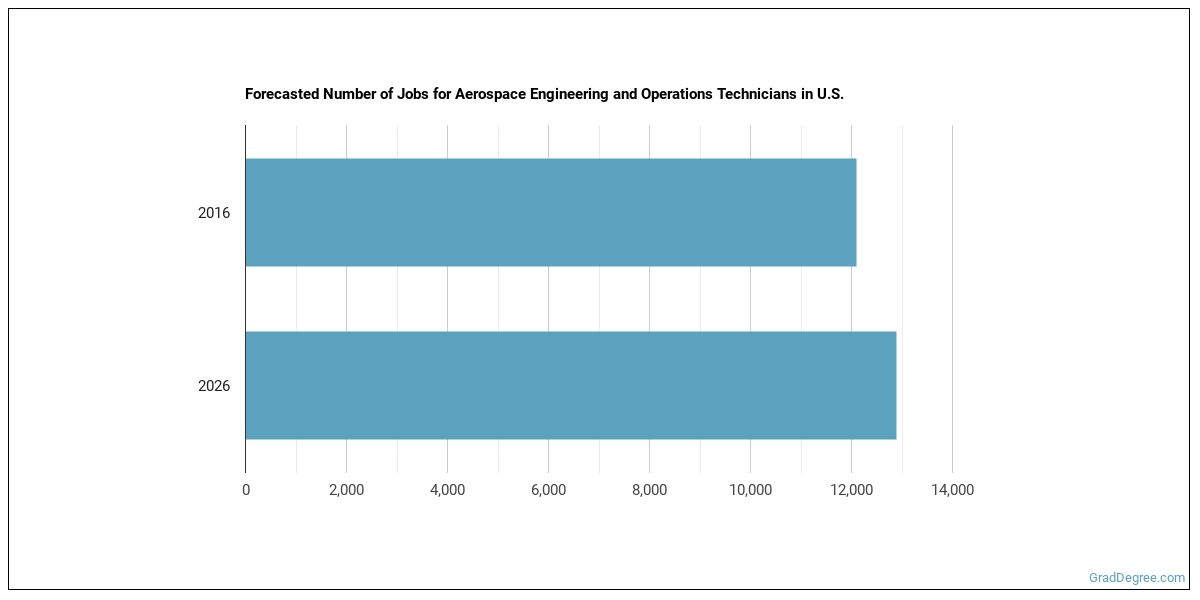
In 2016, there was an estimated number of 12,100 jobs in the United States for Aerospace Engineering or Operations Technician. New jobs are being produced at a rate of 6.6% which is above the national average. The Bureau of Labor Statistics predicts 800 new jobs for Aerospace Engineering or Operations Technician by 2026. Due to new job openings and attrition, there will be an average of 1,100 job openings in this field each year.
The states with the most job growth for Aerospace Engineering or Operations Technician are Utah, Georgia, and Alabama. Watch out if you plan on working in Washington, Kansas, or North Dakota. These states have the worst job growth for this type of profession.
How Much Does an Aerospace Engineering or Operations Technician Make?
The typical yearly salary for Aerospace Engineering and Operations Technicians is somewhere between $42,610 and $100,310.

Aerospace Engineering and Operations Technicians who work in Washington, Colorado, or Missouri, make the highest salaries.
How much do Aerospace Engineering and Operations Technicians make in different U.S. states?
| State | Annual Mean Salary |
|---|---|
| Alabama | $60,630 |
| Arizona | $71,500 |
| California | $68,410 |
| Colorado | $84,190 |
| Connecticut | $65,330 |
| Florida | $62,050 |
| Georgia | $50,930 |
| Illinois | $58,500 |
| Iowa | $57,170 |
| Kansas | $66,870 |
| Maryland | $71,760 |
| Missouri | $76,630 |
| New Jersey | $67,780 |
| New Mexico | $73,570 |
| New York | $75,070 |
| Ohio | $67,210 |
| Oklahoma | $66,120 |
| Oregon | $65,440 |
| Tennessee | $68,440 |
| Texas | $66,960 |
| Utah | $62,060 |
| Virginia | $75,060 |
| Washington | $93,740 |
What Tools do Aerospace Engineering and Operations Technicians Use?
Although they’re not necessarily needed for all jobs, the following technologies are used by many Aerospace Engineering and Operations Technicians:
- Microsoft Excel
- Microsoft Word
- Microsoft Office
- JavaScript
- Microsoft PowerPoint
- Python
- Microsoft Access
- Word processing software
- Microsoft Project
- Autodesk AutoCAD
- Microsoft Visio
- Microsoft SharePoint
- Structured query language SQL
- Linux
- Extensible markup language XML
- UNIX
- Microsoft SQL Server
- Computer aided design CAD software
- National Instruments LabVIEW
- Dassault Systemes CATIA
Becoming an Aerospace Engineering or Operations Technician
Learn what Aerospace Engineering or Operations Technician education requirements there are.

How Long Does it Take to Become an Aerospace Engineering or Operations Technician?

Where Aerospace Engineering and Operations Technicians Are Employed
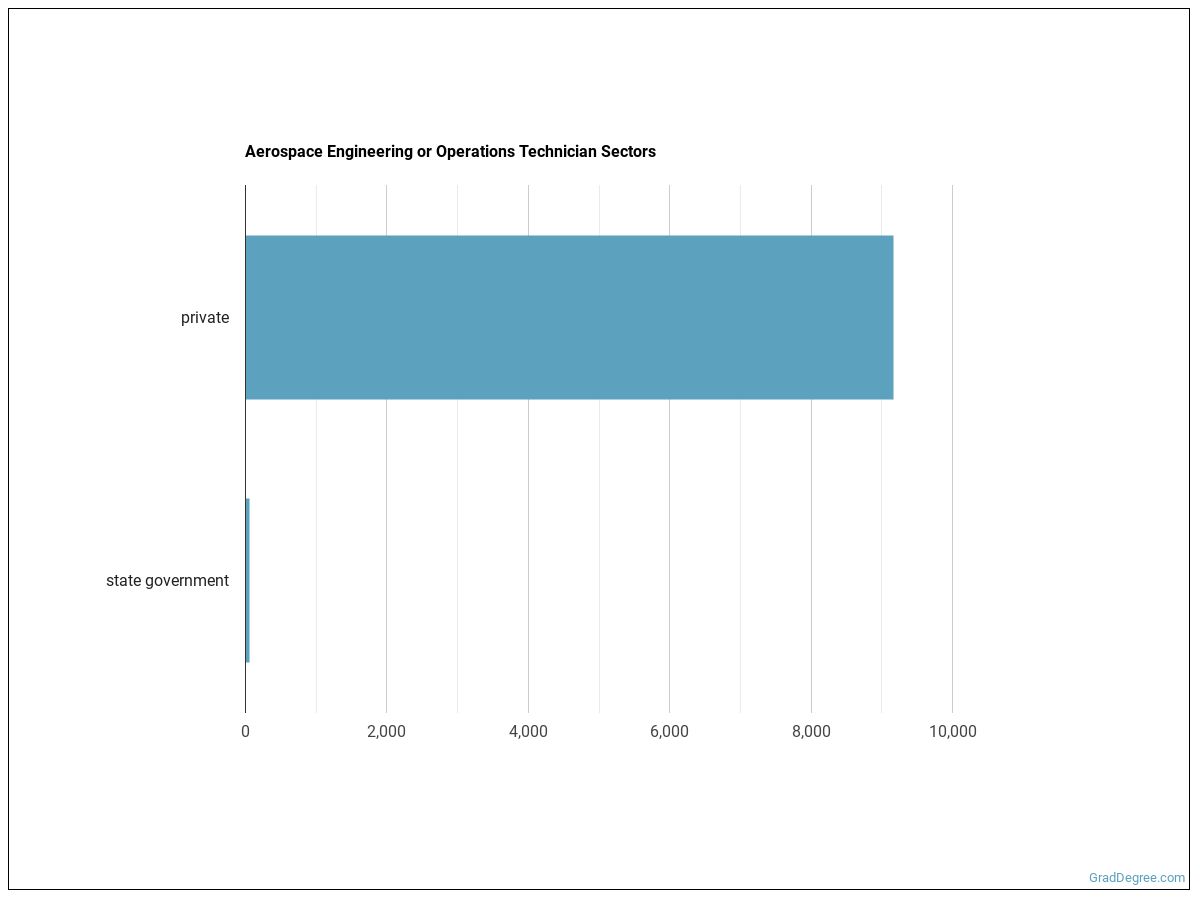
Below are examples of industries where Aerospace Engineering and Operations Technicians work:

References:
Image Credit:
More about our data sources and methodologies.
Featured Schools

GradDegree.com provides higher-education, college and university, degree, program, career, salary, and other helpful information to students, faculty, institutions, and other internet audiences. Presented information and data are subject to change. Inclusion on this website does not imply or represent a direct relationship with the company, school, or brand. Information, though believed correct at time of publication, may not be correct, and no warranty is provided. Contact the schools to verify any information before relying on it. Financial aid may be available for those who qualify. The displayed options may include sponsored or recommended results, not necessarily based on your preferences.
© GradDegree.com – All Rights Reserved.